
You know what you pay for AI each month. Do you know what one finished piece of work costs you? Most people don't. And last weekend's news showed something worse: even the price you do know can be changed without asking you.
Here is the whole argument in one sentence:
The real cost of an AI agent is not the price on the pricing page. It is the cost of one finished, usable piece of work — the model fees, plus the human time spent checking and redoing it, plus one variable you don't control at all: the usage quota, which the vendor can change at any time.
Why say it that way? Look at what happened on Sunday.
01One Sunday, three stories, one lesson
On 2 November 2026, three news stories broke in a single day. On the surface they are about three different companies. Underneath, they answer the same question: who decides what your AI actually costs?
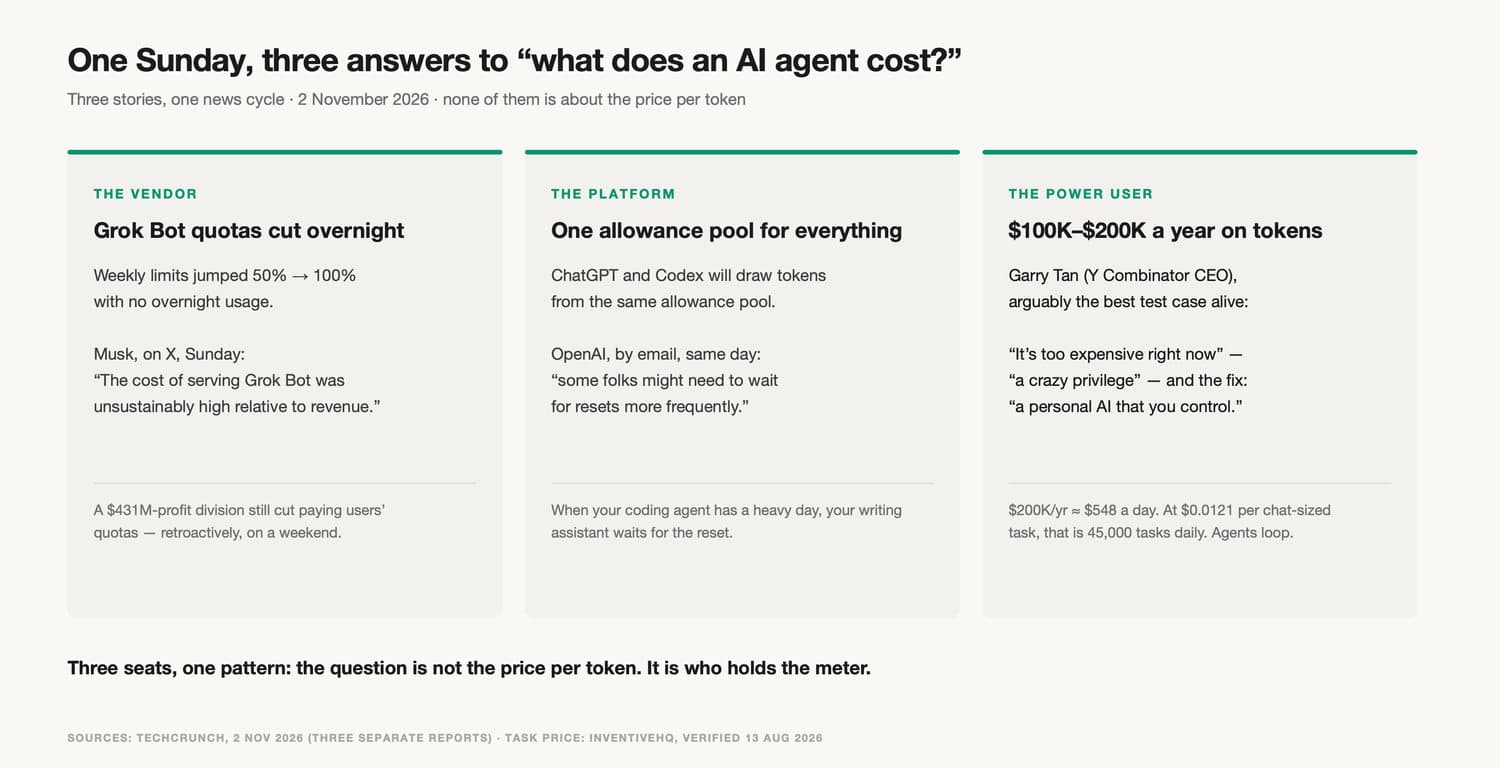
Three stories broke on 2 November 2026: Grok quotas wiped overnight, OpenAI merging two products into one quota pool, and Garry Tan disclosing $100K–$200K a year in token spend. The seller, the platform, and the heaviest user — all pointing at the same thing.
Story one: a quota can be cut after you paid. Most AI products are not unlimited. You get a weekly usage cap — a quota. Over Halloween weekend, Grok users woke up to find their weekly quota already used up. Some had half left the night before. Overnight it went to zero, and they hadn't touched the product. On Sunday, Elon Musk confirmed this was not a bug. His words: "The cost of serving Grok Bot was unsustainably high relative to revenue" [1]. Here is the part worth sitting with. A month earlier, SpaceX's own public filing said this AI division made a $431 million profit for the year. A profitable division still cut paying customers' quotas, on a weekend, retroactively. So a quota is not a promise in your contract. It is the vendor's cost valve. When their costs run hot, your quota is what gets turned down.
Story two: your products now share one quota. The same day, OpenAI emailed users that ChatGPT and Codex (its coding tool) will draw from one shared quota pool. OpenAI's own words: most users won't notice, but "some folks might need to wait for resets more frequently" [3]. In plain terms: you bought two tools. They used to have separate allowances. Now, when one has a heavy day, the other waits. How the pool is split is the platform's decision, not yours.
Story three: the heaviest user in public says the bill doesn't work. In a podcast published this week, Y Combinator CEO Garry Tan put a number on serious AI usage: "I spend about maybe $100[,000] to $200,000 a year on tokens" [2]. A token is the unit AI billing is counted in — the model charges for every chunk of text it reads or writes. Tan may be the most committed AI user alive. His agents have read all his email, his files, and twenty years of his notes. His verdict on the economics: "It's too expensive right now" — "a crazy privilege that not everyone can do." And his idea of the fix was not a product plug. He was talking about Big Tech in general: "you could imagine a personal AI that you control, that you program."
Put the three together. The seller can cut your quota after you've paid. The platform can re-split your allowance between products. The heaviest user says the spend only works as a privilege. Notice what none of these stories is about: the price per token. Token prices actually fell through 2026. All three stories are about the same thing — the meter is in someone else's building. You pay the bill, but you don't control how it's read, or when it gets shut off.
02The price list is public. So why is your bill unpredictable?
AI pricing has a strange property: the unit price is published to the fourth decimal place, and your invoice still surprises you. There are two reasons.
Reason one: an agent doesn't answer once. It loops
Start with the unit price. Take a standard task: the model reads 4,000 tokens, writes 800, fails and retries 10% of the time, and 70% of the input comes from cache (these are the standard assumptions in InventiveHQ's comparison; prices verified 13 August 2026) [6]. On those assumptions, one task costs between $0.00086 and $0.0603 depending on the model — a seventy-fold spread. A mid-range workhorse like Claude Sonnet 5 lands near $0.0121 per task. About a cent.
Sounds cheap. So how does Garry Tan spend $200,000 a year? That's $548 a day. At a cent per task, that would be 45,000 tasks a day. Nobody uses AI like that.
The gap is what an agent is. An agent is AI that does work for you, not just answers questions. And an agent doesn't run once. At every step it re-reads everything that came before — and pays for the re-read. It calls tools, and the tool results come back as more billable text. It fails and retries, and the retry bills too. A chat is one transaction. A job is a chain of them. That is why "unit price × number of tasks" misses real bills by a factor of ten or more.
Reason two is bigger: the largest cost never appears on the invoice at all.
03We opened one month of our own books. Here's where the money went
In October, our own team shipped 1,840 finished, accepted pieces of work through AI agents — drafts, reconciled accounts, reviewed documents, reports. We then added up everything that month actually cost: model fees, servers, and the human hours spent checking and redoing agent output, priced at loaded salary cost. To be clear: this is our own internal ledger. You can't verify it from outside. Treat it as one team's honest accounting, not industry data [9].
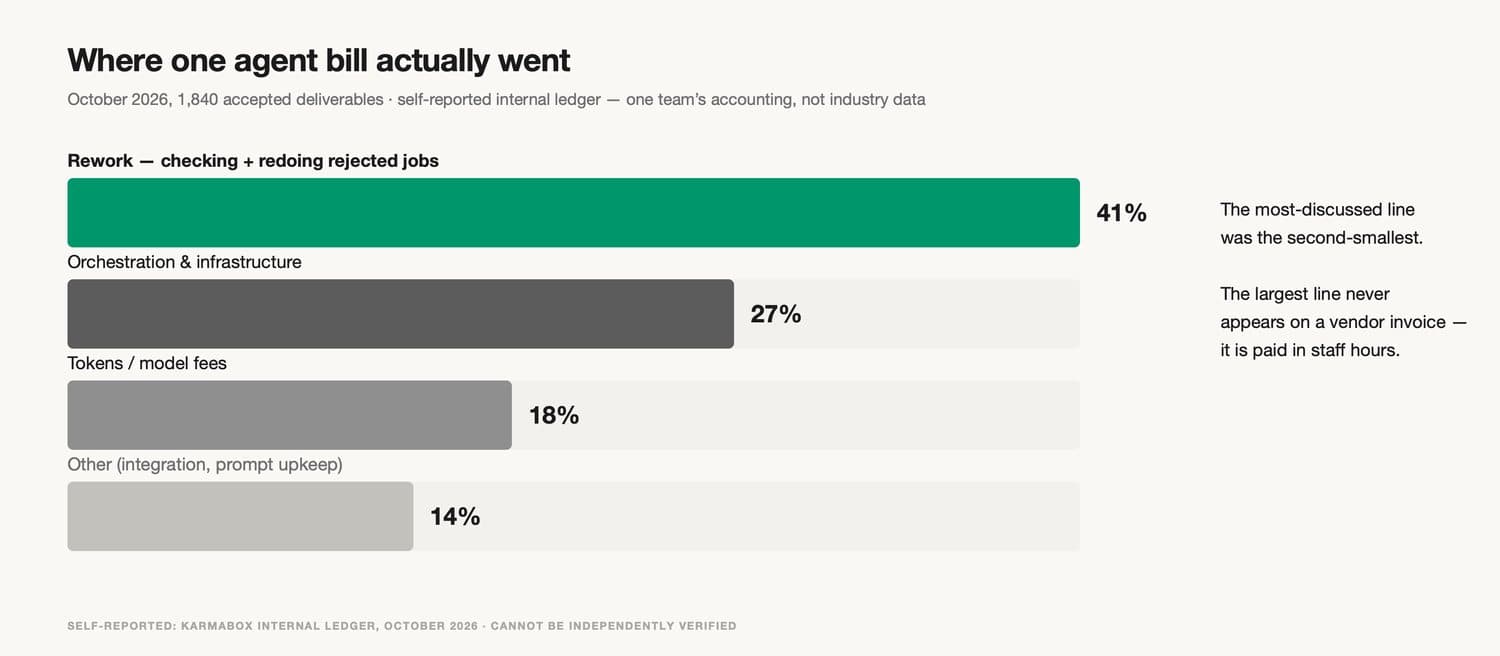
Where one team's AI bill went in October 2026: rework 41%, servers and plumbing 27%, model fees (tokens) 18%, other 14%. The line everyone negotiates is the second-smallest.
| The cost | Share | In plain terms |
|---|---|---|
| Model fees (tokens) | 18% | The only line anyone haggles over |
| Servers, storage, monitoring | 27% | The plumbing that keeps agents running |
| Rework | 41% | Human time checking output, plus redoing the rejected share |
| Other | 14% | Keeping integrations and prompts working |
Read that again. The line everyone negotiates — model fees — was the second-smallest. The biggest line, rework, never shows up on any invoice, because it is paid in your staff's hours.
Don't want to trust our ledger? Fair. Here is a version you can compute yourself, with three numbers, all replaceable: model fees of $0.30 per attempted job (illustrative — a job is hundreds of model calls, not one chat), human review at $45/hour, and two situations: an agent with no enforced rules, whose output takes 6 minutes to check with 35% rejected and redone; and an agent with system-enforced rules — 2 minutes to check, 12% redone. Where a machine is used, it costs $1,200 a month all-in (illustrative: depreciation, electricity, maintenance).
| Four situations (all numbers illustrative) | Cost per finished, usable job |
|---|---|
| Cloud AI, no enforced rules (35% rework) | $7.38 |
| Cloud AI, system-enforced rules (12% rework) | $2.05 |
| Your own machine, too little work — 300 jobs/month | $6.27 |
| Your own machine, enough work — 1,800 jobs/month | $2.47 |
Three conclusions, and the first one contradicts the sales pitch — including ours.
First: the rework rate dominates. Cut rework from 35% to 12%, and the cost per job falls 72%. Halve the token price instead, and the total falls about 3% — twenty-three cents. If your AI cost conversation is about token discounts, you are negotiating the 18% line and ignoring the 41% line.
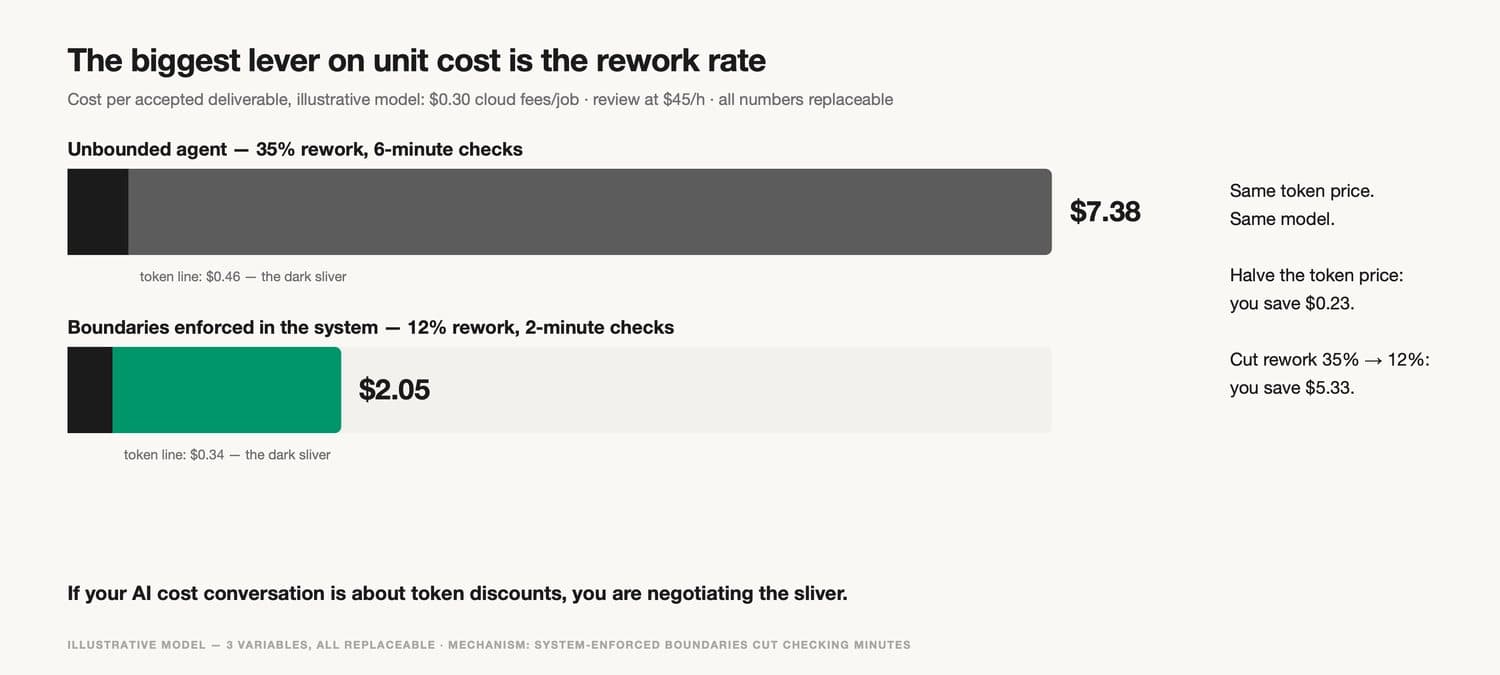
Same model, same token price. Rework at 35% vs 12%: $7.38 vs $2.05 per job. The thin dark strip is the token fee. Halving the token price saves $0.23. Cutting rework saves $5.33.
Second: at these numbers, owning a machine is not cheaper than the cloud ($2.47 vs $2.05) — even when the machine is busy all day. We sell the machine. We're printing that sentence anyway, because the honest reason to own one is not "cheaper per job." It's the next section.
Third: change any number and the conclusion can flip. If your jobs are heavier and cloud fees per job rise, owning wins on price too. If you only have 300 jobs a month, owning is a waste. This is three numbers and one division. Run it with your own figures before you believe anyone's conclusion — including this one.
04What buying the machine actually buys: the meter moves into your building
On "own or rent," the clearest outside analysis is MindStudio's (8 October 2026), and it fits in one sentence: cloud costs grow with every job; a machine is a fixed cost; which one wins depends on how much real work the machine does each day [5]. Their blunt corollary deserves to hang on the wall of everyone selling local AI, us included: an idle machine is pure waste. A machine that works two hours a day loses to the cloud at almost any price.
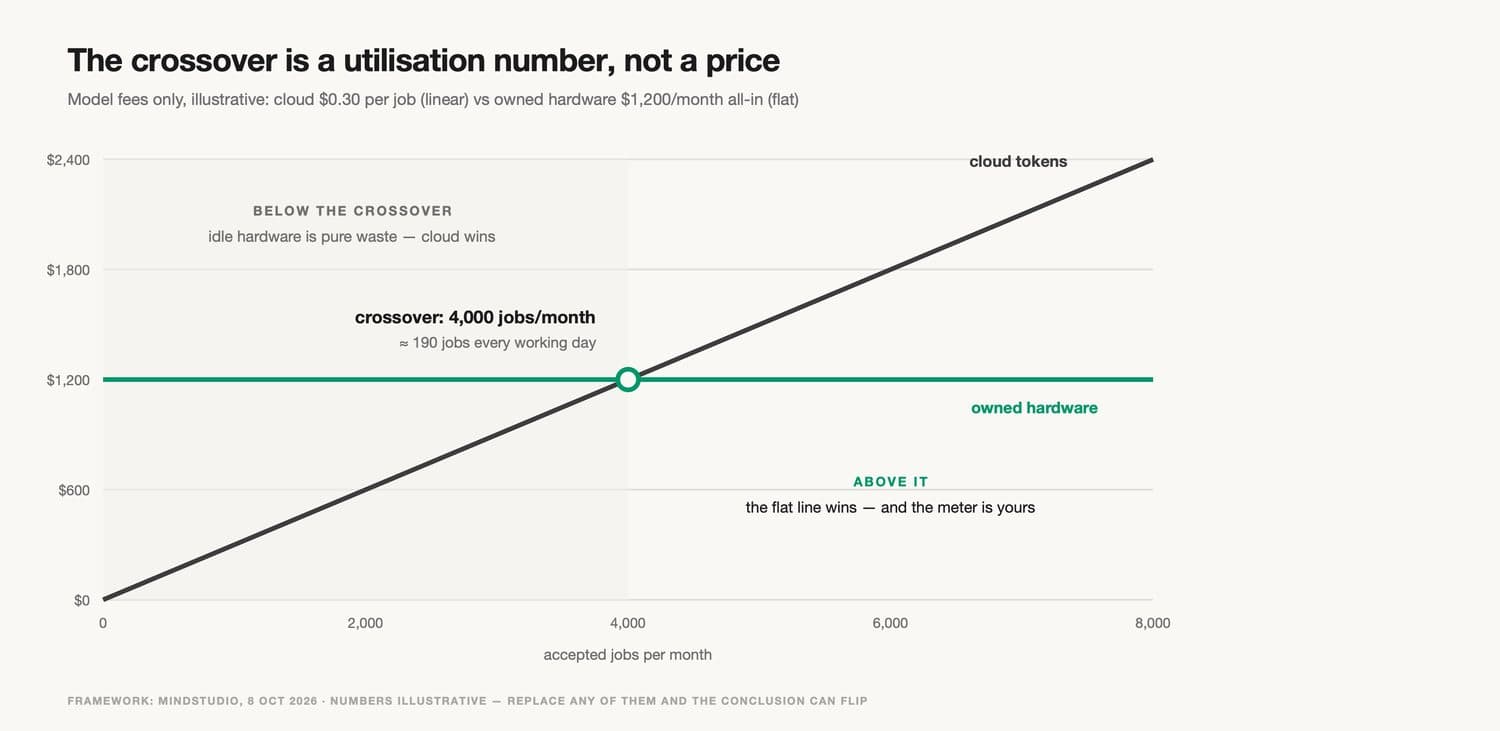
Cloud cost rises in a straight line with the number of jobs; an owned machine is a flat line. With the illustrative numbers, they cross at about 4,000 jobs a month — roughly 190 per working day. Below that, the cloud wins. Above it, the machine does.
The strongest version of the opposite view arrived the same week. Sam Altman: "it's better for RAM to be in a data center than on your desk" [4]. For occasional, unpredictable use, he is right — a data centre spreads one machine across thousands of customers, and nothing on your desk matches that. So this is not a question of belief. It is a question of which row you're in:
| Use the cloud if… | Own the machine if… |
|---|---|
| You use AI a few hours a week | AI has scheduled work every day |
| Your usage jumps around unpredictably | The work is the same jobs, daily |
| You're still finding out what AI is for | You can count your deliverables per month |
| A cut quota costs you patience | A cut quota costs you a deadline |
| Data leaving the building is fine | Data leaving the building is the problem |
Enterprises reached the same split months ago: Dell moved daily, predictable agent workloads onto desk-side machines specifically to stop paying monthly cloud fees for them [7].
05Plainly: what owning fixes, and what it doesn't
This section exists so the argument stays honest. Owning your machine fixes exactly two problems.
It fixes the quota problem. The machine is yours. There is no weekly cap, no shared pool, no policy that changes on a Sunday. Nobody outside can touch your meter.
It fixes the slow-repricing problem. The sticker price that stays flat while tiers get repackaged and allowances get pooled — the same money quietly buying less. That cannot happen on hardware you own.
It does not fix three other problems, and they need naming:
An agent with no enforced rules produces 35%-rework output on your machine just as it does in the cloud. And rework was the biggest line on the bill.
The fixed cost is yours now. If the machine sits idle, the waste is yours too. This point cuts directly against people who sell machines — us — and it is true anyway.
Disks die. The cloud vendor's backups and redundancy are real value you are giving up.
One sentence: owning the machine moves the meter into your building — but the biggest line on the bill, rework, depends on whether the AI follows rules, not on whose building the machine is in.
06How KarmaBox handles both problems
Only now does our product enter the argument, because it was designed around exactly this arithmetic: the meter first, then the rework line.
The meter: KarmaBox is a machine you buy once and run in your own office. The "model fees" line becomes electricity plus depreciation — a number with no reset day and no shared pool. But as the table above shows, a machine only pays off when it has enough work. So it doesn't ship as an empty box. It ships staffed: 19 built-in avatars, each owning a fixed slice of daily work — bookkeeping, outreach drafts, support, document review — so the machine has a queue every day instead of sitting idle (19 avatars, 7 job categories, 60 written procedures, 241 test cases: our own reference page, 15 October 2026 — vendor content, our figures) [8].
The rework line: every avatar's permissions come in three tiers, enforced by the system rather than written in a prompt: things it does directly, things it must stop and ask you about first, and things it has no ability to do at all. The 35%-versus-12% split above is illustrative, but the mechanism isn't: an agent that cannot step out of bounds needs minutes of checking, not hours of redoing. That difference is the 41% line. Why rules must live in the system and not in the prompt is the subject of our piece on the sovereign AI workspace. The one-line version: if you don't control the rules, you don't control the bill.
And the fine print, in large print: at today's illustrative numbers it is not cheaper per job than a well-run cloud setup; it does not survive a dead disk any better; and if you use AI two hours a week, don't buy it — use the cloud.
07FAQ
How much does an AI agent cost per task?
Under standard assumptions (4,000 tokens read, 800 written, 10% retries, 70% cache hits), published prices work out to $0.00086–$0.0603 per task depending on the model — a seventy-fold spread (InventiveHQ, prices verified 13 August 2026). But agents loop — re-reading, calling tools, retrying — so the real cost per finished job is usually dominated by human checking time, not model fees.
Why is my AI bill rising if token prices are falling?
Three reasons. Agents multiply usage: unit prices fall, volumes rise faster. Vendors are merging products into shared quota pools, so one product's heavy day drains another's allowance. And quota policies themselves can change retroactively — which is what Grok users experienced on 1–2 November 2026.
Is running AI locally cheaper than the cloud?
Not automatically. Anyone who says it always is, is selling something. A machine is a fixed cost; the cloud charges per use; the break-even depends on how much work the machine actually does (MindStudio, 8 October 2026). At this article's illustrative numbers, a busy owned machine roughly ties the cloud on cost per job. What it changes is who controls the quota and the price.
What is the biggest hidden cost of AI agents?
Rework: the human minutes spent checking output, plus redoing the rejected share. In our own October ledger it was 41% of total cost — more than double the token line (self-reported, one team). It appears on no invoice because it is paid in salaries.
What should I track to know my real AI cost?
Three numbers per job: what the attempt cost (model fees, or the machine's amortised share), how many minutes the human check took, and whether the result was accepted or redone. The number that reaches your P&L is cost per finished, usable job — not cost per million tokens.
One question to leave with: what did one finished, usable piece of work cost you this month — and who, besides you, can change that number without asking?