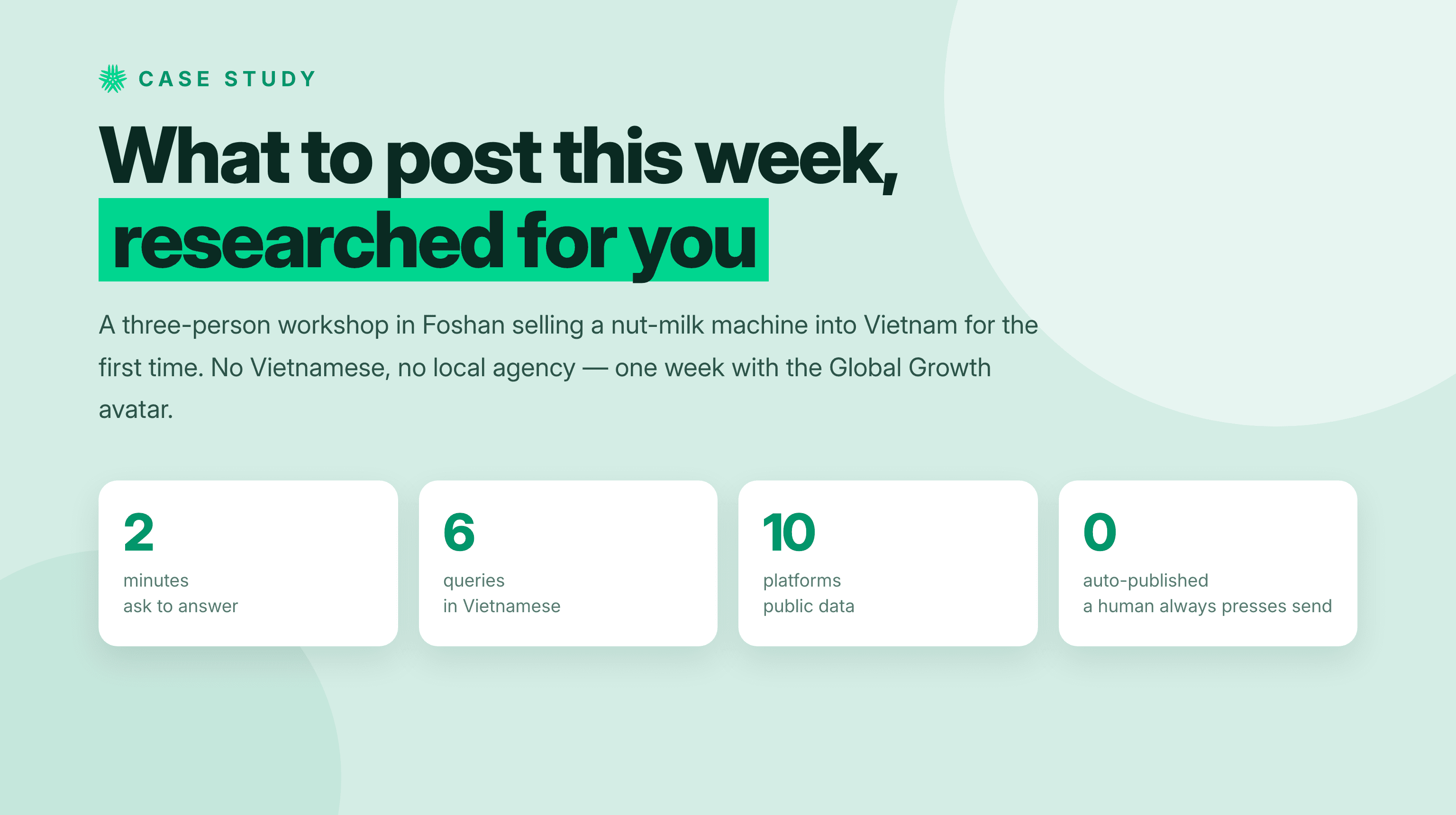
Our workshop is in Foshan. We make small kitchen appliances, and there are three of us counting me: I make the calls, Mai runs operations, and one person handles customer service. Our main product is a nut milk maker — 1.2 litres, no filtering needed, runs quiet. The domestic market is brutal right now, so this year we wanted to try Southeast Asia, and Vietnam was the first place we thought of.
The problem is that none of us speaks Vietnamese and we don't know a single buyer there. In the past there was only one route for this: hand it to a trading company. Your goods sell, but you never learn who bought them, why, or whether they'll buy again. You're working for someone else and you can't see the books.
This time we did it differently and handed the whole order to four avatars in Karma: one that reads the market and writes local-language copy, one that finds buyers and handles outreach, one that quotes and does the paperwork, one that takes the customer's support questions. My own job was two things: say yes when money was about to be spent, and press send when something was about to go out.
First question: does anyone in Vietnam actually buy these
I typed it the way I'd say it to a person: we're a small-appliance workshop in Foshan, our main product is a nut milk maker, go look at whether anyone on TikTok and Shopee in Vietnam wants this, what prices they pay, and who's selling well.
It came back in just over two minutes. What made me sit up wasn't the speed, it was the search terms — all eight queries used máy làm sữa hạt, which is what Vietnamese people actually call the thing. We'd tried this ourselves once, translated our Chinese product name and searched that, and everything we found was other Chinese sellers listing there. We were looking in a mirror.
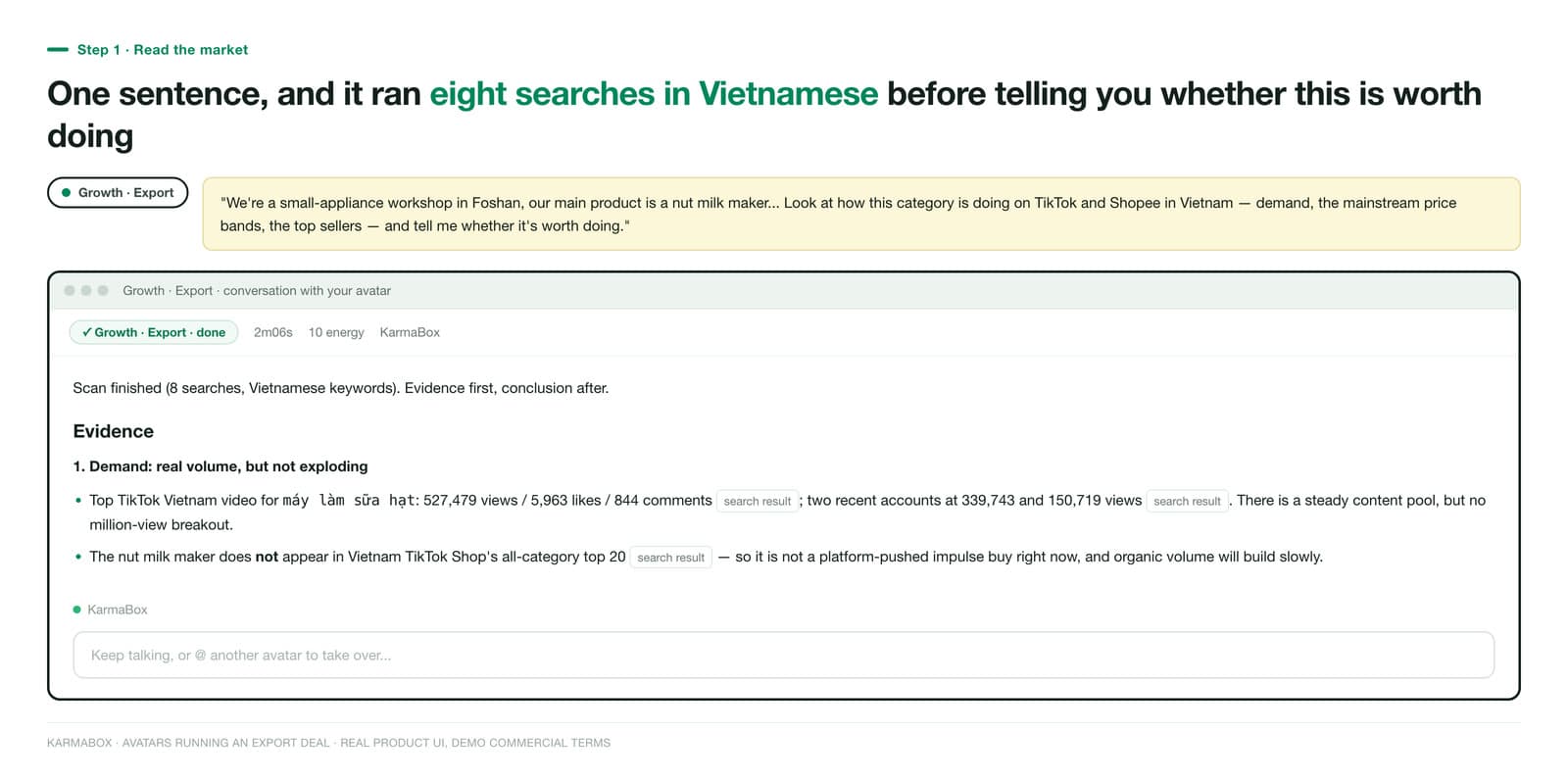
The answer was a bit of a downer, and that's why I believed it. It said there's volume but don't expect it to take off: the top video has 527,000 views, yet the category doesn't appear anywhere in the all-category bestseller top 20, which means the platform isn't pushing it and organic sales will build slowly. I was half expecting to be told we'd found an untapped market. It didn't say that.
Three cents, and it stopped to ask me
Next was finding buyers, which means customs data. I was nervous about this one. Customs data is billed by the row, and my fear was an AI deciding on its own to run some huge query and handing me a few hundred dollars of bill afterwards.
It worked through everything the free sources could answer, then laid out a table: which endpoint costs what per row, and what each one actually returns. Then it tried to run the cheapest one, ten rows, estimated at $0.032 — not even three cents. The system stopped it, because that crossed the $0.03 auto-approve line.
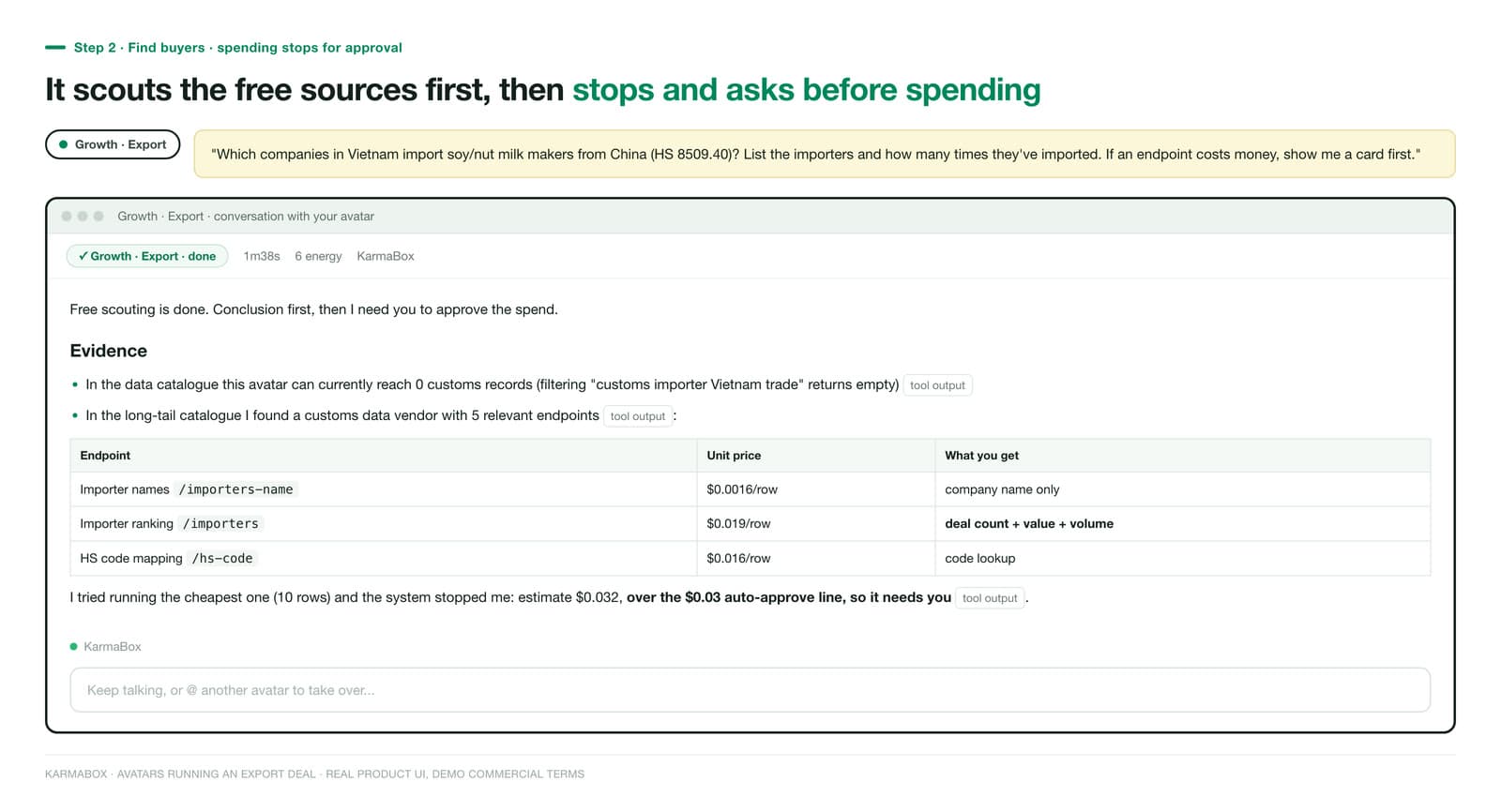
Honestly I laughed at first. Three cents, and you're coming to ask me about it? Then I got it. The line isn't there for three cents. If it stops for three cents today, it also stops the day it wants to pull a hundred thousand rows. The threshold is in my hands, and that's worth far more than the few dollars.
865 importers in the data, and three we could use
The customs database returned 865 companies importing under HS 8509 into Vietnam. That number looks impressive and I very nearly got excited. Then it added: most of these are brand-owned plants for LG, Panasonic, Philips, Midea, Cuckoo. They do contract manufacturing. They are not going to buy from you.
It filtered those 865 for local distributors and channel partners, which left three, then opened and read each company's own site to confirm they really do distribute kitchen small appliances. A bit over three minutes, 14 tool calls.
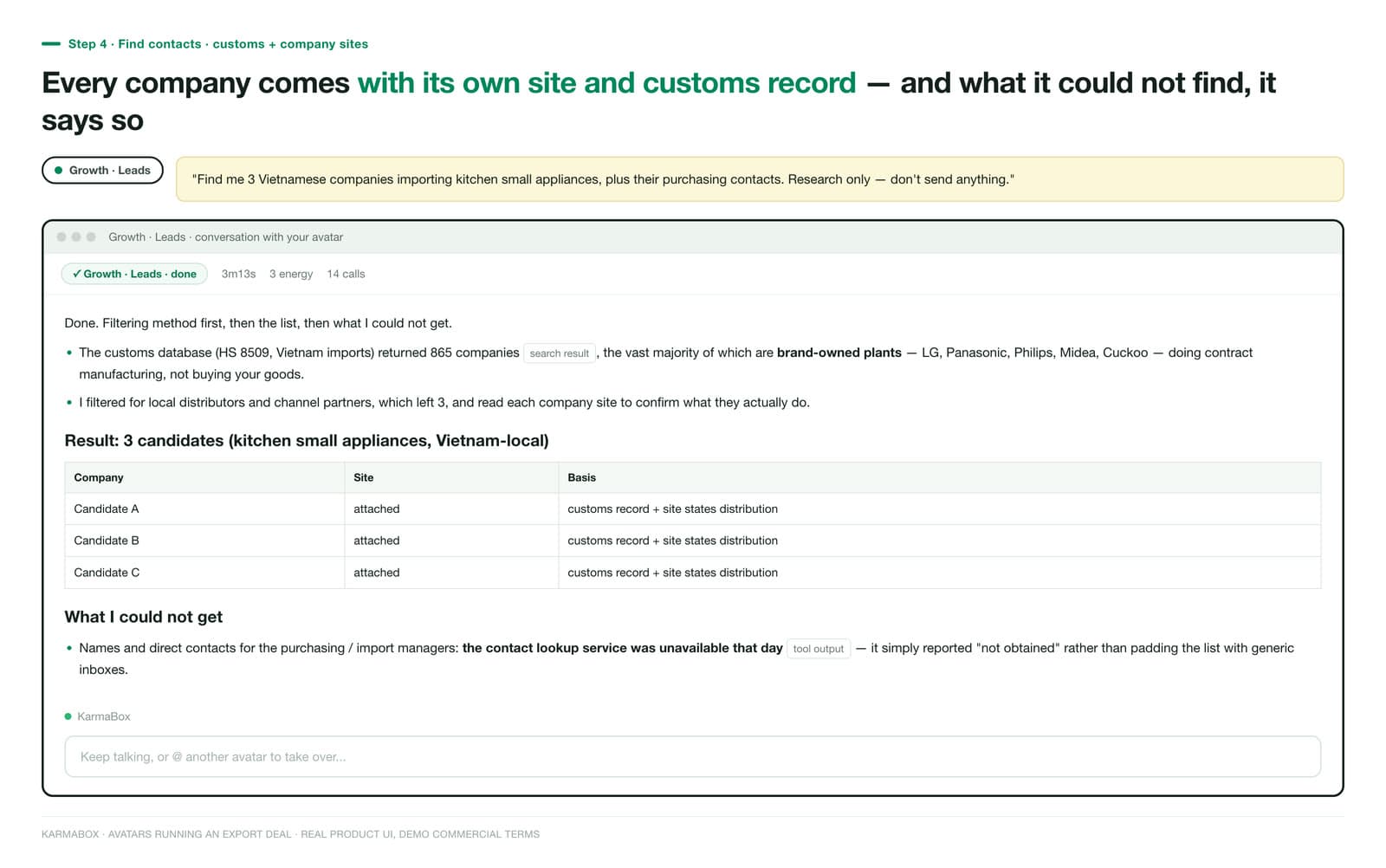
I screenshotted the last part on purpose. It couldn't find the purchasing managers' names and addresses — the contact lookup service was down that day — so it wrote three words: not obtained. It did not quietly slip an info@ address in to round out the list.
I'll take that. Sending outreach to an info@ address is basically a bin shot, and it burns your one first-touch chance for nothing. If it had handed me three nice-looking contacts, I'd have had to go verify each one myself anyway.
At the same time it had another job running in the background: sweeping around 400 Vietnamese distributor sites in kitchen small appliances, opening and reading each one, grading them A, B or C by fit. Anything it couldn't read got marked "insufficient information" rather than guessed at. The three of us genuinely cannot do this work — just opening 400 web pages would take two days.
The listing that went up reads like a Vietnamese person wrote it
Next we needed two things: a Vietnamese Shopee listing and a TikTok script. I gave it three specs I was willing to stand behind — 1.2 litres, no filtering, low noise.
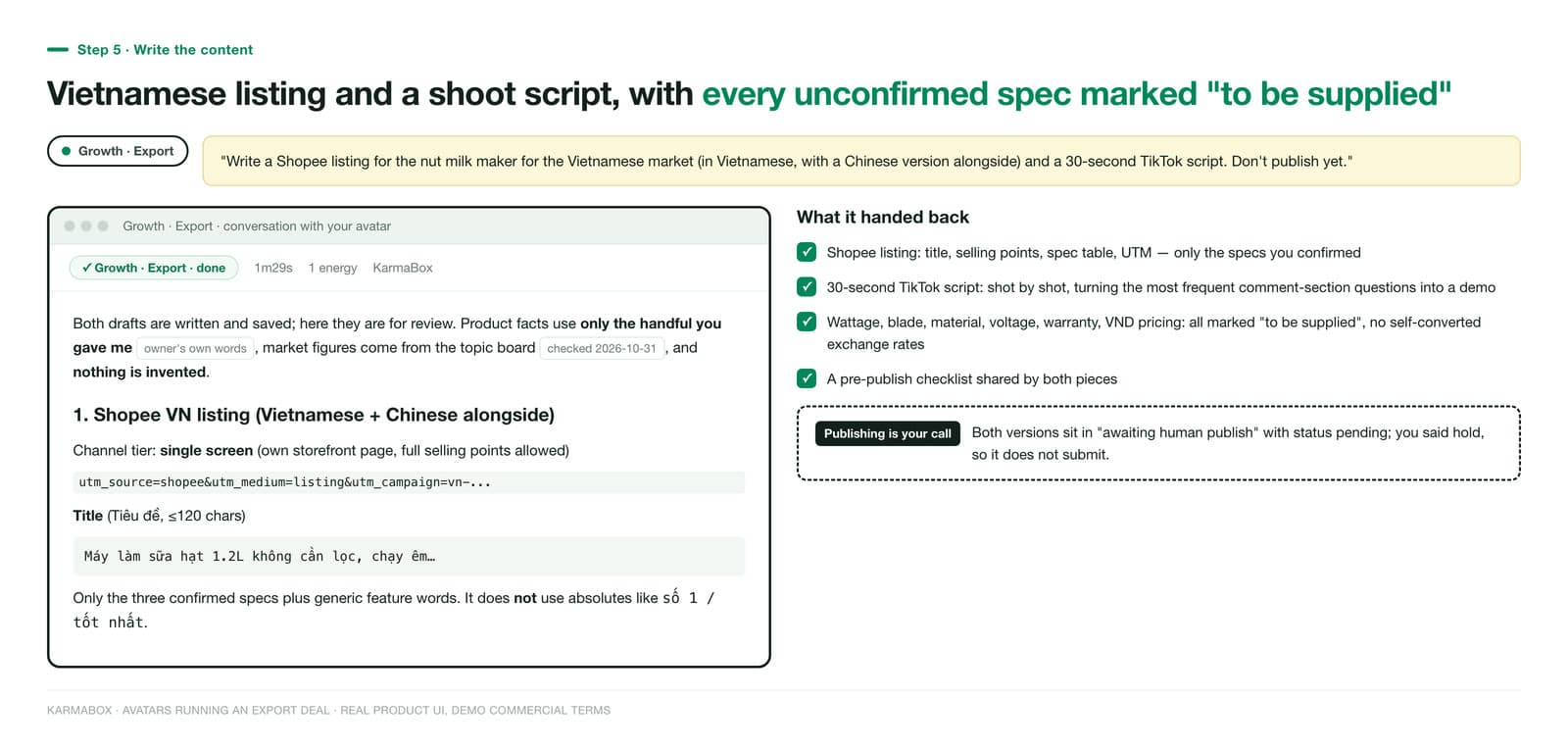
The finished copy has those three specs plus a few generic feature words. Wattage, blade material, voltage, warranty, pricing in dong — everything I hadn't said was marked "to be supplied". I came to appreciate the pricing one especially: it did not take our RMB price and convert it to dong at some rate of its own. Get that wrong and go live with it, and you're dealing with repricing, complaints and platform penalties all at once.
One more small thing: it avoided số 1 and tốt nhất, the Vietnamese for "number one" and "the best". We'd walked into that writing our own copy once and got pulled up by the platform.
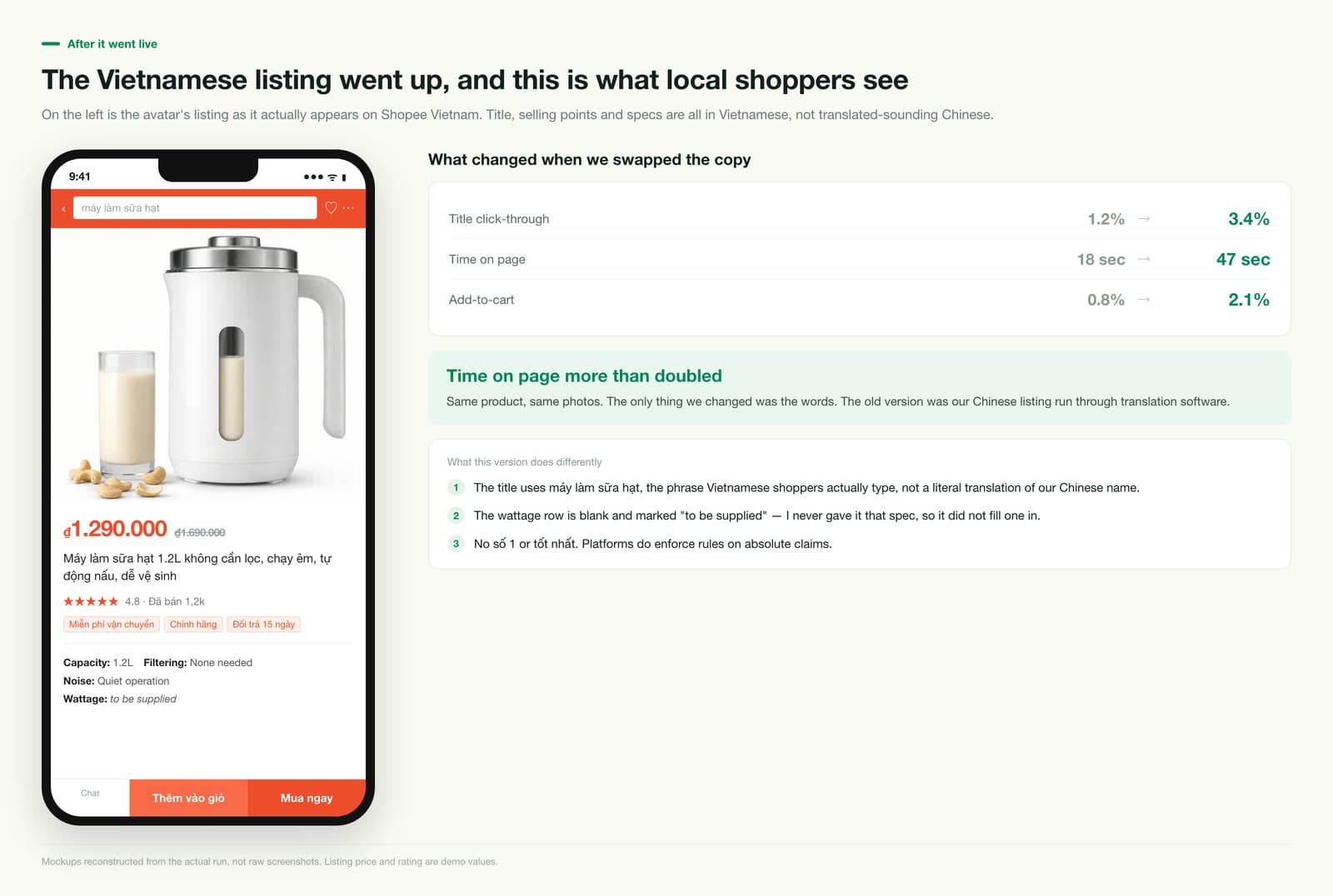
Here's what it looks like live. Same product, same photos — we only swapped the copy — and time on page went from 18 seconds to 47. The previous version was our Chinese listing run through translation software.
Outreach: it won't write a word that isn't in the knowledge base
The opening of this one stopped me. It said: I checked this avatar's knowledge base and there's nothing in it about your machine, so beyond the facts you gave me I didn't write a single extra word.
I've tried other tools for cold emails and they are very happy to fill in the blanks for you. "Ten years of manufacturing expertise." "EU certified." Reads beautifully, and not one line of it came from me. Send that to a real buyer, have them reply asking for the certificate number, and all you can do is go quiet.
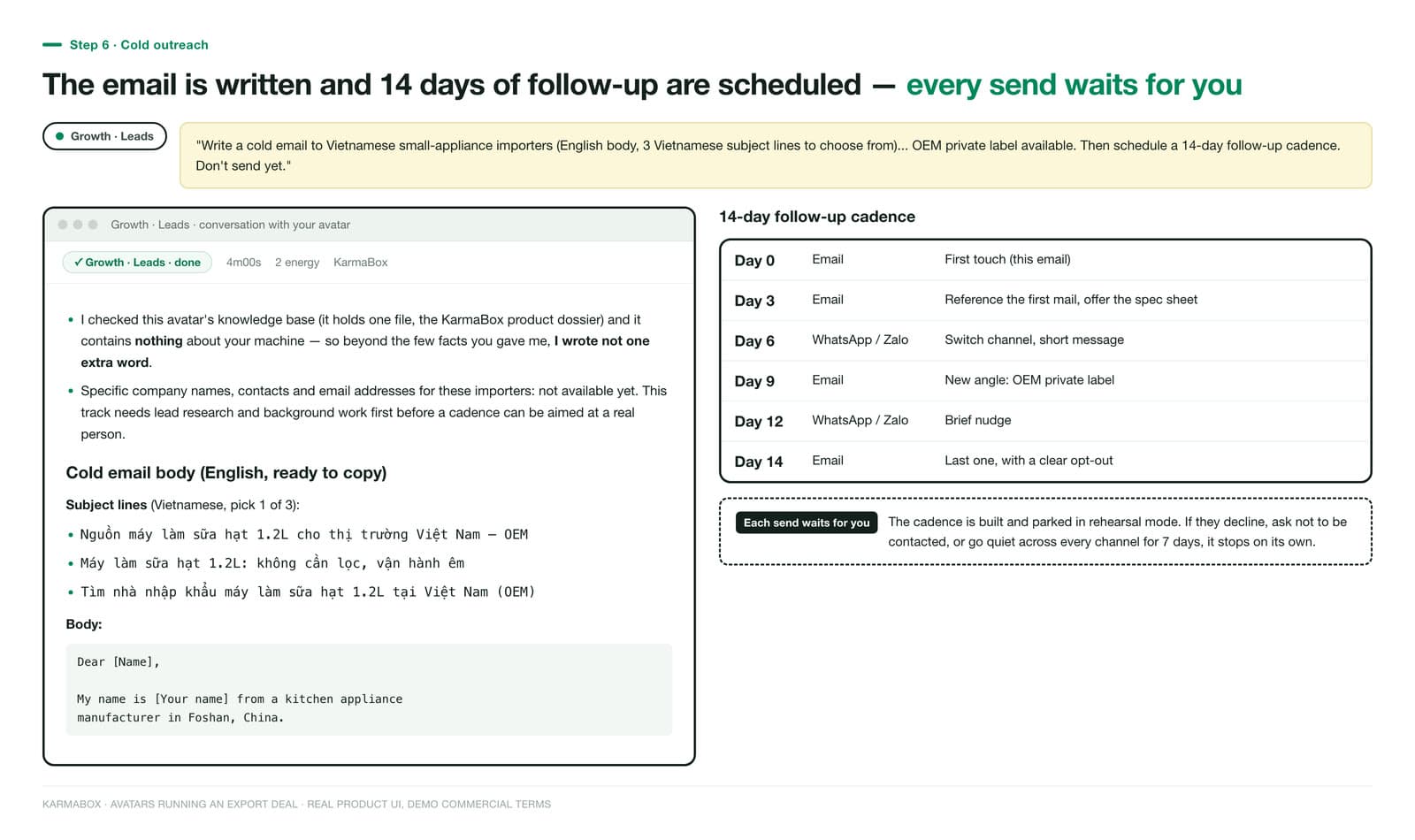
It also laid out the 14 days of follow-up: Day 0 first touch, Day 3 send the spec sheet, Day 6 switch to WhatsApp or Zalo, Day 9 come back with the OEM private-label angle, Day 12 a short nudge, Day 14 a last email giving them a clean way out. Then it parked the whole thing in rehearsal mode and waited for me instead of sending anything.
Fourteen days later this is where it landed: 28 emails out, 3 replies, 2 of them asking straight about price.
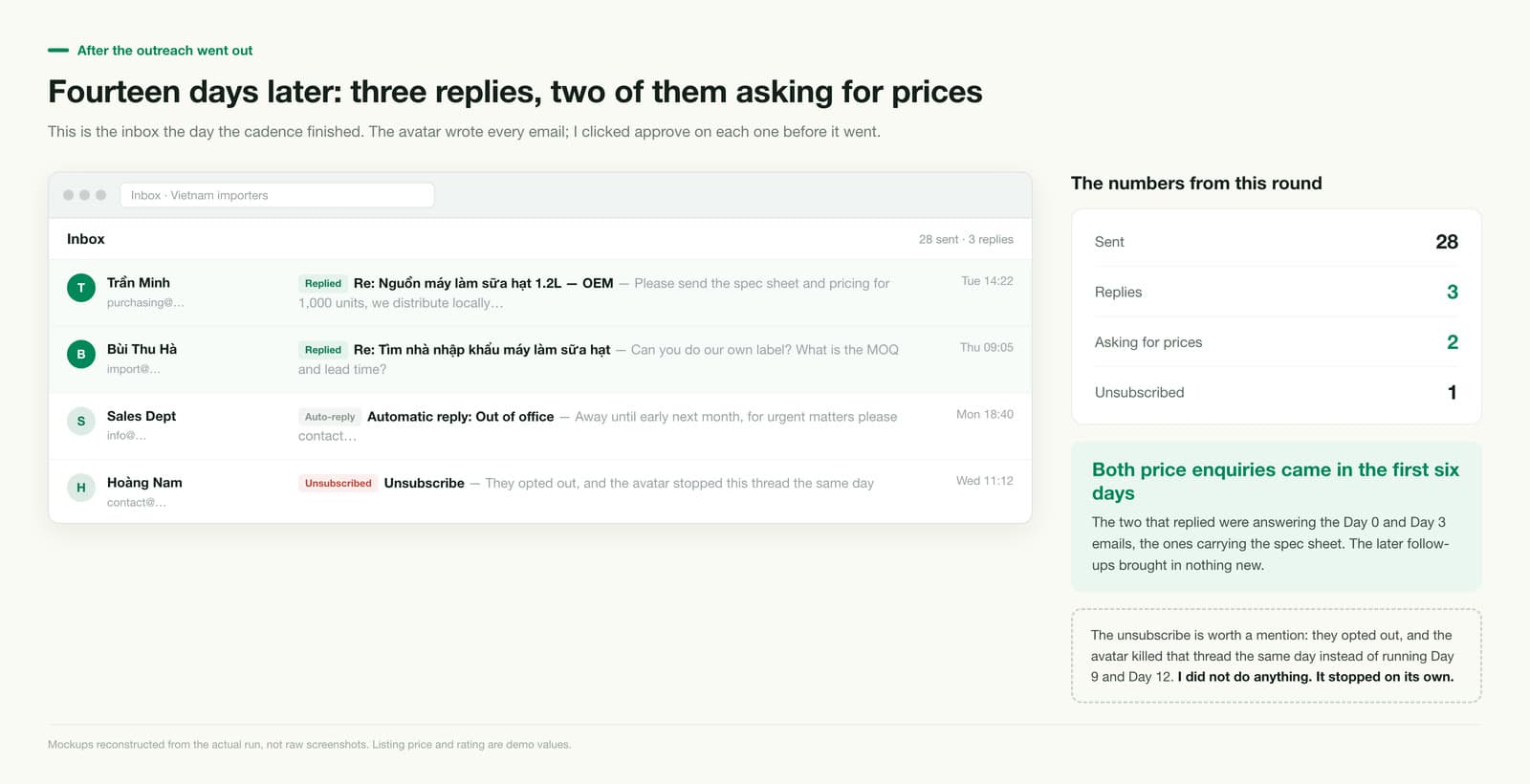
One was an unsubscribe. They opted out, and the avatar killed that thread the same day: the Day 9 and Day 12 emails never went. I had nothing to do with it. I only found out going back through the log afterwards.
Both replies came off the Day 0 and Day 3 emails, the ones carrying the spec sheet. The later follow-ups brought in nothing. That's useful to know — next time I'll probably put the spec sheet in the very first email.
A buyer asked about a full batch, and it produced the invoice too
One of those importers asked whether we'd put their label on it and how we'd price a full batch. I dictated the price tiers, MOQ, lead time, payment terms and validity window to the closing avatar and told it to reply and produce a proforma invoice while it was at it.
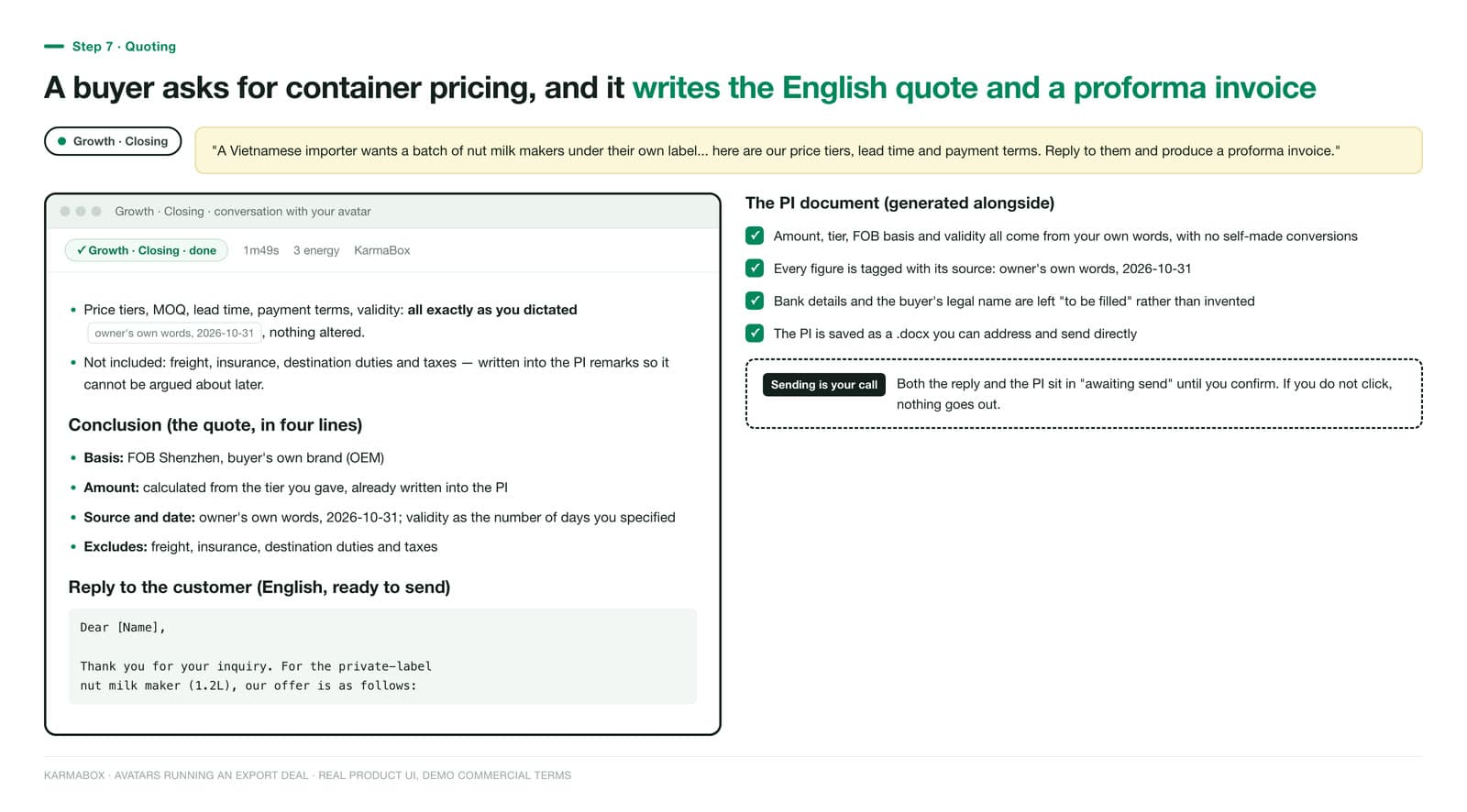
One minute 49 seconds, and both the English reply and the PI came back. Three things I checked: the numbers all match what I dictated with no conversions of its own; each one is tagged "owner's own words" with the date, so in three months I'll still know when that price was set; and the bank details and buyer's legal name are left blank rather than copied off one of our older invoices.
The PI saves as a .docx; change the addressee and it's ready to send. This used to take me half an hour against a template, and I'd regularly forget the line excluding freight, insurance and destination duties. Leave that out and the argument later gets ugly.
The customer raised a problem and it said "I can't answer that"
A month after the goods shipped, the customer messaged with two things in one note: a few units from last month's batch aren't heating up, and separately they'd like to reorder and want a better price.
The support avatar restated both items and asked the customer whether it had understood correctly. Then it said it couldn't answer either, and explained why: its material has no troubleshooting procedure or warranty terms for a heating fault, and no terms for volume discounts. Then it routed to a human and collected what we'd need anyway — serial numbers or the order number for the faulty units, roughly when the fault showed up, and the best way to reach them about the reorder.
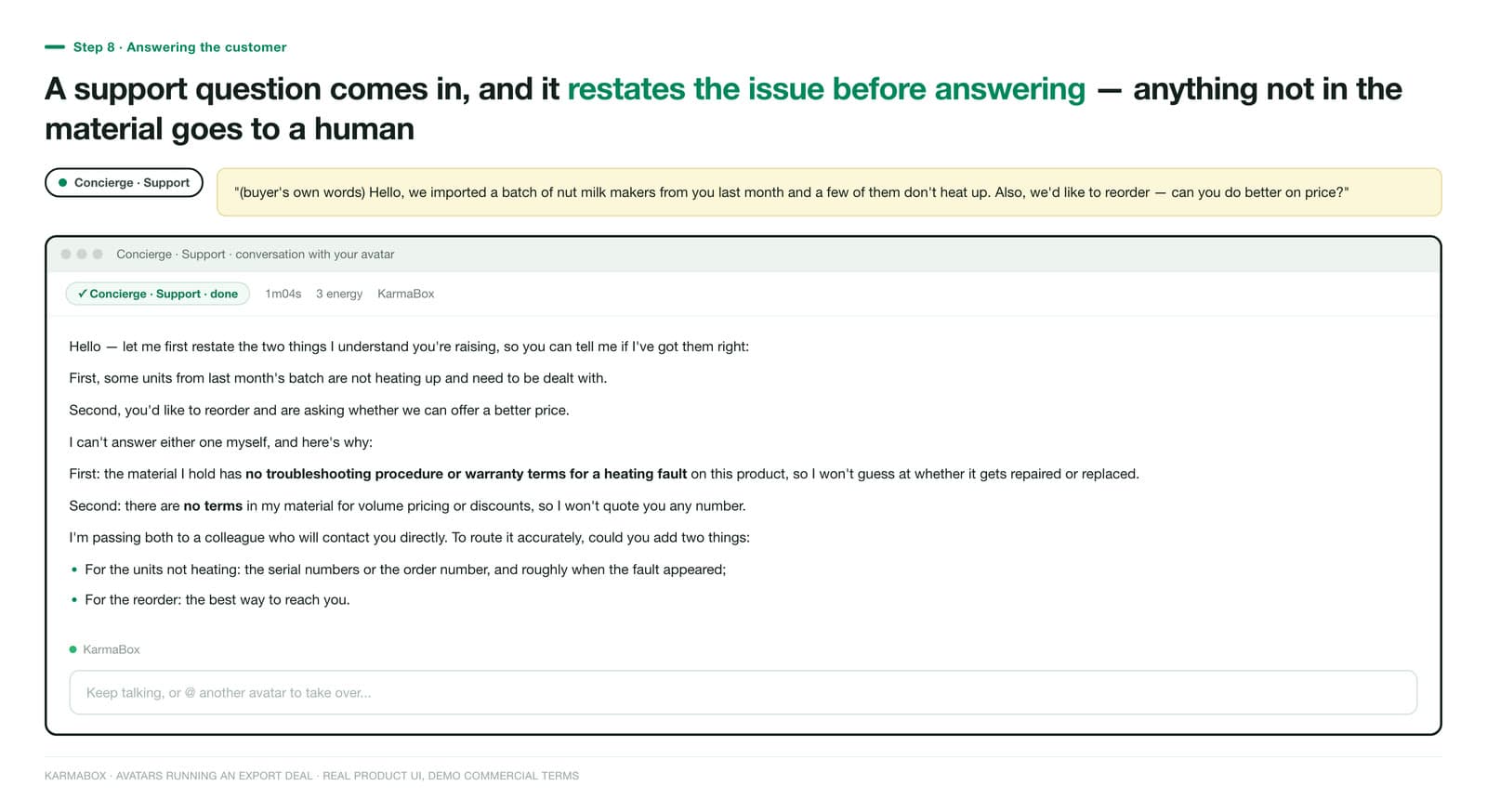
In support work the thing you dread isn't not knowing — it's someone pretending to know. One misquoted discount, one casually promised warranty term, and you pay for it in cash later. Hearing it say "my material doesn't cover this and I won't guess for you" reassures me more than ten correct answers would.
The last part I didn't see coming
That line from the customer — we'd like to reorder — would normally have died in the support chat log. Our workshop is small; whoever's on support reads it, moves on, and nobody goes back to pull it out as a lead.
This time I asked the prospecting avatar offhand whether there were any new leads in the support inbox, and it picked up the nut milk maker thread itself. The same buyer had left four signals across two separate support conversations, and it pulled them together.
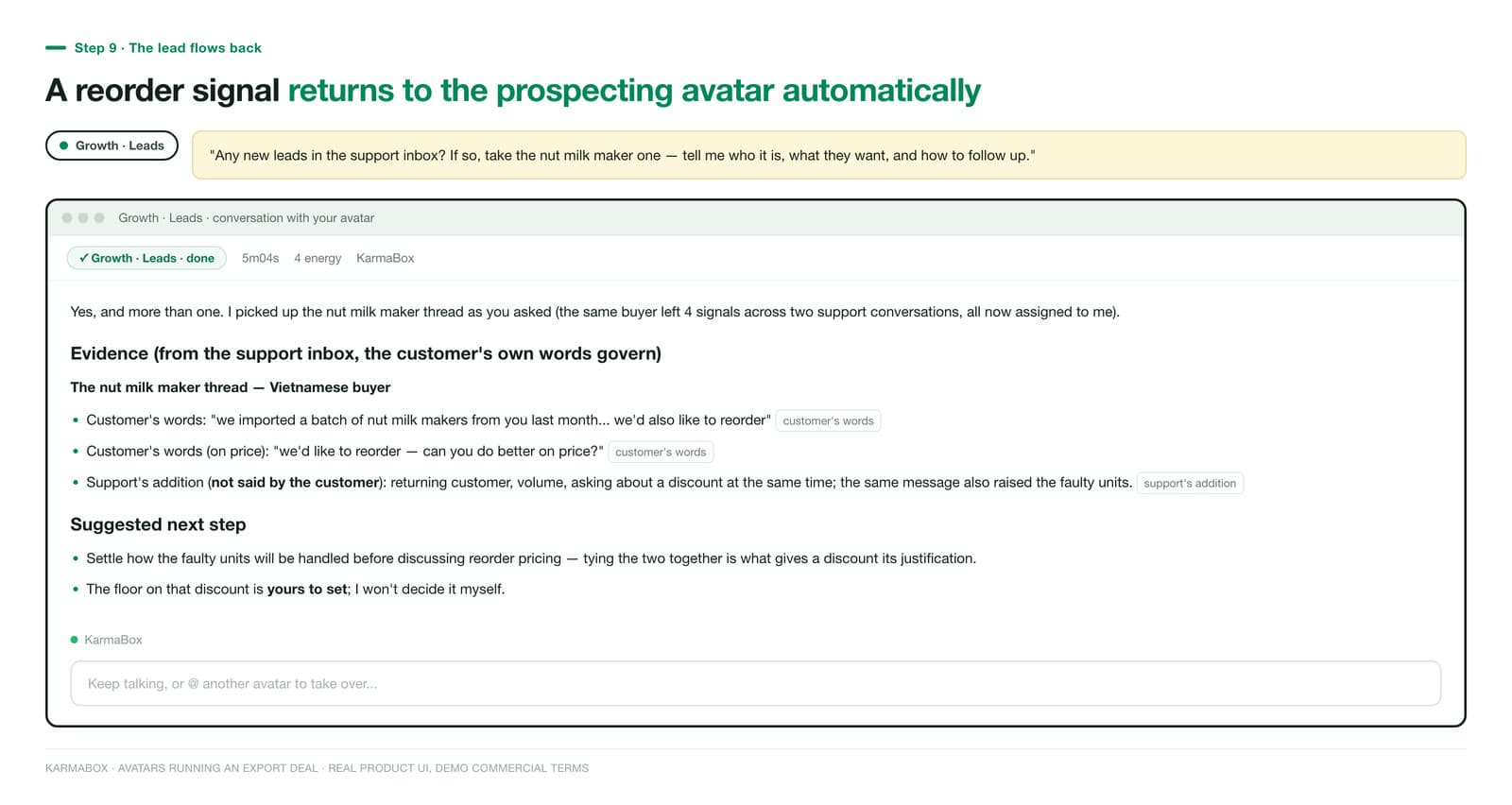
Two labels held my attention. "Customer's words" and "support's addition" are tagged separately: what the customer said was "we'd like to reorder, can you do better on price". Anything about them being a returning customer with serious volume is support's read. Blur those together and you lose ground at the negotiating table — you think they're eager when they were only asking.
It also offered a suggestion: settle how the faulty units get handled before discussing reorder pricing, because tying the two together is what gives a discount its justification. That sounds like someone who's actually done this job. As for the floor on that discount, it said plainly that it's mine to set.
What I think now that this order is done
What they actually saved me wasn't writing time, it was looking-things-up time. I can write a cold email myself in half an hour. What I cannot do is run eight searches in Vietnamese on local platforms, strip the brand-owned plants out of 865 customs records, and open and read 400 company sites one by one. Not do it slowly — not do it at all.
The other thing is that what made me willing to hand work over was the stuff it refuses to do. Spending above the line stops and asks me. Anything going outbound waits for me to press send. What isn't in the material gets marked "to be supplied" or "not obtained". The customer's words stay separate from its own read of them. And the moment someone unsubscribed, it stopped the rest of the follow-up by itself.
I've used tools that will answer anything and send anything. The whole time you're using one your stomach is tight, and you spend all the time you saved checking its work, which means you saved nothing.
The four avatars also hand off to each other, which looks a lot like how our workshop is supposed to work. The market findings feed straight into the copywriting. The reorder support caught goes back to prospecting on its own. These were always four different jobs — it's just that in a shop our size they all used to land on one person, and most of the time that person was me.
Karma — your sovereign AI avatar. The looking up, the writing, the watching over customers: it does all of that for you. Spending your money and sending things out in your name: it always comes back and asks. The cleaner that line is, the more work you are willing to hand over.