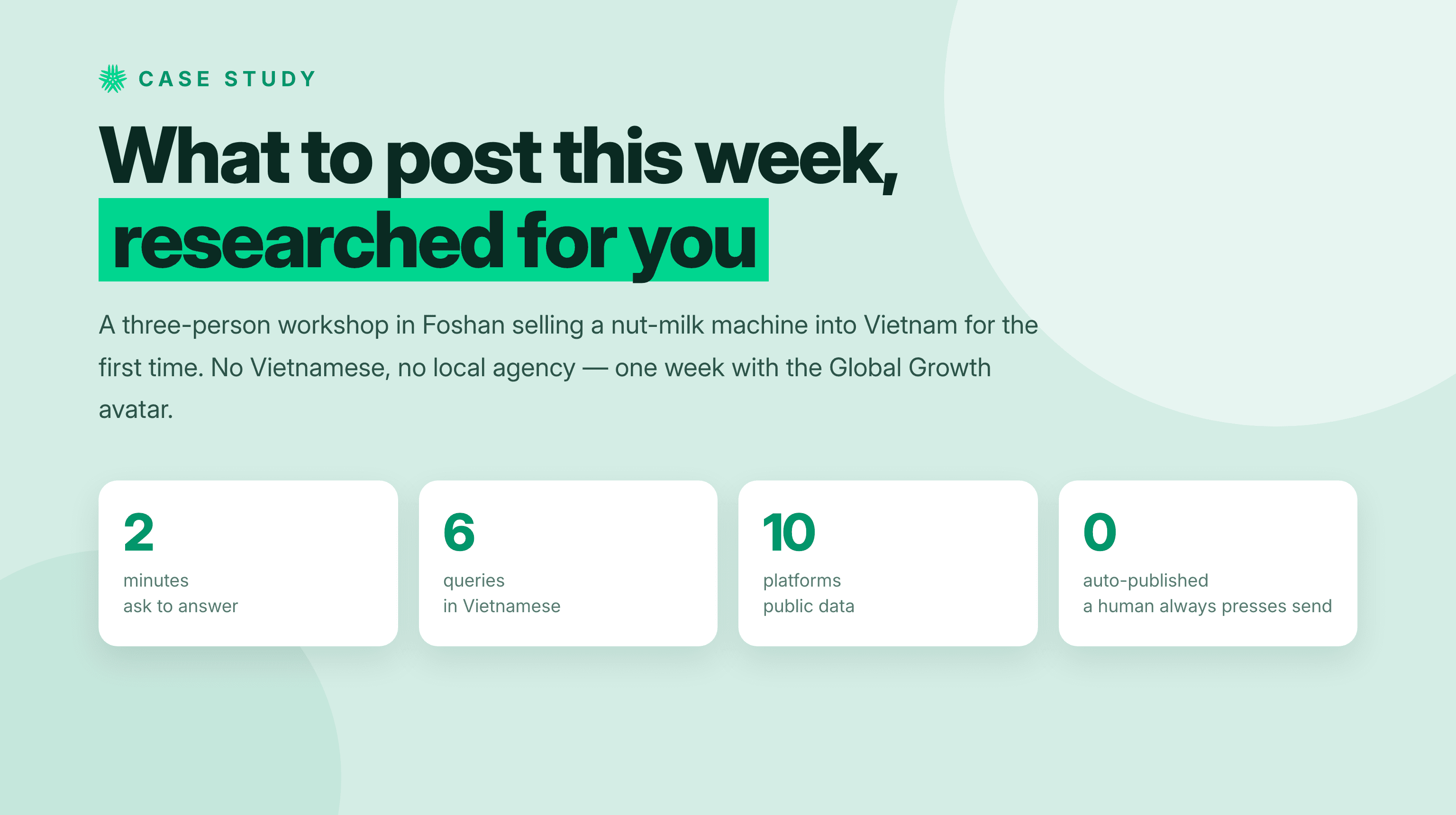
Disclosure: this is our own product, so read it as vendor content. The timings, energy costs and platform data come from one complete recorded run on 29 October 2026 — a single run, not a benchmark. The brand name and model number are anonymised at the customer's request.
A small-appliance workshop in Foshan has three people: the owner decides, one person makes content, one person answers customers. They wanted to sell a 1.2-litre nut-milk machine into Vietnam. First time exporting, and they were stuck on three things: no Vietnamese, no idea what people there were watching, and no budget for a local agency.
Those three compound into a loop: not knowing what people care about means you cannot write what they want to read; no content means no data; no data means you still do not know what they care about. They tried translating the domestic playbook straight across — lead with specs, compare on price. It got views and no engagement: three videos, fewer than twenty comments between them, not one of them about the product.
This is the week they spent with the Growth · Global avatar. The owner said two sentences; the avatar queried ten platforms and handed back seven evidence-linked topic cards, one Vietnamese draft ready to publish, and a rule that runs itself every morning. What follows walks through it in order, with every timing and energy cost copied from the run record.
A word on the avatar first. Growth · Global is one of the nineteen that come built into a KarmaBox account — no configuration needed. One line is hard-written into its role: it goes as far as ready-to-publish and stops. A person always presses publish.
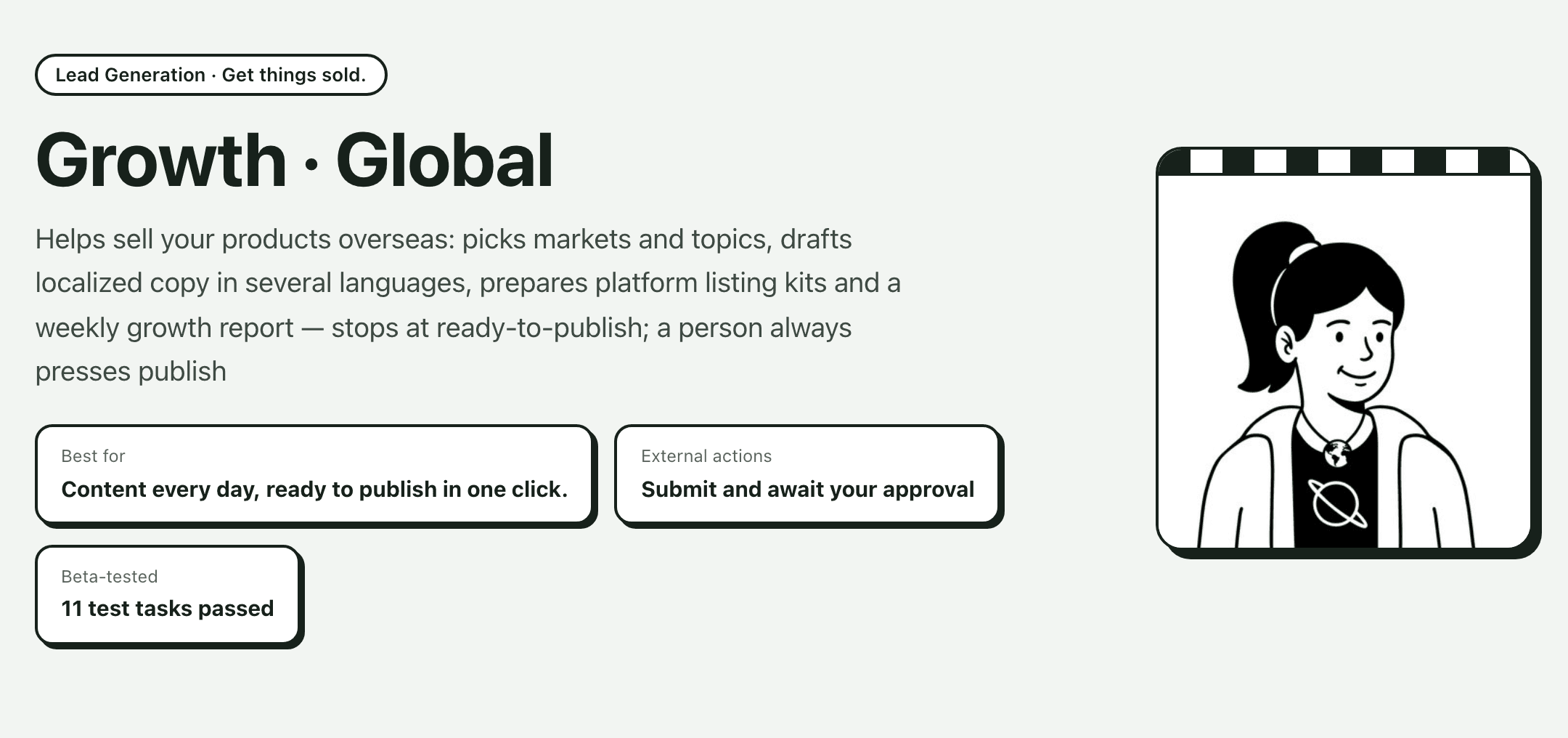
The card states who it suits and whether outward actions need your approval. "A person always presses publish" lives in the role definition, not in a prompt.
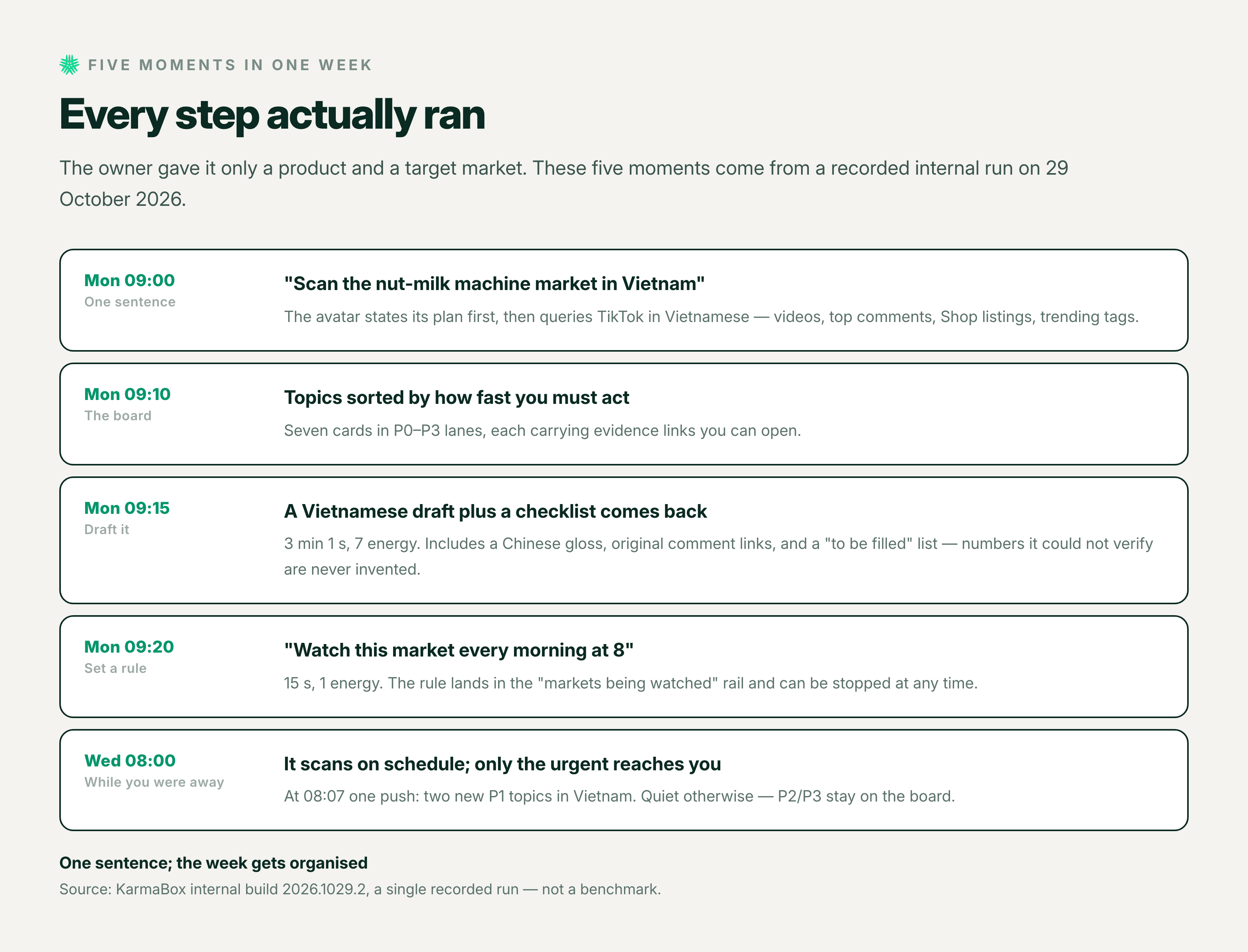
The five moments of that week. The five sections below follow this line in order.
01Mon 09:00 — one sentence buys six Vietnamese queries
"Scan the nut-milk machine market in Vietnam." That was it — a product and a market. No keywords, no platform list.
The avatar states its plan first: how many queries, roughly how long. Then it searches in Vietnamese — máy làm sữa hạt, sữa hạt — across TikTok videos, top comments, Shop listings and 30-day trending tags. Six queries over four platforms: 122.9 seconds, 7 energy. Worth pausing here: it queries in Vietnamese rather than translating the Chinese term. Push an English gloss of "nut milk machine" into the search box and you surface cross-border sellers' ads, not Vietnamese buyers' actual conversations.
02Mon 09:10 — seven cards, sorted by how fast you must move
The content person opens the topic board: seven cards in four lanes. The ordering is not by view count — it is by when the window closes.
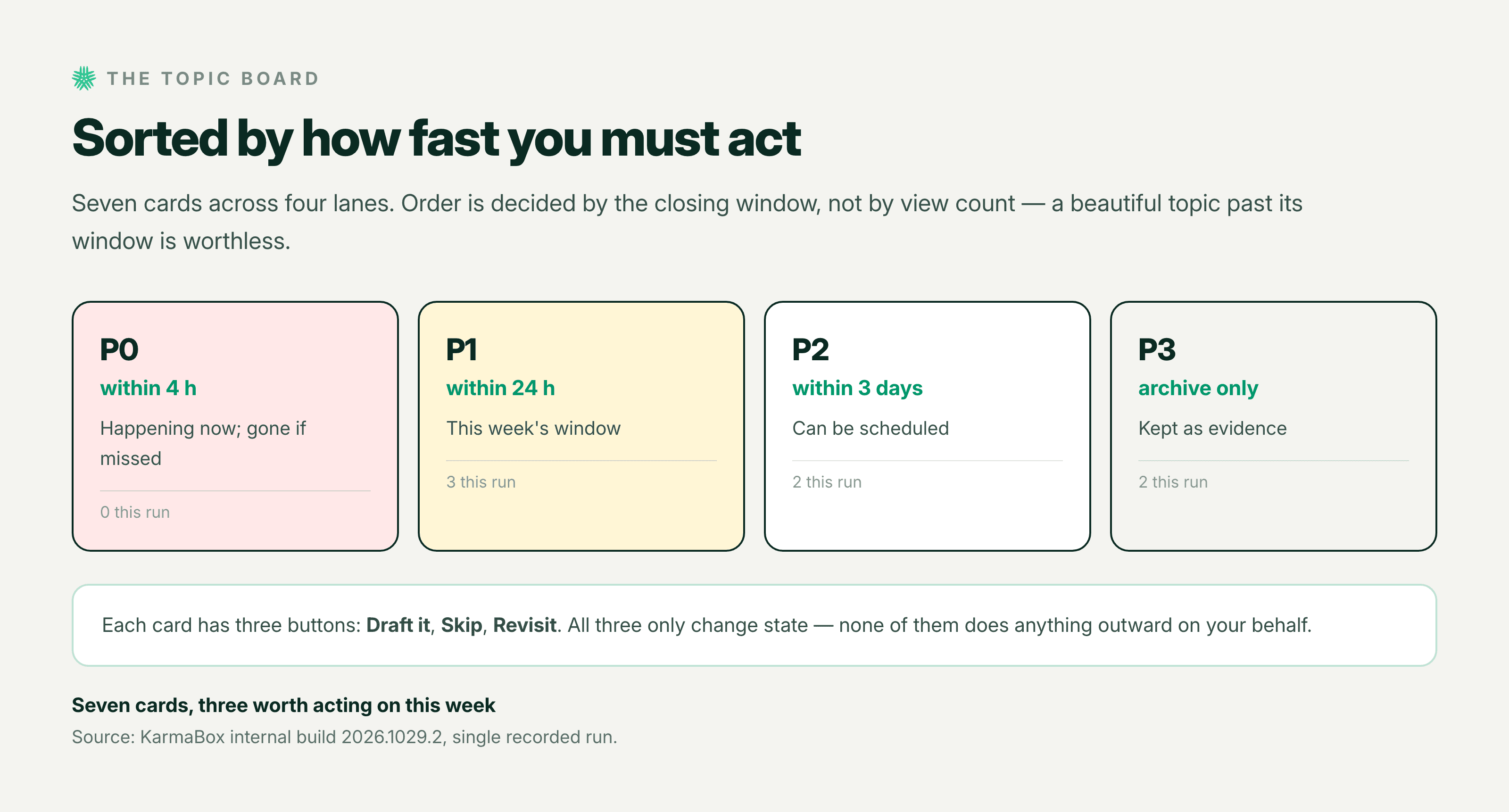
Seven cards this run: three P1, two P2, two P3, no P0.
Each card states the event, the window, which content pattern fits, and your angle — with evidence links carrying real numbers underneath. Click one and you land on the original post or listing. That is the difference from an ordinary competitor report: a report hands you a conclusion, a card hands you the conclusion plus the source you can open yourself.
03Mon 09:30 — the finding that paid: buyers don't ask about specs
Of the three P1 cards, the one worth acting on read like this: in Vietnamese comment sections, buyers ask whether it is easy to wash, whether it heats enough, whether it draws much power, whether it grinds fine. Not specs.
Two videos make it obvious. An 8-in-1 feature showcase: 48,311 views, 152 likes, 8 comments. A pumpkin-cashew milk recipe: 50,833 views, 588 likes, 48 comments. Near-identical reach; roughly six times the likes and comments. Buyers stop on how to make the thing, not on the machine that makes it.
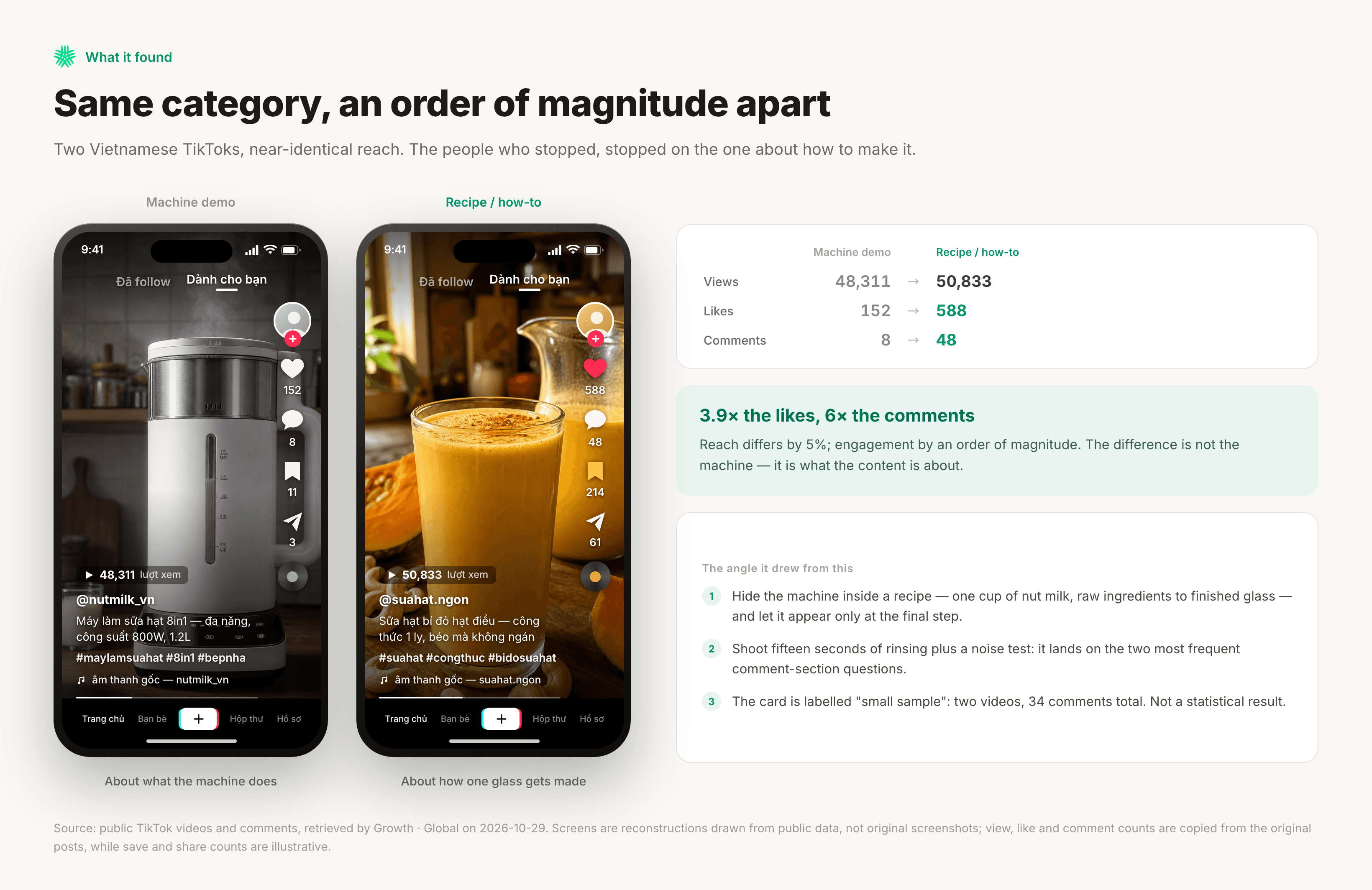
How the two look in the feed. Reach differs by 5%, likes by 3.9×, comments by 6× — and the one on the right is not about the machine, it is about how a glass of milk gets made. Screens are reconstructions drawn from public data, not original screenshots; view, like and comment counts are copied from the original posts, while save and share counts are illustrative.
An ordinary competitor analysis stops here — it tells you recipe content performs better and leaves the rest to you. This card kept going, with two angles you could start shooting today: hide the machine inside a recipe, one cup of nut milk from raw ingredients to finished glass, and let it appear only at the final step; then shoot fifteen seconds of rinsing plus a noise test, which lands on the two most frequent comment-section questions. This workshop's machine happens to be filter-free and quiet — the angle came from matching their own selling points against what locals were actually asking, not from a generic template.
One caveat, stated plainly: this compares two videos totalling 34 comments. It is not a statistical result, and the avatar labelled the card "small sample" itself. It shows its scope so you can decide how far to trust it — which is a different thing from an "industry insight" delivered with unearned confidence.
04Mon 14:00 — hit "draft it," three minutes later a Vietnamese draft
Press "draft it" on the card that matters: 3 minutes 1 second, 7 energy, and a Vietnamese reply draft comes back. It writes to the card's pattern and angle rather than translating word for word — local phrasing, evidence numbers reproduced exactly, prices in the original currency.
| What came back | Why it is built that way |
|---|---|
| Vietnamese reply copy, six questions answered | Copy-paste ready; no second pass needed |
| Line-by-line Chinese gloss | For your review only — it never ships |
| Original comments, view and comment counts, source links | Every claim traces back to something you can open |
| A 15-second vertical shot list (rinse + noise) | Aimed at the two most frequent comment-section questions |
| Pre-publish checklist: sign from a real account, add UTM, keep it out of hard-ad territory | Compliance and tone reminders — the call stays yours |
| A "to be filled" list: wattage, blade, noise in dB — never invented | If it was not verified it stays blank. That rule does not bend |
That last row is the most important line in the whole exercise. An assistant that invents numbers hands back every minute it saved the first time a customer checks — and takes some trust with it.
05Wed 08:07 — the owner was driving when the phone buzzed
The owner's second sentence: "From now on, watch the Vietnamese nut-milk machine market every morning at eight." Fifteen seconds, 1 energy, and the rule lands in the "markets being watched" rail — stoppable at any time.
At eight on Wednesday it scans, compares against existing cards, and at 08:07 sends one push: two new P1 topics in Vietnam. The rule caps itself at one push per day, and only new P0/P1 items qualify — P2 and P3 go quietly to the board. The owner was driving; the headline was enough to know whether to pull over. Usually it is not.
06Where it looked, across the whole week
The sections above are what happened. This one is the substrate underneath it: the ten platforms the avatar can pull from, and which question each one answers. A scan runs at most eight queries, chosen against your question. If a platform is not in the registry it will look, quote the cost, and ask before spending it.
| Platform | What it queries | Which question it answers |
|---|---|---|
| TikTok | Video search, top comments, Shop listings, 7-day tags, ad library | What people watch and ask, prevailing prices, who is advertising |
| YouTube | Video search, current month | Whether reviewers exist and which angles they take |
| Trending topic posts | Which visual angles are landing | |
| Meta ad library | Live ad creatives | What competitors are paying to push |
| Reddit / X | Post and trending search | Unfiltered complaints and emerging threads |
| Amazon / Google Shopping | Search results, product reviews, local listings | Price bands, ratings, where the bad reviews cluster |
| Google Search / Trends | Local results, 12-month interest | What buyers see, and whether demand is rising or falling |
One honest gap: there is no usable Shopee data source today, so Southeast Asian local pricing leans on Google Shopping instead. Where a platform cannot be queried the avatar says so rather than filling the hole. Results for the same question are reused for six hours, so you do not pay twice.
07It researches and drafts — it does not decide
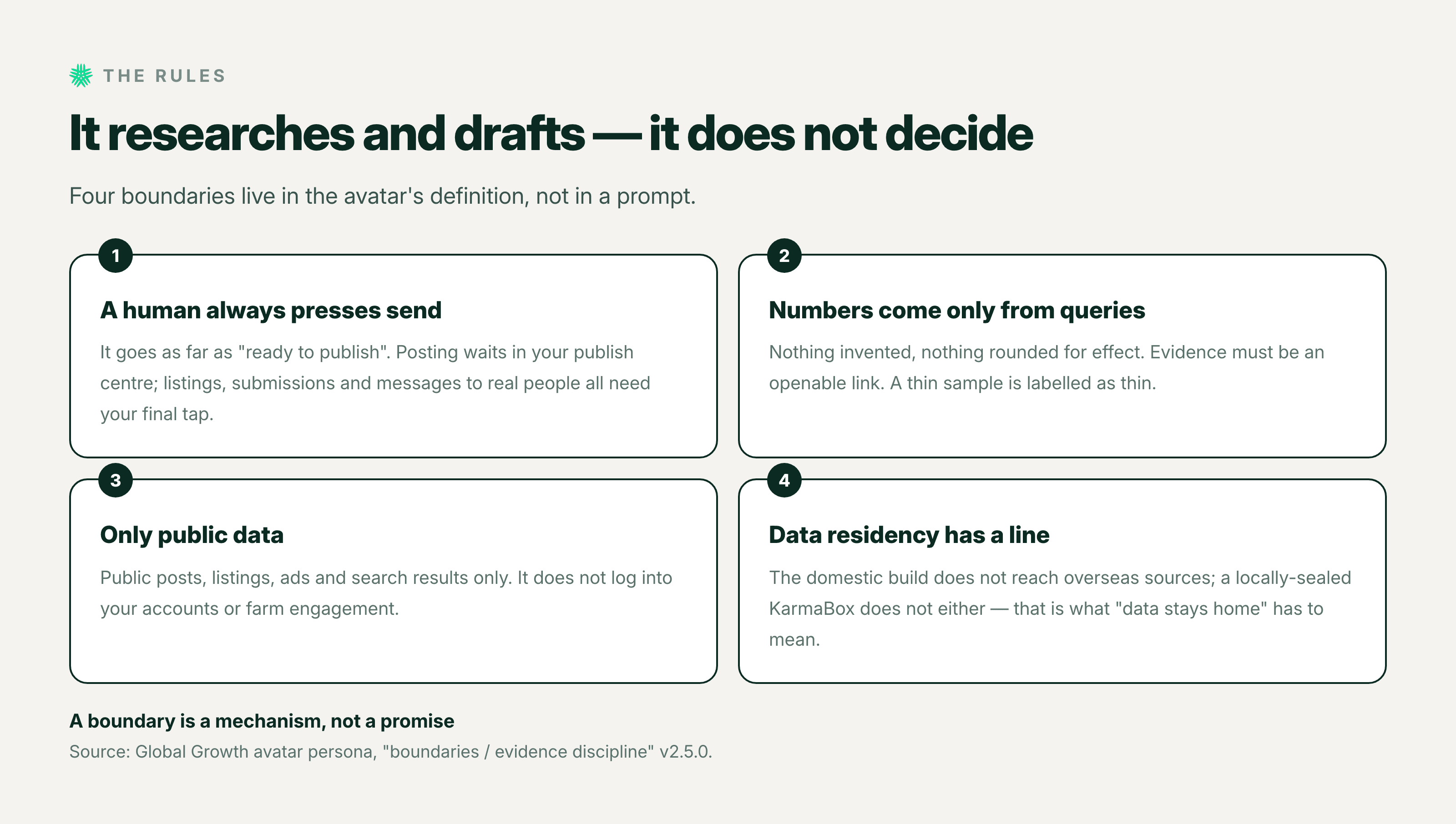
These four live in the avatar's persona definition rather than in a prompt — which is why they survive a model swap.
Of the four, the first is the one most often underrated. It goes as far as "ready to publish" and stops. Posts wait in your publish centre; listings, submissions and messages to real people all need your final tap. This has nothing to do with how clever the model is — it is a property of the action surface. We draw that distinction out more fully in a separate piece on where the line between an avatar and a chatbot actually falls.
The fourth is the one that bites hardest in an export workflow: the domestic build does not reach overseas sources, and a locally-sealed KarmaBox does not either. That is not a missing feature; it is what "data stays home" has to cost if the phrase is going to mean anything.
08How to start this week
Find the Global Growth avatar in your list and tell it what you sell and which market you are eyeing. One sentence is enough.
Have it scan one market, pick a single card, draft it, edit, then publish. Follow one card — do not fan out on the first run.
Let it watch daily. If you want more headroom, add your own data-source key in settings — results are then marked as using your key.
A closing caveat worth stating: this is one week at one three-person workshop, not a methodology that transfers to every category. What it removes is the most draining stretch — feeling your way into an unfamiliar market from zero. What it does not remove is your judgement about your own product. Which suggestion is worth trying is still your call.
09FAQ
Will it post on my behalf?
No. It goes as far as "ready to publish" and stops. The draft waits in your publish centre until you approve it. The same applies to listings, submissions, and messages to real people.
Are the numbers real? How do I check?
Numbers come only from query results — nothing invented, nothing rounded for effect. Every piece of evidence is an openable link to the original post, listing or comment. Thin samples are labelled as thin, and figures it could not verify are left blank.
I don't speak the target language — how do I review the draft?
The draft comes with a line-by-line gloss in your language, for review only — it never ships. You check the meaning, then decide what to change.
Will it spam me with notifications?
Each rule pushes at most once a day, and only for new P0/P1 items. P2 and P3 go quietly to the board. Any rule can be stopped at any time.
Can the domestic build query overseas platforms?
No. The domestic build does not connect to overseas sources, and neither does a locally-sealed KarmaBox. That is part of what the data-residency promise costs, not a missing feature.
What about platforms it cannot query?
It says so. Shopee, for instance, has no usable data source today, so Southeast Asian pricing leans on Google Shopping instead. It will not pretend to have looked.