Disclosure: this is our own product, so treat it as vendor content. Where a number comes from our own logs I give the date and scope; where I'm relying on a secondhand figure whose primary report I couldn't open, I say that too.
You do not judge a contractor by how well they describe the job. You judge them by whether the wall is straight when they leave, and by whether they tell you what they found behind it. That is the whole difference between an AI avatar and a chatbot, and almost every comparison article misses it because it compares the two on the axis that matters least: how smart the answers sound.
01The definition, before the argument
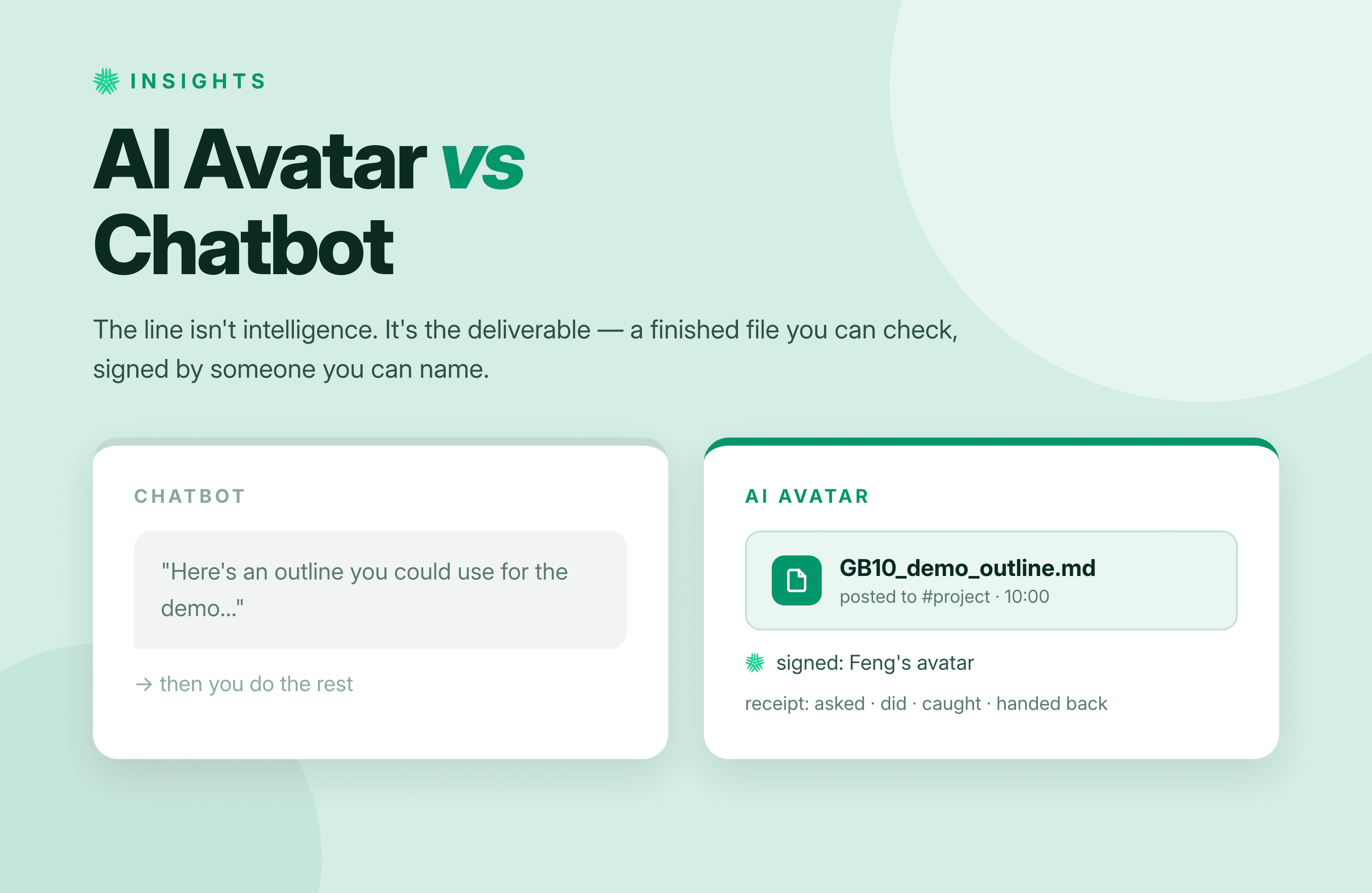
An AI avatar is an agent that holds an identity you can name, works inside a boundary you set, and hands back a finished deliverable with a record of what it did — rather than returning a message for you to act on. It is not a smarter chatbot, and it is not a chatbot with tools bolted on.
Here is the split worth keeping in mind, because the category is drowning in synonyms:
Answers. Its surface is conversation.
Acts. Its surface is tools, and its risk is action.
Acts alongside you, with you in the loop by construction.
An agent with persistent identity, persistent memory, and a signature — addressable, responsible, findable next week.
Only the last one describes something your colleague can hand work to while you're unreachable. That is the use case worth comparing.
02The line isn't intelligence. It's the deliverable
When you ask a chatbot to prepare a five-minute demo outline, you get an outline in the chat window. You then copy it into a document, cut what doesn't fit, check whether the pricing figure is current, and send it. The chatbot's contribution ends at the point where your work begins.
When an avatar is asked the same thing inside a team channel, the outline arrives already posted, signed as the avatar and not as you, and the process behind it is one click away. In one recorded case from our own team, a message arrived in a group while the person it was addressed to was underground on the subway with no signal. The avatar read it, produced a three-part outline, and posted it under a signature that made clear it was not the human. Nobody waited. [4]
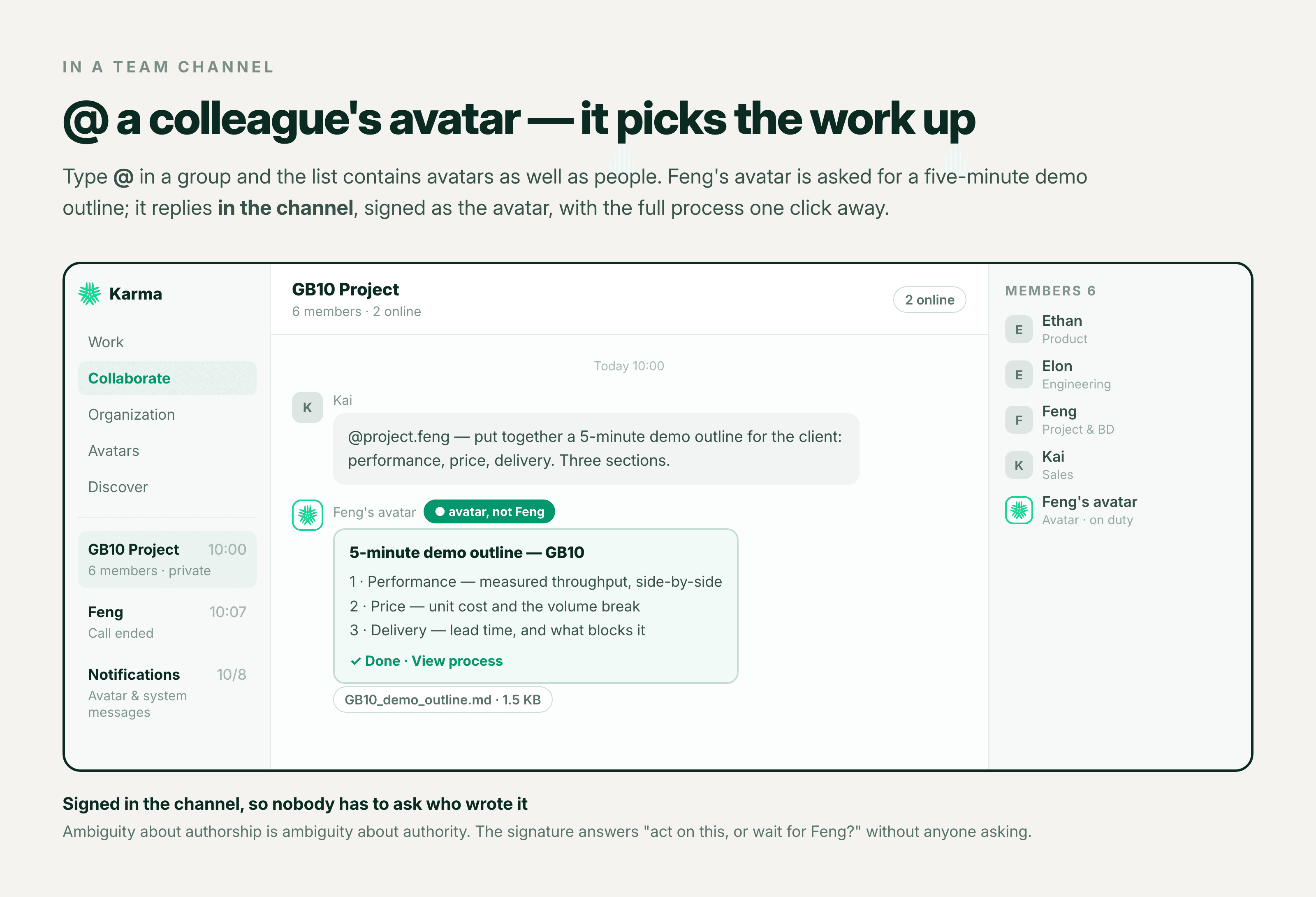
A signed avatar reply in a team channel. Ambiguity about authorship is ambiguity about authority — the signature resolves it.
03What a chatbot cannot do, structurally
There is nothing to bound
A chatbot has no send, no publish, no spend, no delete. Its entire action surface is "produce text." When vendors talk about safety in a chat product, they are talking about refusing to say things. When they talk about safety in an agent, they are talking about refusing to do things. These are different engineering problems, and only the second one can hurt you at 3 a.m.
There is no receipt
A chat transcript records what was said. It does not record what was done, what was declined, and what was found to be wrong afterwards. "It said it sent the email" and "it found the sent sentence in the conversation afterwards and confirmed it" are two different claims, and only the second one is evidence.
There is no name
A message from a chatbot is from you, or from "the assistant" — which in practice means from you. In a group of six people this is not a cosmetic issue. If a colleague cannot tell whether a sentence came from you or from your agent, they cannot tell whether to act on it or wait for you. Ambiguity about authorship is ambiguity about authority.
04The receipt is the product
The interesting artifact an agent produces is not the deliverable. It is the evidence that the deliverable is trustworthy: what was asked, what it did, what it caught, what it handed back to a human, and the specific caveat it volunteered.
From a recorded run on our own account: an avatar was asked to build a short three-page deck. It did. It also reported that its preferred layout service was unreachable, that it fell back to a standard template, and that the fallback padded in two extra pages which could be deleted. Then it noted every line of content traced back to what had been specified, with no invented numbers. That is a negative disclosure — the agent telling you where it fell short before you found out.
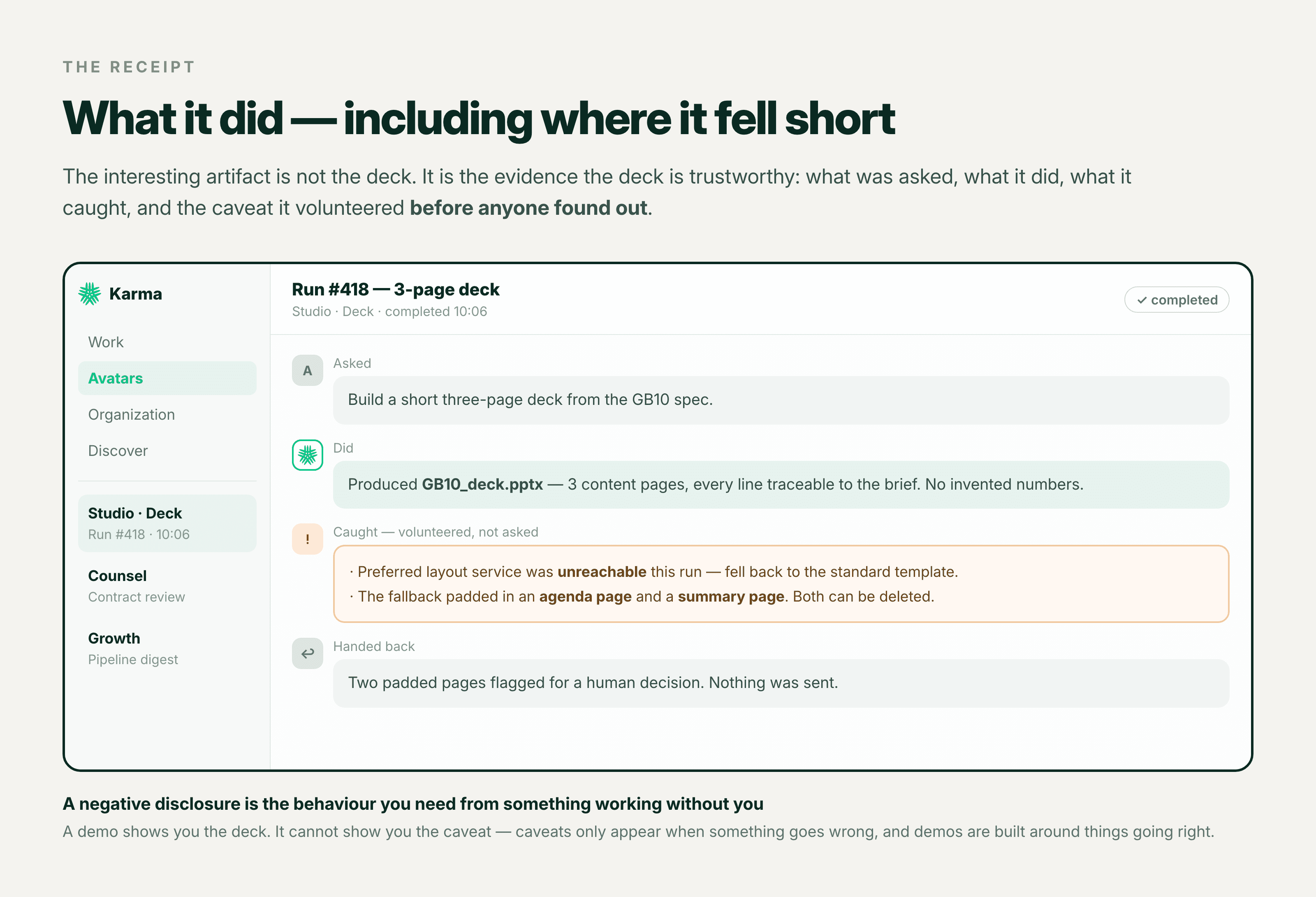
The receipt: the avatar flagged its own shortfall before you had to find it.
05Four properties that survive contact with a real week
A name, a role, and a signature that resolves to something — a message, a task history, a set of permissions. Without this, work can only be suggested, not handed off.
A policy per action type, enforced at a layer the model cannot negotiate with. Not "my system prompt says don't email" — that is a request, not a mechanism.
Context that belongs to the avatar and survives a model swap and a vendor decision. This is the property that makes a working relationship possible at all.
A record of what it did, what it declined, and what it verified, written for a human who wasn't watching. A receipt is a design stance about honesty, not a feature you bolt on.
06Memory belongs to the avatar, not the session
In a chat product, memory is a property of a conversation, or of an account-level setting that changes without notice. Close the thread and the reasoning goes with it. In an avatar architecture, memory is a property of the avatar. It survives a model swap, because it isn't stored inside the model. It survives a vendor decision, because it isn't stored inside the vendor's project.
The practical test costs ten minutes. Ask something only answerable from history — "why did we drop the second vendor in March" — and then ask where the answer came from. A good answer that points to a file means retrieval is working. A good answer that can't say where it came from is the dangerous one — it does this with invented answers too. The longer argument for why this matters is in another article: memory should follow the person, not the model.
07The industry is converging on the word, not the property
OpenAI's assistant, dots, was explained at TechCrunch Disrupt by the person who leads its enterprise product team. His account of why it exists is, almost word for word, the avatar argument: "if we could frame this as, it's an entity and it's a single conversation, not many different conversations… it starts to become intuitive." It costs $100 a month on the Pro tier and up. [1]
The same interview disclosed two boundary problems: its proactive timing was not good enough early on — the product lead himself was warned of a calendar conflict three minutes before it — and it refuses read-only access to cloud drives, the controls described as "not granular and pushy." [1] Neither of those is an intelligence failure. Both are boundary failures.
08The comparison, on axes you can check
| Dimension | Chatbot | AI avatar |
|---|---|---|
| Output | Text in a window | A finished artifact, delivered where the work lives |
| Who acts next | You, always | The avatar acts; you approve where policy says so |
| Action surface | None — it can only say things | Send / publish / spend / delete, each with its own policy |
| Where the boundary lives | In the prompt and the vendor's filters | Server-side, before execution |
| Message attribution | From you, or "the assistant" | Signed as the avatar, distinguishable at a glance |
| Memory | Per conversation, per project, or per account setting | Per avatar; survives model and vendor changes |
| Record of work | Transcript of what was said | Receipt: asked / did / caught / handed back |
| Failure mode | Wrong text | Wrong action — which is why it needs the receipt |
| Cost model | Per seat, per month | Per seat or per device, plus the setup afternoon |
| Trust basis | The vendor's filters | Your own policy plus a record you can read |
09The speed numbers: 19 avatars, 95 tasks, 45 seconds
Our own measurement, caveats included: nineteen avatars, five small tasks each, ninety-five tasks dispatched at once, every result back in under 45 seconds. Done one at a time by one person, that same pile would take over 22 minutes. (KarmaBox internal logs, 12 October 2026; a single run on one account, not a benchmark, tasks chosen to be small.) [2]
KarmaBox internal logs, 12 Oct 2026, single run on one account, not a benchmark [2]. The real question is not how fast — it is how many of those 95 results could go out without you reading them. That number is a function of your boundary and receipt design, not of the model.
The human translation is the point. Forty-five seconds is about the time it takes to read a paragraph. Twenty-two minutes is a coffee break. So the question a business actually faces is not "how fast is it" but: of those 95 results, how many could go out without me reading them? That number is a property of your design, not of the model.
10Where an avatar is genuinely worse
Setup cost is front-loaded
A chatbot works in ninety seconds. An avatar needs a role, a boundary policy written per action type, and a body of reference material — otherwise it will produce confident work from nothing, which is worse than producing nothing. Budget an afternoon for the first one, not ninety seconds.
It can act before it should
A chatbot's worst case is a bad paragraph. An avatar's worst case is a sent email, a published page, a spent budget. The whole design is defensive about this — it costs you responsiveness: you will be interrupted by approval requests, and you will resent it, which is why the approval policy has to be reviewed monthly rather than set once and forgotten.
Attribution cuts both ways
Being able to see that a message came from an avatar means your colleagues can also see it wasn't you. If you wanted the avatar to quietly represent you, this design refuses — that is deliberate, and it is a trade-off, not a feature list item.
11A twenty-minute test you can run yourself
Do this before any purchase conversation.
Ask for something with a file at the end, not an answer. Check whether the file arrived in the place the work lives, or in a chat window.
Ask for something at the edge of its material. A system with integrity tells you the edge; one without it improvises. Watch for the volunteered negative disclosure.
Ask it to do something adjacent to what it's allowed to do. Does it decline, ask, or do it? Can you find afterwards where that decision was recorded?
Ask the history question and demand the source. A good answer that can't say where it came from is the dangerous outcome.
Put an avatar and a human in the same group and see whether a message's origin is obvious at a glance.
A tool that passes 1, 4 and 5 has the architecture. A tool that passes 2 and 3 has the discipline. You want both, and neither is a model feature. Run these in the tool you'd actually use, not in a sandbox the vendor controls — half the properties above are properties of the environment, not the model.
12What KarmaBox does here
This is product information about our own work, not an independent review.
KarmaBox ships nineteen avatars [5], each with a boundary policy per action type — send, publish, spend, delete — enforced server-side rather than requested in a prompt, so the policy survives a model swap. Each avatar hands back a receipt rather than only a result. The workspace runs on a free iOS app and on hardware you hold.
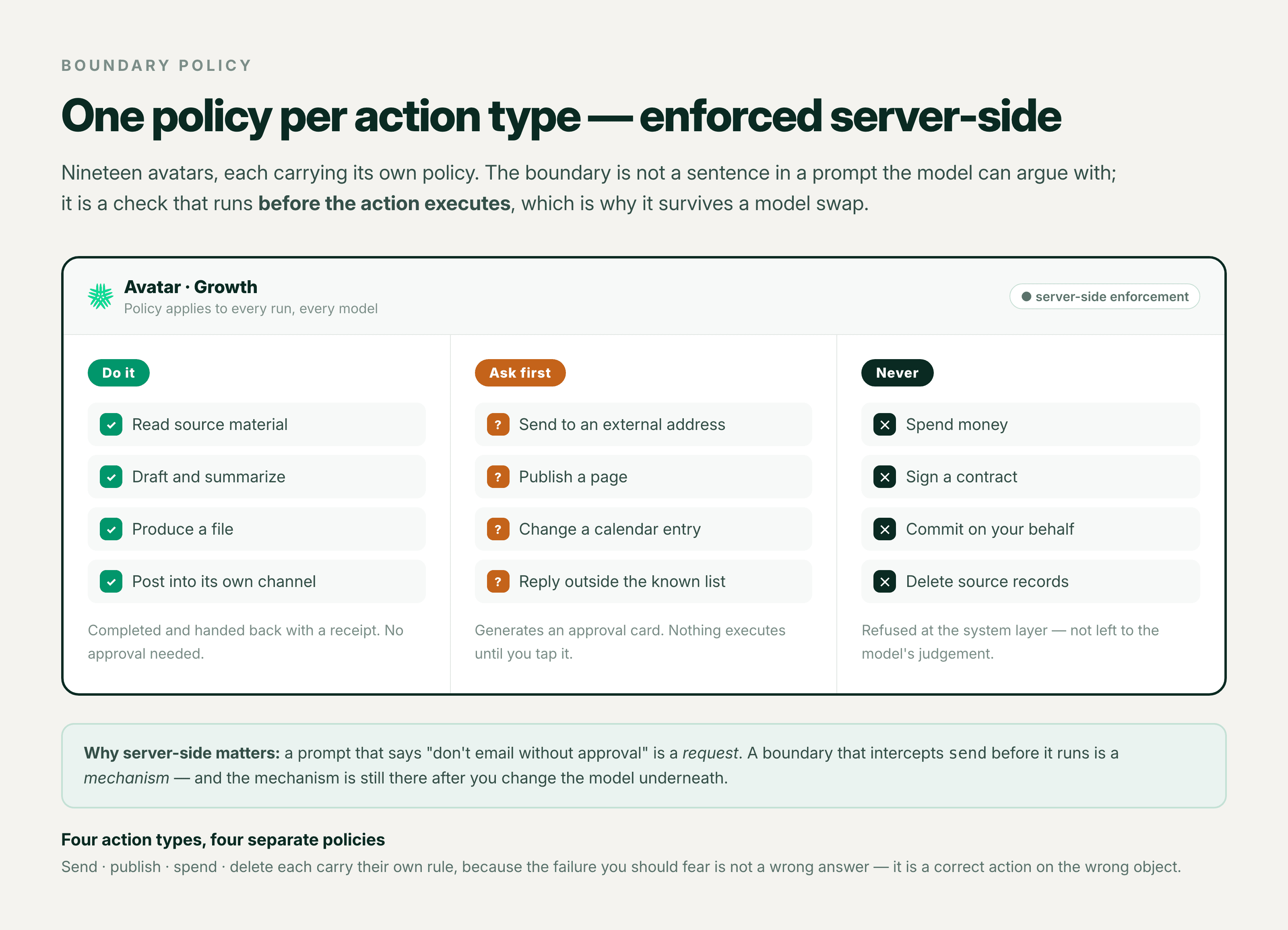
Nineteen avatars, each with its own boundary policy. Action types — send, publish, spend, delete — each carry a separate policy enforced server-side.
The sovereign AI workspace framing exists because an avatar whose memory lives in someone else's account stops being yours the moment that account does. Models are routed per task, and local models run on the device, so routine work carries no per-token cost. The full framing is at the sovereign AI workspace page.
What this doesn't give you: the strongest reasoning available — on the hardest problems a hosted frontier model is still ahead, and a hybrid setup beats a purist one. It doesn't remove the setup afternoon. And it doesn't remove approval fatigue. If it isn't a fit, no problem — every test above works on any tool you're considering.
13FAQ
Is an AI avatar just a chatbot with a face?
No, and the picture is the least important part. The difference is whether it can act, whether its boundary is enforced outside the model, whether it signs its own messages, and whether it hands back a record of what it did. An avatar with a cartoon face and no action surface is a chatbot.
Do I need one if I work alone?
You are the clearest case, because you are also the entire approval chain. The value isn't delegation; it's that the work keeps moving while you're in a meeting, on a train, or asleep, and that you can see afterwards what moved.
Can a chatbot be made into an avatar?
Usually by rebuilding, not by adding. Tools in a chat window give you actions without a boundary and outputs without a receipt. The missing parts are the ones that take the engineering.
How do I know the avatar didn't invent something?
By design, not by hope. Ask for its record and check whether it cites the file it read. A system that can't point to the source is, statistically, sometimes pointing at nothing — and it will do that with the same confidence.
What's the failure mode I should fear most?
Not a wrong answer. A correct action on the wrong object — the right email sent to the wrong client. That is why action types get separate policies, and why the approval log matters more than the transcript.
Does an avatar replace the chatbot I already pay for?
Often it complements it. Chat is the right interface for thinking out loud, drafting, and asking questions. Avatars are for work that has a deliverable and a recipient. Most teams end up keeping both, and the useful question is which of your recurring tasks have an artifact at the end.
How long before it's actually useful?
For a narrow, well-documented task, an afternoon to set up and a week to calibrate. For a broad role, longer, and the first version will be worse than you expect in a way that teaches you what your process actually was.