An employee leaves on Friday. On Monday, their team discovers that the AI assistant knows why a customer rejected a proposal, which pricing assumptions changed, and how an unfinished project should continue. Unfortunately, that context sits inside the former employee's account. The company paid for the subscription, but nobody checked what could be transferred. What looked like a productivity tool has become a continuity problem.
AI agent memory does not have one universal owner. Rights and responsibilities depend on what the memory contains, how it was created, the employment or service agreement, applicable law, and the vendor's terms. A company may have rights in work materials while employees retain rights concerning their personal data. Neither position automatically establishes who can access, export, or delete every record in an AI account.
The practical goal is therefore a governed handover: preserve authorized business knowledge, protect personal and confidential information, revoke the departing person's access, and prove that the successor can continue the work. This guide explains the distinctions and provides a process for managers, IT administrators, and people teams. It offers a general governance framework; employment, intellectual property, and privacy requirements vary by jurisdiction and need local review.
What agent memory actually contains
AI agent memory is information retained and reused to influence later responses or actions. Depending on the system, it may include conversation history, explicit preferences, generated summaries, retrieved documents, project instructions, or records of previous tool use. These components can live in different databases and follow different retention rules. Treating all of them as a single downloadable "brain" makes both ownership discussions and technical handovers less accurate.
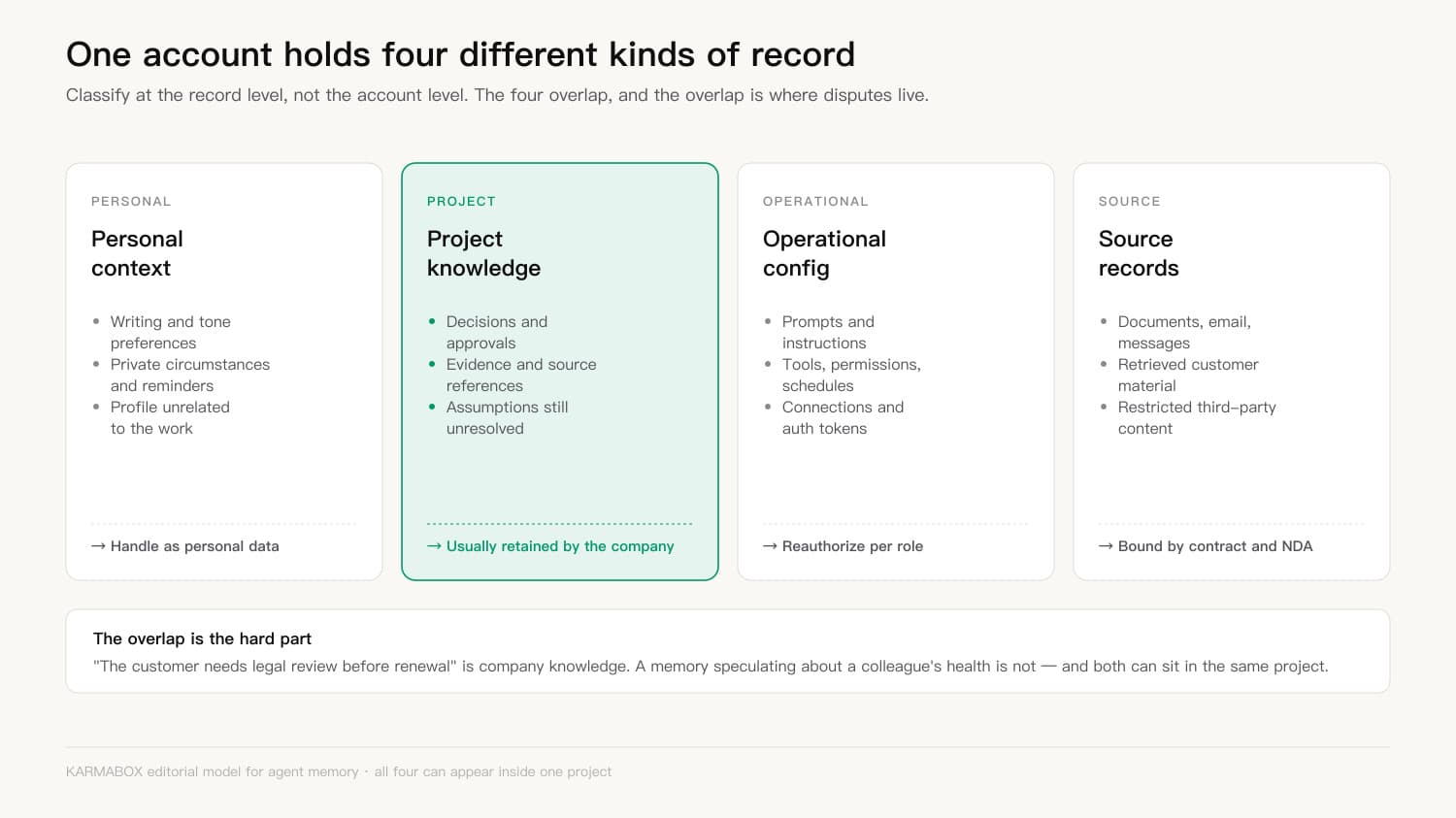
Separate four practical categories. Personal context describes the individual, such as writing preferences or private circumstances. Project knowledge records decisions, evidence, and working assumptions. Operational configuration defines prompts, tools, permissions, and schedules. Source records include the documents or messages from which a memory was derived. The categories can overlap, so classification should happen at the record level rather than only at the account level.
A memory that says "the customer needs legal review before renewal" may be useful company knowledge. A memory that speculates about a colleague's health is a different kind of record, even when both appear in the same project. The system's summary can also be wrong. Before preserving it as institutional knowledge, establish its source, who approved it, and whether it is still accurate enough to guide action.
Memory is also distinct from model training. Saving a project summary does not necessarily modify the model's weights, and exporting a chat does not extract the model itself. Ask where each information layer resides and how it is used. KarmaBox's discussion of sovereign AI for individuals and teams provides a useful starting point for separating control over data, models, and identity.
Ownership scenarios that need different answers
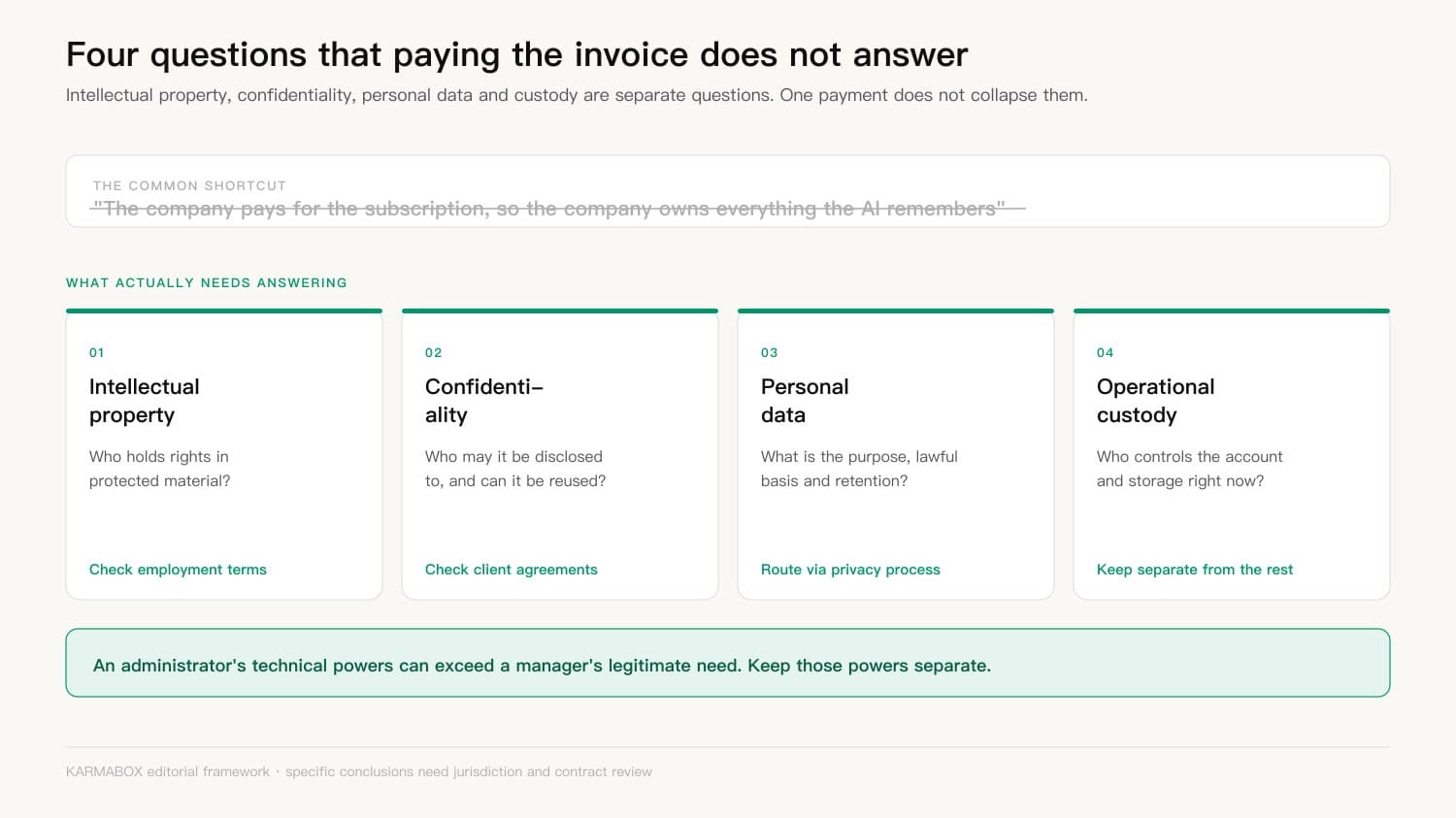
Start by separating intellectual property, confidentiality, personal data, and operational custody. Intellectual property concerns rights in protected material. Confidentiality limits disclosure and reuse. Data protection governs processing of identifiable people's information. Custody describes who currently controls an account or storage location. Paying a bill may establish a commercial relationship, but it does not collapse these four questions into one answer. A useful policy assigns a responsible steward without pretending every record is company property.
Work created in a company workspace
An organization should normally arrange for approved project knowledge to remain available to the relevant team after a departure. That is a governance objective, not a universal ownership rule. As one jurisdiction-specific example, UK Intellectual Property Office guidance explains that an employer is generally the first copyright owner of specified works created by an employee in the course of employment, subject to contrary agreement[1]. This does not decide whether every AI-generated summary attracts copyright.
The handover should identify the specific materials the business is entitled to retain and the people entitled to use them. An account administrator may have technical powers that exceed an individual manager's legitimate need. Keep those powers separate. A manager who needs an approved customer brief does not automatically need access to every private conversation associated with its author.
Company work inside a personal account
A personal subscription creates a difficult boundary when it mixes company documents with family matters, job applications, or another client's work. Do not solve this by asking for the employee's password or cloning the entire account. Arrange a scoped, authorized extraction of business records, with a review mechanism for disputed material. If the person has already left, use established legal and vendor procedures rather than impersonating them.
The preventive measure is straightforward: important business context belongs in an approved organizational repository while the work is happening. Employees should know what they must document, what personal use is permitted, and how mixed records will be handled. A policy introduced only during a contested departure is much harder to apply fairly and consistently than one explained during onboarding.
Contractors and client-owned material
Contractor arrangements deserve their own review. The same UK copyright guidance distinguishes commissioned work from employee work and emphasizes contractual allocation[1]. A contractor may bring reusable methods while producing client-specific deliverables. Define which memories can be retained, transferred, or reused; check the client agreement as well as the contractor agreement. A company's access to an agent does not erase a customer's confidentiality restrictions or a third party's licence conditions.
Shared agents with several contributors
A shared agent often blends contributions from sales, engineering, support, and outside advisers. Its memory should therefore have a business steward, not simply inherit the permissions of whoever created the bot. Assign responsibility for approving changes, correcting errors, and managing access. If a contributor leaves, preserve authorized shared knowledge while reviewing records tied specifically to that individual. Shared use does not make all source material suitable for organization-wide disclosure.
| Scenario | Main handover question | Practical control |
|---|---|---|
| Company workspace | Which records can the team retain? | Approved scope, named steward, source references |
| Personal account | How can work and personal material be separated? | Scoped extraction; no password takeover |
| Contractor or client work | What do the agreements permit? | Check assignment, licence, and confidentiality terms |
| Shared agent | Who approves updates and access? | Role-based access and a successor steward |
Personal data remains a separate responsibility
When employee information enters agent memory, the organization needs a justified processing purpose, an applicable lawful basis, appropriate access limits, and a retention approach. The ICO's employment records guidance also explains why consent can be problematic in employment relationships: workers may not have a genuine choice[2]. A signed AI policy should explain the process; it should not be treated as permission for unrestricted reuse of personal information.
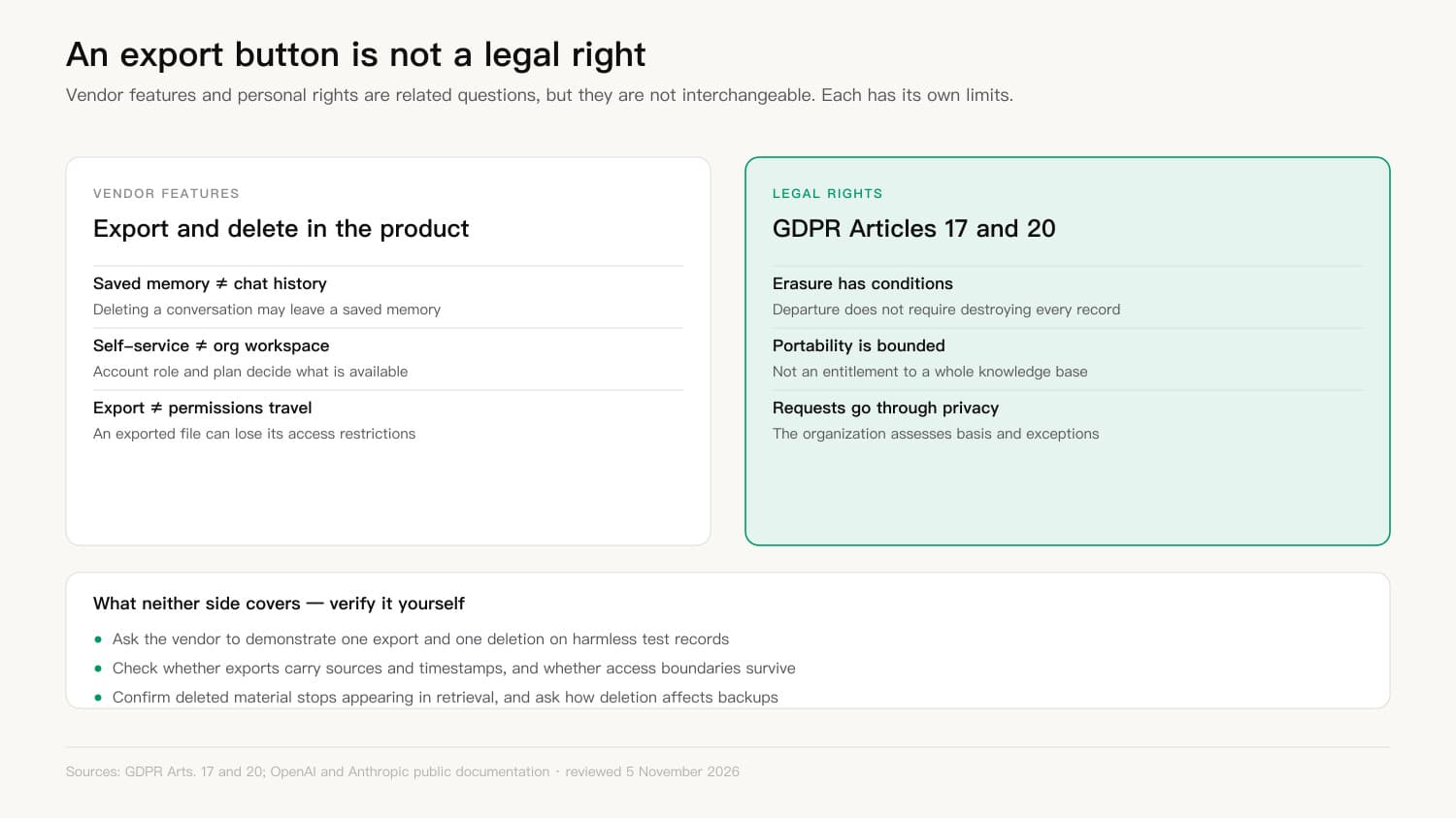
Under the EU GDPR, Articles 17 and 20, erasure and portability have conditions and limits[3]. Departure does not automatically require destruction of every business record, and portability is not a blanket entitlement to a company's whole knowledge base. Route requests through the organization's privacy process. A technical export feature and a person's legal rights are related questions, but they are not interchangeable.
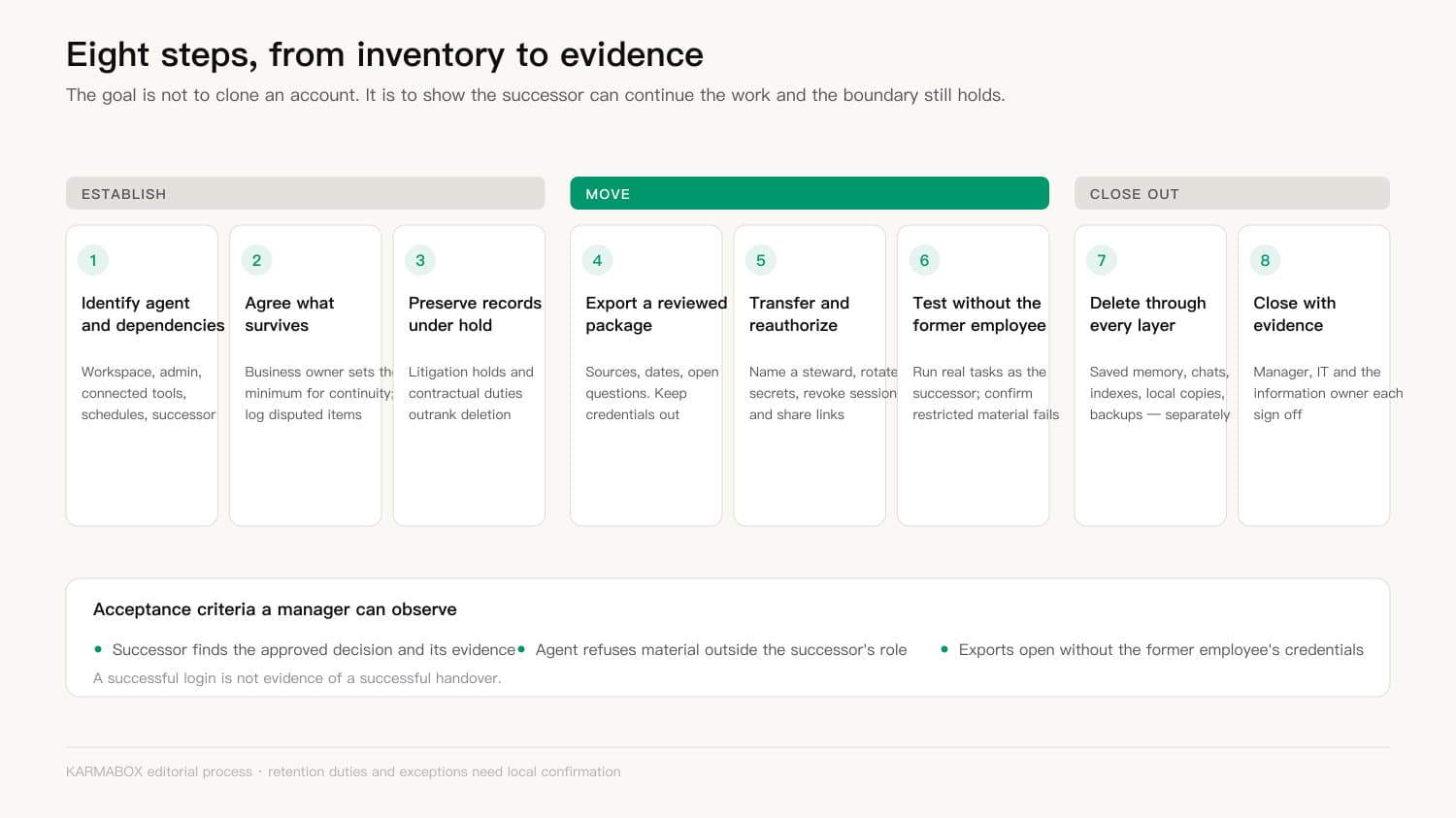
Offboarding steps for an AI agent with memory
1. Identify the agent and its dependencies
Create an inventory before removing the account. Record the workspace, business purpose, administrator, source repositories, memory stores, connected tools, schedules, and proposed successor. Include local devices and browser integrations when relevant. Ask which activities would stop if the employee's login disappeared today. That question often reveals hidden dependencies, such as an automated report that reads a shared drive through a personal authorization token.
2. Agree what must survive and what must not
Have the business owner identify the minimum knowledge needed for continuity: unresolved decisions, customer commitments, operating instructions, and links to authoritative records. Separately identify personal conversations, irrelevant profiles, duplicate drafts, and restricted third-party material. Record decisions about disputed items and involve privacy or legal specialists where necessary. This review should produce an approved scope for handover, not an unrestricted instruction to preserve everything "just in case."
3. Preserve records that are subject to a hold
Check for applicable litigation holds, investigations, contractual recordkeeping duties, or other retention requirements before deletion. If relevant records must be preserved, place them in a controlled archive with designated access and a review owner. Keeping evidence does not mean making it available to the successor's everyday agent. Document the reason and scope of the hold so that exceptional retention does not quietly become a permanent default.
4. Export a reviewed handover package
Export approved knowledge into formats the organization can read independently of the original assistant. Include source references, dates, unresolved questions, and the status of each important assumption. Keep credentials out of the package. Store the export in an approved location and restrict distribution. Where automatic extraction is incomplete, a reviewed written brief may provide a more dependable starting point than a large archive nobody can interpret.
5. Transfer responsibility and reauthorize tools
Assign a named business steward and a separate administrative recovery route. Reconnect necessary tools using an approved identity with only the permissions required for the task. Rotate exposed secrets and revoke the departing user's sessions, tokens, and sharing links as appropriate. Do not simply rename the old account and assume the problem is solved. The successor needs legitimate authority, and automated actions need a clear accountable owner.
6. Test continuity without the former employee
Run representative tasks from the successor's identity: retrieve an approved project decision, prepare an internal brief, and identify the correct escalation contact. Test that restricted personal material is unavailable too. Compare responses with the source documents and record missing context. A successful login is insufficient evidence of a successful handover. The test should establish that the new arrangement preserves necessary work while respecting the new access boundary.
7. Delete through every relevant layer
Remove material that should no longer remain in active use, following the applicable policy and any retention exceptions. Check saved memories, chat histories, source files, retrieval indexes, local copies, and connected systems separately. Ask the vendor how deletion affects backups and when it takes effect. Record what was deleted, what remains for a justified reason, and who will revisit remaining records. An empty chat window is not proof of complete removal.
8. Close the handover with evidence
The manager should confirm continuity, IT should confirm access changes, and the relevant information owner should approve retention decisions. Keep a concise record of the export location, successor, validation results, deletion requests, and outstanding exceptions. Review the process after the departure. If the handover depended on remembering an undocumented setting or finding a cooperative former employee, convert that dependency into a routine control before the next departure.
Designing memory with export and delete built in
The strongest offboarding process starts before anyone leaves. Make the authoritative project record independent of an individual assistant. Use the agent to retrieve and explain that record, while treating generated memories as reviewable working context. This reduces the chance that a useful inference becomes the only surviving account of a decision. It also allows the company to replace a model without rebuilding all of its business knowledge from conversations.
Define a portable memory record with an identifier, content, source, business steward, access group, review date, and retention category. Where appropriate, record whether a statement is confirmed, provisional, or superseded. These fields are a proposed design pattern, not a universal product standard. They make export more useful because the receiving system can distinguish current approved knowledge from a historic guess or an instruction that has expired.
Do not assume that copying a memory also copies its permissions. An exported file can lose access restrictions that existed in the original application. Reapply authorization at the destination, and check whether client material may cross organizational or geographic boundaries. Keep sensitive archives separate from the agent's everyday retrieval store. A portable record is valuable only if it remains usable by the right people under the right conditions.
What vendor features do and do not establish
OpenAI's memory documentation distinguishes saved memories from chat history: deleting a conversation alone does not necessarily remove a saved memory[4]. Its data export guidance also distinguishes eligible self-service accounts from organization-managed workspaces[5]. These are separate controls. Before designing an exit process, verify the options available for the exact plan, account role, and workspace configuration your company uses.
Anthropic documents memory in Claude, including memory saved as individual topics and included in data exports[6], along with the scope and limits of those exports[7]. Treat this as a useful portability feature, not evidence that every conversation, permission, document, and workflow will migrate intact. Review what is transferred and test the destination. The examples here describe documented controls, not a product ranking or a certification of complete portability.
Ask any vendor to demonstrate an export and a deletion using harmless test records. Inspect whether the export includes sources and timestamps, whether access boundaries survive migration, and whether deleted material stops appearing in retrieval. Record exclusions and administrator requirements in the procurement decision. For a KarmaBox deployment, use the product documentation to confirm the actual configuration rather than assuming that a sovereignty claim guarantees a particular export format or retention control.
A small policy that people can actually follow
A workable policy states where business memory may be stored, who approves sharing, and what happens when a person changes roles or leaves. It should explain the handling of personal material and how someone can challenge an inaccurate memory. Assign responsibilities across the employee, manager, IT, and privacy function. Avoid a single sweeping sentence saying the company owns everything an AI remembers; it leaves the operational questions unanswered.
For example, a company could require approved project decisions to be recorded in its shared repository, prohibit credentials in conversational memory, and require a reviewed handover brief before account closure where circumstances allow. It could also schedule periodic checks for stale context. These are illustrative policy choices, not universal legal obligations. The right detail depends on the organization's information risks, systems, workforce arrangements, and contractual commitments.
Make ownership visible in daily work
Give every important shared agent a short register entry that employees can find. It should identify the business steward, approved purpose, permitted data categories, source repository, and escalation route. This register is particularly useful when an agent changes hands several times or operates across departments. People should be able to find out who can authorize a correction without searching old messages or guessing which colleague originally configured the assistant.
Treat changes in role as a memory event too. A promotion, internal transfer, or temporary assignment can change what a person should access even though they remain employed. Review the agent's retrieval scope and inherited permissions when those boundaries change. Otherwise, an assistant can quietly carry information from a previous role into a new one. This is a reason to connect access to current responsibilities rather than to a permanent personal profile.
Review the quality of remembered knowledge on a schedule proportionate to its consequences. A stale preferred meeting time is usually less consequential than an obsolete instruction for approving refunds or disclosing customer records. Prioritize memories that trigger actions, affect people, or influence important commercial commitments. Give the reviewer a way to mark an instruction superseded and to trace which agents still use it. Corrections should improve the shared record, not remain buried in one conversation.
Budget for the work after export
Portability has operational costs even when a vendor charges nothing for the file. Someone must interpret the export, remove inappropriate material, rebuild permissions, reconnect tools, and check the new workflow. Estimate that work before adopting an assistant for a critical process. If the organization cannot describe a realistic migration path, the memory may become a source of dependence regardless of what the contract says about ownership.
Keep an ordinary, readable continuity brief alongside any specialized export. State the current objective, approved decisions, unresolved issues, responsible people, and source locations. This document is not intended to reproduce every interaction. Its purpose is to let a qualified colleague resume work if an account becomes unavailable unexpectedly. Test that assumption periodically by asking another authorized team member to use the brief without help from its original author.
For smaller teams, start with one agent and one realistic departure scenario. Identify what would be lost, write a short handover record, and test a change of access. Expand the process when the pilot reveals a need, rather than introducing a complicated approval chain for every harmless preference. The objective is a repeatable boundary around useful knowledge: people understand what the organization retains, and the organization knows how to retain it responsibly.
An illustrative handover from employee to team
Before applying the process, set acceptance criteria that a manager can observe. A successor should be able to locate the latest approved decision, identify its supporting evidence, and distinguish it from an abandoned proposal. The agent should refuse access to material outside the successor's role. Exported files should open without the former employee's credentials. These checks translate an abstract promise of ownership into specific evidence that the company can continue operating responsibly.
Imagine a customer success manager whose agent contains renewal notes, proposed concessions, and personal reminders. The team first identifies the approved renewal plan in its customer system. It then checks the agent's useful additional context against meeting records. An unsupported assumption about the customer's budget is marked unverified rather than transferred as fact. Personal reminders are excluded from the successor's knowledge package. This example is hypothetical and describes a proposed process.
The successor receives the reviewed brief and access to approved sources. IT reauthorizes the customer system connection and disables the former employee's access. A test confirms that the successor can explain the renewal decision but cannot retrieve excluded private material. The company records any remaining retention exceptions. The result is continuity with a defensible boundary: useful work knowledge survives, while the employee's entire digital history does not become the team's default memory.
Does a company own everything its AI agent remembers?
No. A memory may combine company work, personal data, client information, and licensed material. Applicable law and contracts affect the rights in each part. Account control does not establish unrestricted ownership or reuse rights. Classify the content and define an authorized steward, purpose, and access policy.
Can an employee take AI memory to a new employer?
Not as a blanket entitlement. Personal information and general experience must be distinguished from confidential company records, client data, and protected work. Review the relevant agreements and local law before transferring anything. A vendor's export button does not authorize disclosure to another employer.
Should all memory be deleted when an employee leaves?
Not automatically. Preserve authorized business records and meet applicable retention duties, while removing information that should no longer be used or retained. Review personal material separately. Record justified exceptions and deletion schedules instead of choosing between indiscriminate copying and immediate destruction.
Is a chat export enough for an AI handover?
Usually it needs further validation. A chat export may omit saved memory, files, tool permissions, or operational configuration. Check the export's scope and create a reviewed continuity package. Test the successor's workflow using approved sources before treating the handover as complete.
Who should be responsible for company AI memory?
Assign a business steward for usefulness and accuracy, with IT managing technical access and recovery. Involve privacy, security, and legal specialists when the content or circumstances require them. Employees should understand their documentation duties, but continuity should not depend on one person's account or password.
This article presents an editorial framework for managing organizational AI memory, supported by the primary sources below. It does not claim an independent legal review. For the broader relationship between knowledge, identity, and control, read our guide to sovereign AI for individuals and teams. Sources and product documentation were reviewed on November 5, 2026.