An AI agent says it has updated a customer record, sent a document, and completed a follow-up task. The summary sounds reassuring. But when someone asks which record changed, who approved the recipient, or whether the message actually left the system, the team has only a chat transcript. The agent's account of its work is being mistaken for evidence that the work happened as intended.
An AI agent audit trail is a linked record of the request, identity, permissions, decisions, actions, and outcomes behind a task. It should let an authorized reviewer reconstruct what happened without relying on the model to explain itself afterward. Logs and action receipts make accountability practical: they connect a claimed result to an observed event, identify who authorized it, and expose gaps that need investigation.
The goal is not to collect every possible detail forever. It is to retain sufficient, trustworthy evidence for the risk and purpose of the workflow while limiting unnecessary sensitive content. This guide explains a useful record structure, approval and permission evidence, relevant EU AI Act provisions, and protocol practices. The recommendations are an engineering framework, not a declaration that every agent is legally high-risk or that one logging configuration guarantees compliance.
What is an audit trail for an agent
A chat history records what participants said. An audit trail connects those statements to system activity. A user may ask for a draft, the model may propose an email, a policy check may deny an attachment, and a tool may send only the approved text. Those are separate events. If the system stores only the final answer, the reviewer loses the difference between intent, proposal, authorization, execution, and confirmed outcome.
Think of an action receipt as a compact record returned or confirmed by the system that performed the action. It might contain a transaction identifier, resource version, delivery status, or authoritative timestamp. A receipt should identify what it proves and what it does not. A mail service accepting a message is different from a recipient reading it. A successful API response may confirm a queued job rather than a completed business operation.
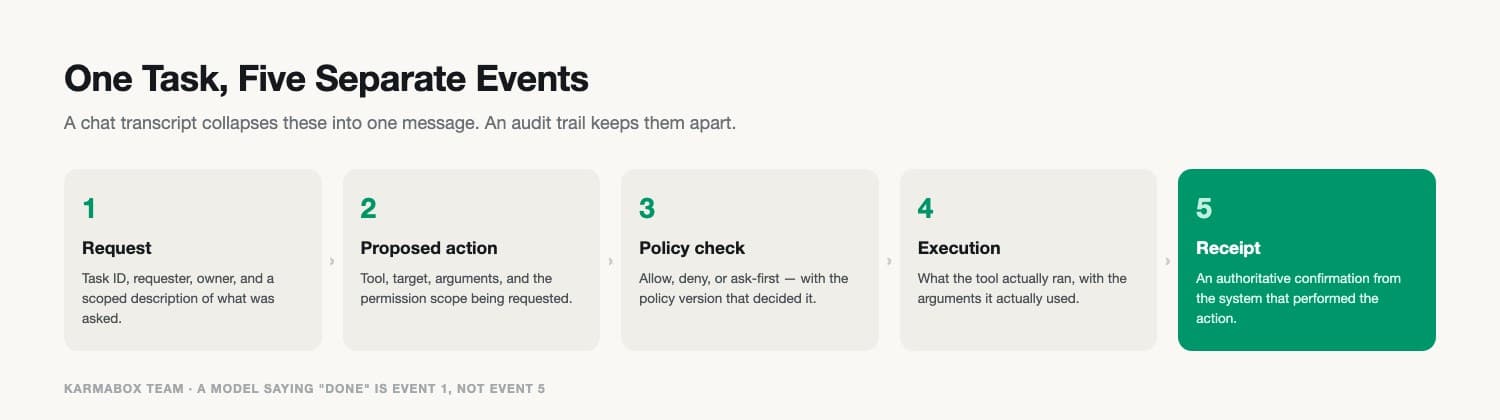
Auditability and explainability answer different questions
Auditability asks what happened and what evidence supports it. Explainability asks how a result can be understood, including relevant inputs, limitations, and decision criteria. The two support each other, but an event log is not a complete explanation of a model's internal computation. Likewise, a polished explanation is not proof that a tool used the stated input or that a human approved the action described.
Do not require hidden chain-of-thought as the foundation of accountability. Instead, record the task, the sources actually supplied, the policy checks, the structured decision, and the observed result. Where a reason is useful, capture a concise explanation tied to evidence and label whether it came from a model, a rule, or a human. Generated reasoning can be incomplete or misleading and should not replace independently recorded execution facts.
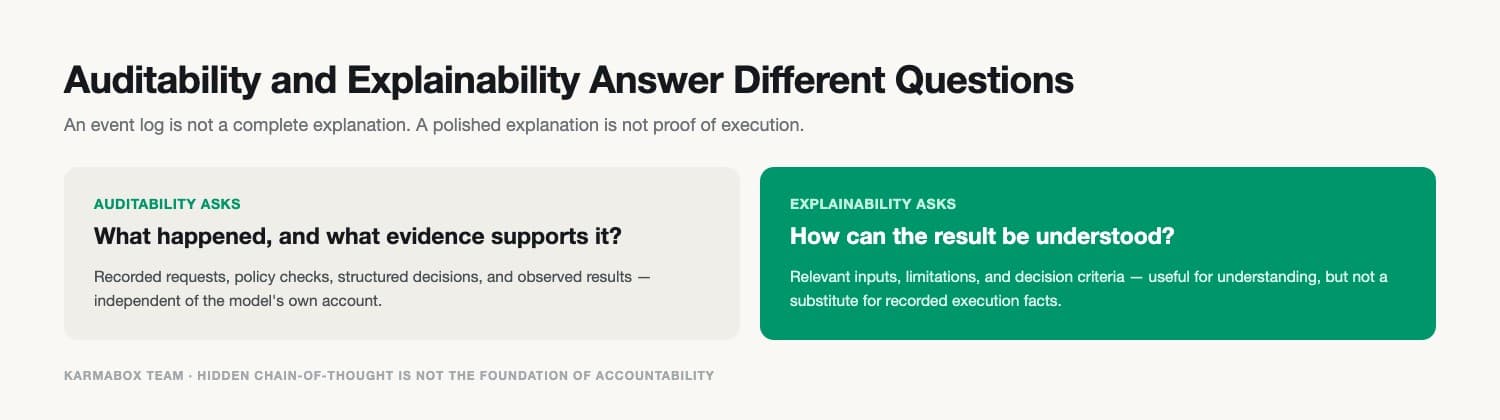
One task can cross several systems
An agent may retrieve documents, call a model, request approval, invoke a business tool, and delegate work to another agent. Each component can generate a different identifier and clock. Use a common task or trace identifier plus parent-child relationships to connect events. Preserve original service identifiers as well. Without correlation, a folder full of technically detailed logs can still fail to answer which tool call belonged to which user request.
What to record
The request and its accountable owner
Record the task identifier, request time, initiating user or service, organizational context, and a scoped description of the requested work. Distinguish the person requesting a task from the person accountable for the underlying business process. A scheduled agent may have no human pressing a button at execution time, but it should still have an owner, an approved purpose, and a reference to the configuration that authorized the schedule.
Keep the original request or a controlled reference where necessary, rather than allowing a later model summary to become the only record of what was asked. If the request contains sensitive information, separate protected content from general operational metadata. Reviewers should be able to understand the task without every support engineer receiving unrestricted access to customer documents or employee conversations.
The agent and the configuration that actually ran
Record a stable agent identifier, the software or workflow version, selected model identifier, serving provider, and relevant configuration version. Preserve the template or policy version used for the task, not merely whatever version is current when someone investigates later. If routing changes the model midway through execution, create a new event with the reason and destination. A single generic label such as "assistant" is not enough to distinguish materially different deployments.
For local deployments, record the model artifact or approved version reference and runtime details needed for investigation. For hosted services, record the model identifier the service exposes and note any versioning limitations. Do not promise exact reproducibility when the provider can change an alias or the computation is nondeterministic. The record should accurately describe the evidence available, including uncertainty about components outside your control.
Sources and the information boundary
Identify documents, retrieved passages, database versions, or other sources supplied to the model when they matter to the outcome. Record provenance and relevant access checks. A source link alone may become useless if the page or record later changes, so use versioned references or appropriately protected snapshots where justified. Avoid copying whole repositories into logs when a narrower evidence record can support the same review.
Record the destination of material sent outside the current trust boundary. That may be a cloud model, a remote tool, or another organizational workspace. The event should connect the destination to the applicable data policy and approval, without unnecessarily duplicating the payload. This makes it possible to investigate not only whether an answer was correct, but also whether the information was processed in an authorized place.
Proposed actions and executed tool calls
Store the proposed action separately from the execution event. Include the tool name and version, target resource, validated arguments or a protected reference, requested permission scope, and execution identifier. Record argument changes made by validation or human review. If the agent proposed sending a document to three recipients but the approved call used only one, the record should preserve that distinction rather than overwriting the proposal.
Use explicit statuses such as proposed, denied, approved, started, completed, failed, or outcome unknown. The exact vocabulary can vary, but its meaning must be consistent. A timeout should not automatically become a failure, because the downstream system may have completed the action. Record retries and reconciliation checks. This matters especially for payments, messages, record updates, or any operation where repeating an uncertain action can create another problem.
Results and receipts from the system of record
Capture the response status and an authoritative reference from the tool or business system. Where appropriate, include the resulting record version, transaction identifier, or job status. Preserve error codes and the distinction between a transport success and business acceptance. A model-generated statement saying "done" should be presented as a communication event; it should not be the only evidence that an external action succeeded.
Connect corrections to the original action. If a person reverses an update or an agent issues a compensating transaction, record who did so, why, and which earlier event it addresses. Do not silently replace the old record with a cleaner story. An audit trail is useful partly because it preserves the difference between what first happened and how the organization later corrected it.
Human approval and permission records
An approval record should describe what the person actually saw and authorized. Capture the approver identity, decision time, proposed action reference, scope, conditions, and expiry where relevant. Bind approval to the content and target that will be executed, using a version or digest where appropriate. A general instruction to "help with customer email" should not be represented as approval of every recipient, attachment, and future message.
Approval and authorization are different controls
Human approval expresses a decision about a proposed action. Authorization determines whether the actor is allowed to perform it. Both may be necessary, and neither automatically substitutes for the other. Record the policy version, relevant role or scope, and allow or deny decision from the enforcement layer. A person cannot safely approve beyond their delegated authority, and a technically permitted action may still require a separate business approval.
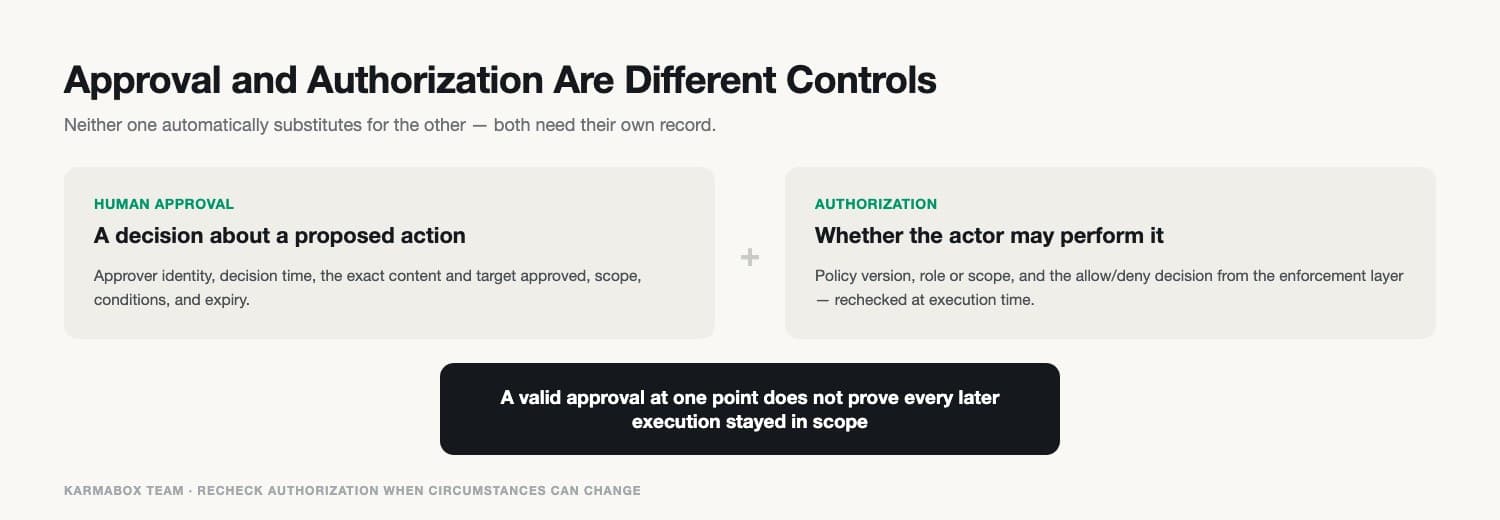
Recheck authorization at execution when circumstances can change. Access may have been revoked after the proposal, the target may have changed, or approval may have expired. Record the result of that check and any decision to stop. This closes a common evidence gap: a valid approval at one point does not establish that every later execution was within the same permission boundary.
Identity establishes who acted not what they may do
A verifiable agent identity can help connect a request to a known actor or key. It does not by itself grant permission, prove honest behavior, or establish that a claimed result happened. Record identity verification separately from authorization and execution evidence. If an agent delegates work, capture the parent task, receiving agent, delegated scope, and returned receipt so responsibility does not disappear at the handoff.
KarmaBox's guide to sovereign AI for individuals and teams provides broader context for separating these concerns[7]. For a particular deployment, confirm the available permission and audit features in the KarmaBox documentation. This article proposes evaluation criteria; it does not claim that every suggested record or integrity control is already implemented in every KarmaBox configuration.
What the EU AI Act requires and when
Under the consolidated AI Act[1], Article 12 concerns automatic record-keeping capabilities for high-risk AI systems; Article 13 concerns transparency and instructions to deployers; Article 14 addresses human oversight. Articles 19 and 26(6) address provider and deployer retention of automatically generated logs under their control, with an appropriate period of at least six months unless applicable law provides otherwise. These are scoped obligations, not a universal six-month rule for every chatbot record. "Must be retained" only answers whether a log exists; who can compel its production in litigation or an investigation is a separate question, covered in are AI chat logs discoverable.
The adopted Digital Omnibus on AI, Regulation (EU) 2026/1744[2], was dated July 8, published July 24, and entered into force July 27, 2026. It sets application of the relevant Chapter III high-risk provisions for December 2, 2027 for Article 6(2)/Annex III systems and August 2, 2028 for Article 6(1)/Annex I systems, subject to the text's exceptions and transitional rules. Those are adopted dates, not merely the earlier political agreement.
Gibson Dunn's May 27, 2026 note[4] discussed the provisional agreement and expressly distinguished it from formal enactment. It is useful historical commentary, but the final text controls this article's deadline summary. Article 50 transparency duties follow a different schedule; the high-risk postponement should not be described as postponing the entire Act. The Commission's implementation timeline[3] explains the separate milestones.
Ask qualified counsel to determine the system's classification, your role, and any applicable transition provisions. General agent logging remains useful even where a particular AI Act provision does not apply. Conversely, an engineering checklist cannot satisfy every obligation on its own. The Chinese edition discusses the same EU framework and does not present these dates as Chinese legal requirements or a global compliance timetable.
Protocol logs are a starting point
Agent protocols can provide request identifiers, task state, and structured logging messages, but applications must connect them to business evidence. The MCP task specification dated November 25, 2025[5] discusses task-linked operations and audit considerations. Treat that as a versioned protocol reference, not proof that adopting MCP automatically gives an application durable, complete, or tamper-evident audit records.
Version changes matter. The official MCP July 28, 2026 changelog[6] describes logging being removed from the protocol core, with standardized tracing fields or external observability tooling recommended instead. A deployment should test its actual negotiated protocol and SDK behavior rather than assuming logging subscriptions or callbacks work as they did previously. Verify that important events reach durable storage, that dropped messages are detectable, and that business receipts are captured independently of optional diagnostic logs.
Separate observability from audit requirements. Debug logs help developers diagnose performance and failures; an audit record supports a defined accountability question. Debug verbosity may be reduced in production, but approvals and consequential action outcomes still need the intended coverage. Design a small set of required events and measure their completeness. Do not make evidence of a customer-impacting action depend on someone remembering to enable a verbose troubleshooting mode.
Keep the evidence trustworthy and proportionate
Restrict who can write, read, export, and delete audit records. Separate production action permissions from audit-store administration where practical. Use append-oriented storage, controlled retention, and integrity mechanisms appropriate to the risk. A hash or signature can help detect certain changes, but it does not prove that the original event was truthful or complete. Protect the capture process, signing keys, and access records as well as the stored file.
Use synchronized timestamps and preserve event sequence information, while acknowledging that distributed clocks can differ. Record delayed delivery and collection failures. If logging is unavailable, decide in advance which actions may continue and which must pause. A low-risk draft and a consequential account change may justify different behavior. The logging service itself is a dependency, so include its failure modes in the agent's operating plan.
Log references instead of secrets
Do not place passwords, access tokens, private keys, or unnecessary personal information in general logs. Use redacted values, protected object references, or narrowly scoped evidence stores. Make sure redaction occurs before sensitive content reaches broad-access logging infrastructure. Retention periods should follow the purpose, applicable obligations, and documented exceptions. Keeping every payload forever can turn an accountability system into an unnecessarily large collection of sensitive material — the same failure mode covered in AI agent data leakage, where the log itself becomes another leak path.
Give reviewers the least access necessary for their investigation. A support engineer may need a task status and error code, while a designated reviewer may need protected source content. Log access to the audit system itself and make exports traceable. Where a dispute or investigation requires preservation, handle that through an authorized exception process rather than quietly disabling deletion across all records indefinitely.
A worked example of an agent receipt
Consider a hypothetical agent preparing a supplier email. It retrieves an approved purchase note, drafts the message, and proposes attaching a pricing sheet. A policy check blocks the attachment because the recipient is external. A manager approves the revised message without that file, and the mail service accepts it. The audit trail should connect the request, source version, blocked proposal, revised content, approval, tool execution, and mail-service receipt.
The reviewer should be able to answer a precise question: was the restricted file sent through this workflow? A denied proposal and an executed call without the attachment provide useful evidence, while the downstream receipt confirms the accepted message identifier. If the mail service does not report final delivery, the record should say accepted, not delivered or read. This example is illustrative and does not represent a measured KarmaBox transaction.
Test the audit trail before relying on it
Run controlled exercises with synthetic data. Include a normal action, denied permission, expired approval, changed arguments, tool timeout, retry, cancellation, and delegated task. Ask a reviewer who did not build the system to reconstruct each case from the stored evidence. Record which questions remain unanswered. A dashboard showing many events is not sufficient if the reviewer cannot connect a human decision to the action that actually executed.
Measure completeness as well as volume. Check that every consequential action has an owner, authorization result, execution identifier, and appropriate outcome evidence. Detect orphan events and missing receipts. Define how long evidence takes to become searchable and whether access controls survive export. Repeat these checks after model, tool, SDK, or routing changes, because the workflow can change without the logging dashboard visibly breaking.
Design an audit record people can actually use
Begin with the question a reviewer needs to answer. A finance reviewer may need to know who approved a change and whether the amount matched that approval. A security reviewer may need to know which resource an agent accessed and under which credentials. A customer-support reviewer may need to reconstruct the sequence that produced an incorrect message. These questions overlap, but they do not require identical access to every field or the same presentation of the evidence.
Provide a readable summary linked to the underlying events. The summary can explain the task, approval, execution, and outcome in ordinary language, while the event details preserve identifiers and technical evidence. Make clear when the summary was generated and which records it references. If a model produces the summary, treat it as an aid for navigation rather than the authoritative source. Reviewers should be able to check each consequential statement against the original record.
Define the minimum event schema
A practical event can include an event ID, task ID, parent event ID, timestamp, actor, event type, target, policy reference, outcome, and evidence reference. Additional fields depend on the action. An approval event needs the decision and approved scope; an execution event needs the tool invocation and resulting status. This is a proposed design pattern, not a required legal format or a claim of compatibility with every agent framework.
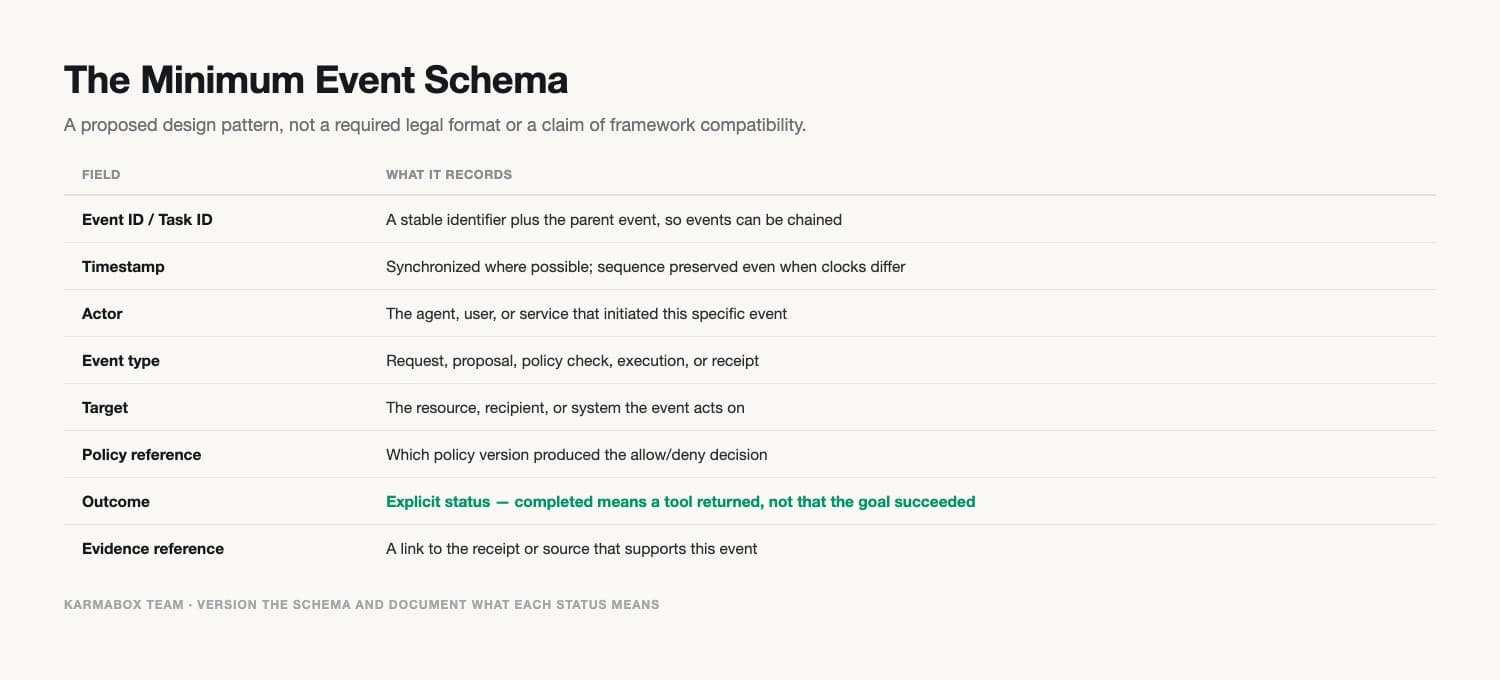
Version the schema and document what each status means. If completed means only that a tool returned, do not let a downstream report interpret it as proof that the business objective succeeded. Preserve distinctions when integrating several services with different terminology. Explicit semantics make later investigation easier and reduce the temptation to infer a positive outcome from an ambiguous field name. They also help automated checks identify missing evidence without judging the content of every interaction.
Assign responsibility for evidence gaps
When a required receipt is missing, route the exception to someone who can reconcile it with the business system. Do not ask the model to guess what happened and then store that guess as closure. Mark the uncertainty, preserve the available references, and record the later investigation. If an event cannot be reconstructed, that limitation is itself useful evidence about the system's control quality and should inform whether similar actions remain appropriate for automation.
Review audit quality as part of ordinary operations. Track missing approvals, unresolved outcomes, collection failures, and time needed to assemble a case. Look for repeated gaps at the same connector or handoff. Start with a manageable set of consequential actions and improve coverage where the evidence shows a need. A maintained, understandable record for important work provides more accountability than indiscriminate logging that nobody can interpret or safely access.
Frequently asked questions
Is a chat transcript an AI agent audit trail?
Not by itself. It records conversation but may omit permission checks, tool arguments, approvals, retries, and confirmed outcomes. Link the transcript to structured execution events and authoritative receipts where those facts matter.
Must every agent log be kept for six months?
No. The AI Act's relevant retention provisions concern specified high-risk systems and logs under the provider's or deployer's control, with applicable-law qualifications. Determine the actual obligations and use a documented retention schedule rather than applying one period indiscriminately.
Should logs include the model's hidden reasoning?
An audit trail should prioritize requests, evidence, policies, approvals, actions, and observed results. A concise decision explanation can help, but it is not proof of internal computation or successful execution. Hidden reasoning is not a substitute for independent action records.
Does MCP automatically provide an audit system?
No. Protocol identifiers and logs can support correlation, but the application still needs durable capture, access control, retention, integrity measures, and business receipts. Verify the behavior of the exact protocol and SDK versions in use.
What is the best first step for a small team?
Choose one consequential action and record its requester, agent version, permission decision, human approval where required, tool execution, and result receipt. Test whether another authorized person can reconstruct the event before expanding the design.
About the author and review
Karma Box Team publishes practical guides to agent control and deployment. This article synthesizes the cited legal texts and protocol documentation; it does not report a product certification or completed legal review. Sources checked November 12, 2026. A qualified legal reviewer should confirm classification and dates for the intended deployment, while an engineering reviewer should validate actual logging behavior before product-specific promises are published.