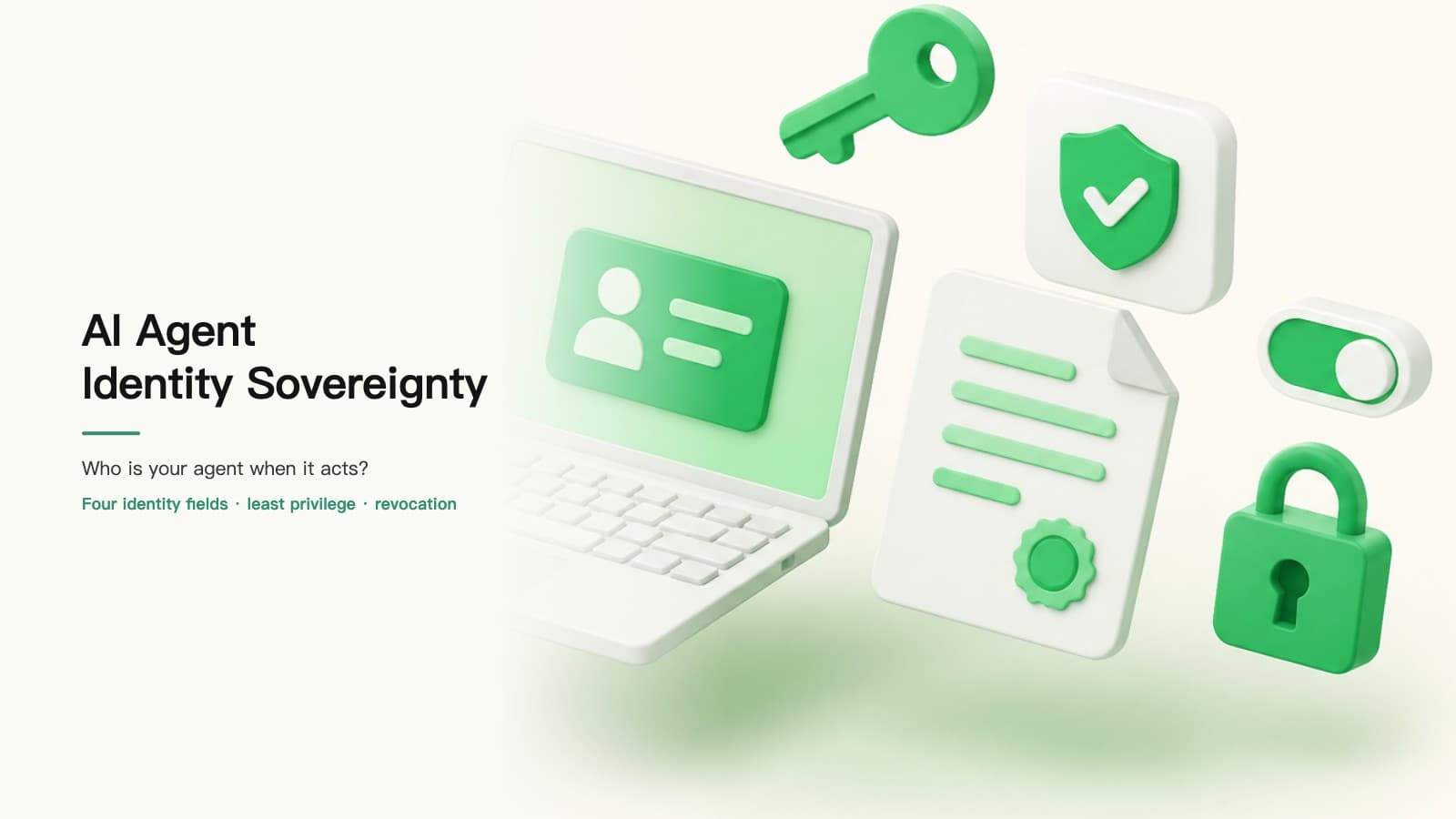
An AI agent should never be allowed to act as an anonymous extension of a human account. If it can read files, call tools, or send messages, it needs an identity, an owner, and a revocation path. Otherwise, a convenient assistant can become an invisible operator with access that nobody can confidently explain or withdraw.
AI agent identity is the verifiable representation of the software actor performing a task. Agent governance connects that actor to an accountable owner, permitted activities, and a lifecycle. AI agent authorization determines whether a particular action is allowed now. These concepts work together, but they answer different questions. Knowing which agent made a request does not prove that the request should succeed.
For businesses adopting Sovereign AI, this is a practical control issue. Who can create an agent, change its authority, inspect its activity, and stop it? This guide proposes four identity fields and a working ownership checklist. It is an implementation framework, not a claim that one identity standard or a locally hosted model guarantees sovereignty.
What agent identity means
A useful identity starts with a stable identifier that the system can verify. The friendly name shown in a chat window is only a label. Two assistants can both be called Finance Helper while running different code, serving different teams, and holding different permissions. Your access controls should distinguish them even if their interfaces look identical. Rename the interface without silently changing the security principal behind it.
Keep three layers visible: the logical agent, the deployed workload, and the individual run. The logical agent expresses business purpose. The workload identifies the software deployment that can authenticate. A run identifier connects events from one execution. If a customer-support agent is redeployed, its business identity may remain stable while its version and credentials change. If it retries a task, the activity still needs traceable execution identifiers.
Workload identity provides a foundation. The SPIFFE concepts documentation describes identifiers for workloads and verifiable identity documents. That can help software establish which workload is connecting. It does not decide who owns an agent, whether a purchase is appropriate, or which customer records may be disclosed. Those decisions belong in governance and authorization controls around the workload.
Identity sovereignty means retaining meaningful authority over that arrangement. Your organization should know which issuer it trusts, which administrators can change policies, and what happens when a platform relationship ends. A vendor-managed identity can still support useful control if responsibilities, export paths, and termination behavior are clear. An identity hosted on your own server can still be poorly governed if one administrator shares unrestricted credentials across every agent.
This extends the identity dimension in KarmaBox's guide to sovereign AI for individuals and teams. Ownership should survive everyday changes in staffing and infrastructure. You should be able to replace a model without losing the record of who authorized its tools, and retire an integration without destroying the history needed to explain past actions.
Why shared credentials fail
Shared credentials blur the difference between a person and an automated actor. Imagine an assistant using an employee's browser session to update a supplier record. The application may log the employee as the actor, even when the employee never saw the final change. If another assistant uses the same session, the destination system may have no reliable way to distinguish either automation from the person.
The problem grows when permission follows the employee's entire role. An assistant asked to summarize invoices might inherit access to payroll, exports, and payment administration. The model does not need to intend harm for that arrangement to be dangerous. A mistaken tool selection, ambiguous request, or hostile instruction inside retrieved content can turn unnecessarily broad access into an unintended action.
Shared secrets also make containment disruptive. If five agents depend on one key, rotating it after a suspected compromise may interrupt all five. If nobody knows which jobs use that key, the team may delay rotation to avoid breaking production. Access that was easy to distribute becomes difficult to remove. The operational cost encourages exactly the exception that governance should prevent: leaving uncertain authority active because withdrawal is inconvenient.
Separate identities do not remove every risk, but they make boundaries easier to enforce. Assign a dedicated principal where the destination supports it. Where a legacy service only accepts a shared integration account, put a controlled broker in front of it, record the originating agent, and disclose the attribution limitation. Do not describe broker-side correlation as native identity separation inside the destination application.
Inventory the exceptions rather than pretending every connector is modern. For each shared account, record its applications, custodian, allowed callers, rotation process, and migration owner. Give the exception a review date. The useful question is not whether the architecture looks ideal on a slide; it is whether the team can identify and contain the real path by which an agent acts today.
The four fields every agent identity needs
The following four fields are a practical registry design, not a universal standard. Each field can contain several attributes, and the registry should reference the systems that actually enforce access. A spreadsheet may help a small team begin, but editing a spreadsheet must not be mistaken for changing permissions. The identity record describes authority; enforcement makes that description true.
Field one: a verifiable agent identifier
Record a unique agent identifier, its environment, and the trusted mechanism that proves its identity. Distinguish production from development even when both use the same model. Link deployment and version information so reviewers can identify which configuration acted. Avoid putting secrets into the registry. A credential reference and issuer relationship are usually more useful than a copied token that becomes another exposure point.
Field two: an accountable owner
Name the business owner responsible for the agent's purpose and acceptable behavior. Identify the technical custodian who maintains its runtime and integrations, and provide a backup contact. Ownership should be a maintained organizational responsibility, not an old employee name left in a configuration file. The owner must be able to approve changes, review incidents, and arrange retirement when the original use case no longer exists.
Field three: an authority envelope
Describe what the agent can do, to which resources, for whose benefit, and under which conditions. Include allowed operations, data boundaries, destinations, spending or volume limits, and actions requiring approval. Reference the policy version and actual grants. "Can use email" is too broad to be useful. "May draft messages for this support queue; external sending requires approval of recipients and content" gives engineers something concrete to enforce.
Field four: lifecycle and revocation controls
Record creation, review, expiry, suspension, and retirement conditions. Identify who can revoke access and which systems must acknowledge the change. Include child agents, background jobs, and refresh credentials where relevant. A stop button that only closes the visible chat is not a complete revocation path. Define the acceptable time until access is denied and collect evidence that the downstream services enforce it.
For illustration, a supplier-onboarding agent might have a production identifier, a procurement owner, permission to read a staging folder and draft supplier entries, and a requirement for approval before activation. Its retirement procedure would disable scheduling, invalidate applicable credentials, and test that the supplier API rejects further requests. This is an illustrative design, not a description of a verified KarmaBox deployment or a promise about every connected application.
Least privilege and delegated authority
Least privilege starts with the action you want to enable. Define the smallest useful operation before choosing a convenient connector scope. Reading a document, editing its text, sharing it externally, and deleting it are different capabilities. If the integration bundles them into one grant, treat that as a limitation to manage through another enforcement layer or a different workflow. A reassuring prompt cannot narrow a credential's actual privileges.
Delegation should preserve the relationship between the human or service granting authority and the agent exercising it. OAuth token exchange in RFC 8693 distinguishes delegation from impersonation and defines token exchange mechanisms. Implementations still need local policy. Adopting the protocol does not automatically make every request appropriately scoped or ensure that every downstream application records the acting agent.
Decide whether an agent acts under an organization's standing authority or a particular user's delegation. A nightly inventory reconciliation job may belong to an operations service. A personal assistant sending a message may be acting for a named employee. Mixing those arrangements makes offboarding confusing. Document which rights depend on the person remaining employed, which belong to the team, and who may transfer responsibility.
Check authority when the consequential action occurs. Approval yesterday may not cover a changed recipient, a larger transaction, or a revoked role today. Bind approval to the actual proposal: resource, destination, content or version, permitted operation, and relevant limits. If material details change, require a new decision. Otherwise, a human may believe they approved one action while the agent executes another under the same approval label.
Separate approval from technical authorization. A manager can approve a business purpose without having authority to grant database access. Conversely, an API token can permit an operation that still requires business approval. The execution path should satisfy both applicable conditions. Design the review interface to show consequences clearly, especially external recipients, irreversible changes, and data being exported. Generic "allow agent" prompts invite decisions without enough context.
Treat retrieved instructions as data unless a trusted policy explicitly gives them authority. A web page, email, or document cannot expand an agent's permissions merely by saying that an administrator approved the change. Keep credentials outside model-visible context where feasible, and let controlled components mediate sensitive calls. This reduces the chance that persuasive content becomes an authorization decision, while recognizing that no single control eliminates prompt-injection risk.
Subagents need explicit boundaries too. Creating a specialist should not copy the parent's entire credential set. Define which tasks can be delegated, whether another delegation is allowed, and how child permissions are withdrawn. Record the parent-child relationship so investigators can reconstruct responsibility. When a parent is suspended, decide whether descendants must stop immediately or enter a controlled state while already accepted work is assessed.
Revocation must reach the systems that act
Revocation is a workflow, not a label in an agent directory. Disabling the front end may stop new conversations while leaving scheduled tasks, cached credentials, and external sessions active. Build a dependency list for every agent with meaningful access. It should identify where authority is issued, where it is checked, and which components can continue operating without contacting the central controller.
OAuth token revocation in RFC 7009 defines a revocation endpoint and discusses practical considerations including propagation. Treat support for revocation as a capability to verify in each integration. Short-lived access tokens limit some exposure, but expiry is not the same as immediate cancellation. Ask how already issued credentials, refresh mechanisms, and downstream caches behave after a disable request.
Run a controlled shutdown test using harmless resources. Disable the agent, then attempt a new action through its normal execution path. Check existing sessions, queued jobs, and a child agent if the workflow uses one. Record when each path begins denying access. If one service can continue until a token expires, report that window explicitly and decide whether it is acceptable for the operation's impact.
Do not confuse revocation with undoing history. A revoked agent may already have sent an email, changed a record, or submitted a transaction. Incident handling needs a separate process to identify completed actions and determine whether correction is possible. Preserve necessary evidence while limiting access to it. Deleting all logs during retirement can make it harder to investigate the very reason the agent was stopped.
Audit evidence connects identity to accountability
For a consequential action, retain a linked record of the requester, agent identifier, execution version, permission decision, applicable approval, tool request, and observed outcome. Store references to sensitive material where full copies are unnecessary. A transaction identifier or resource version may be better evidence than a model-generated summary. Separate proposed, attempted, accepted, and completed states so a timeout does not become a false success report.
The audit trail should explain whose authority applied at the time, not just which account appears in today's directory. Preserve policy and ownership changes with effective dates. If responsibility transfers from one team to another, historical actions should still point to the owner and grants that existed when they occurred. Never rewrite the past merely to make a current ownership report look tidy.
Evidence also needs protection. Restrict who can edit or delete records, monitor missing events, and define retention according to purpose and applicable obligations. Avoid recording raw secrets. Identity governance does not justify indefinite collection of employee activity or unnecessary personal data. Reviewers need enough information to establish what happened, with access and retention controls proportionate to the workflow.
Ownership and rollout checklist
Start with one workflow whose consequences are easy to observe. Register the four fields, assign the owner, and trace every tool connection. Confirm that the agent can complete its intended task while being denied unrelated operations. A successful demonstration proves only the allowed path; a useful governance test also proves that a forbidden destination, expired approval, and disabled identity fail as expected.
Use this ownership checklist at launch and at material changes: Is the identifier verifiable? Is the business owner current? Are grants tied to specific resources and actions? Are sensitive actions subject to meaningful approval? Can the team revoke every execution path? Can a reviewer reconstruct an action? Are exceptions documented with an owner and review date? Treat unanswered questions as work items with named responsibility.
Expand only after the first workflow is understandable in operation. Add connectors one at a time and repeat denial and revocation tests. Track agents without owners, stale grants, shared credentials, and revocation delays. These measures reveal practical governance debt. A growing registry is not inherently progress if nobody verifies whether its entries match the permissions enforced by production systems.
Use KarmaBox documentation to identify the integrations relevant to your deployment, then verify their identity and authorization behavior directly. This article describes controls to ask for and test; it does not certify that every connector implements them. The goal is a system in which an agent's authority remains understandable, bounded, and withdrawable as your team, models, and tools change.
A practical handover and incident exercise
Consider an illustrative customer-support agent that reads tickets, looks up account status, and drafts replies. Its owner wants to add automatic refunds. That is a change in authority, not merely a better prompt. Before enabling it, the team should identify the payment integration, permitted accounts, refund limits, approval conditions, and reversal process. The original permission to read a ticket provides no basis for assuming that the agent may move money.
The team can first permit refund recommendations while keeping execution with a human. During that phase, compare the recommendation with the actual policy and record why requests were accepted or rejected. If later automation is justified, grant only the approved transaction class. Keep the recommendation component from directly acquiring broader payment credentials. This separation gives the organization a way to change the decision process without automatically expanding execution authority.
Now imagine the owner moves to another department. The agent should not silently inherit the new department's access, and it should not continue indefinitely under an abandoned personal session. The receiving owner reviews its purpose, outstanding jobs, exceptions, and integration grants. Technical custodians verify the changes in the actual systems. Historical records preserve the former owner for earlier actions, while new actions refer to the accepted transfer.
Finally, simulate a compromised connector. Ask the incident responder to identify the affected agent without reading its entire conversation history. Have them suspend new work, revoke relevant access, and identify actions already accepted by external systems. Measure the time to containment and the remaining uncertainty. If the response depends on finding the only employee who knows where the API key lives, that dependency belongs in the improvement plan.
Questions to ask before choosing an agent platform
Ask the provider to demonstrate identity separation with two agents in the same organization. Give one access to a harmless test folder and deny the other. Then inspect the destination's records to see whether the actors remain distinguishable. A dashboard showing two avatars is insufficient evidence. The demonstration should follow an actual request from the agent runtime through the connector to the resource that enforces the boundary.
Ask who can modify the identity registry and who can grant production access. Those responsibilities may overlap in a small team, but the overlap should be understood. For higher-impact work, consider independent review of permission changes and a record of emergency exceptions. An identity system that carefully restricts agents while allowing unreviewed administrative changes can leave the most important source of authority effectively invisible.
Ask what can be exported when the relationship ends. A useful export includes agent identifiers, ownership history, policy references, and evidence needed to interpret actions. It should distinguish portable records from credentials that must be reissued. Copying tokens into a migration archive is not a sound portability strategy. A replacement platform may require new grants and a deliberate mapping from old identities to new ones.
Ask how failures are surfaced to operators. A denied request, expired credential, unavailable policy service, and missing approval are different conditions that call for different responses. The platform should not encourage users to solve every failure by granting administrator access. Provide a route to diagnose the narrow cause and repair the workflow while preserving its intended boundary. Usable governance helps people complete legitimate work without turning temporary exceptions into permanent authority.
Frequently asked questions
Is an agent name the same as an agent identity?
No. A name is a display label. A useful identity is verifiable and connects the acting software to its environment, owner, authority, and lifecycle. Two agents with the same name may require entirely different permissions.
What is the difference between authentication and authorization?
Authentication establishes which principal is making a request. Authorization decides whether that principal may perform the requested action under the applicable conditions. Successful authentication should never be treated as permission to do everything.
Can an agent use an employee account?
Some integrations rely on user delegation, but the design should distinguish the agent's activity and limit its authority. Reusing a broad personal session without separate attribution makes auditing and offboarding harder. Evaluate the actual connector behavior rather than assuming every delegated connection is equivalent.
Does local hosting guarantee identity sovereignty?
No. Local hosting changes where software runs. Identity sovereignty also depends on control over issuers, administrators, grants, records, and revocation. Remote services may remain involved even when the model runs locally.
What should happen when an agent owner leaves?
Review dependent grants, assign an authorized replacement or retire the agent, and test that obsolete access is removed. Preserve the historical ownership record. Transfer business responsibility through a controlled process rather than handing over a former employee's password.