A new AI model can make an assistant faster, cheaper or better at a task overnight. On November 9, 2026, Anthropic released two new models and cut its top-tier input price, and Meta released a low-cost model built for agents, all on the same day. For a team whose daily work runs through AI agents, a day like that raises a practical question: if the model underneath changes, what happens to everything the team has already built on top of it?
The answer depends on where that work lives. An AI model is the engine that reads a request and produces a response; it is trained and served by a vendor, and the vendor decides when it improves, how it is priced and when it is retired.
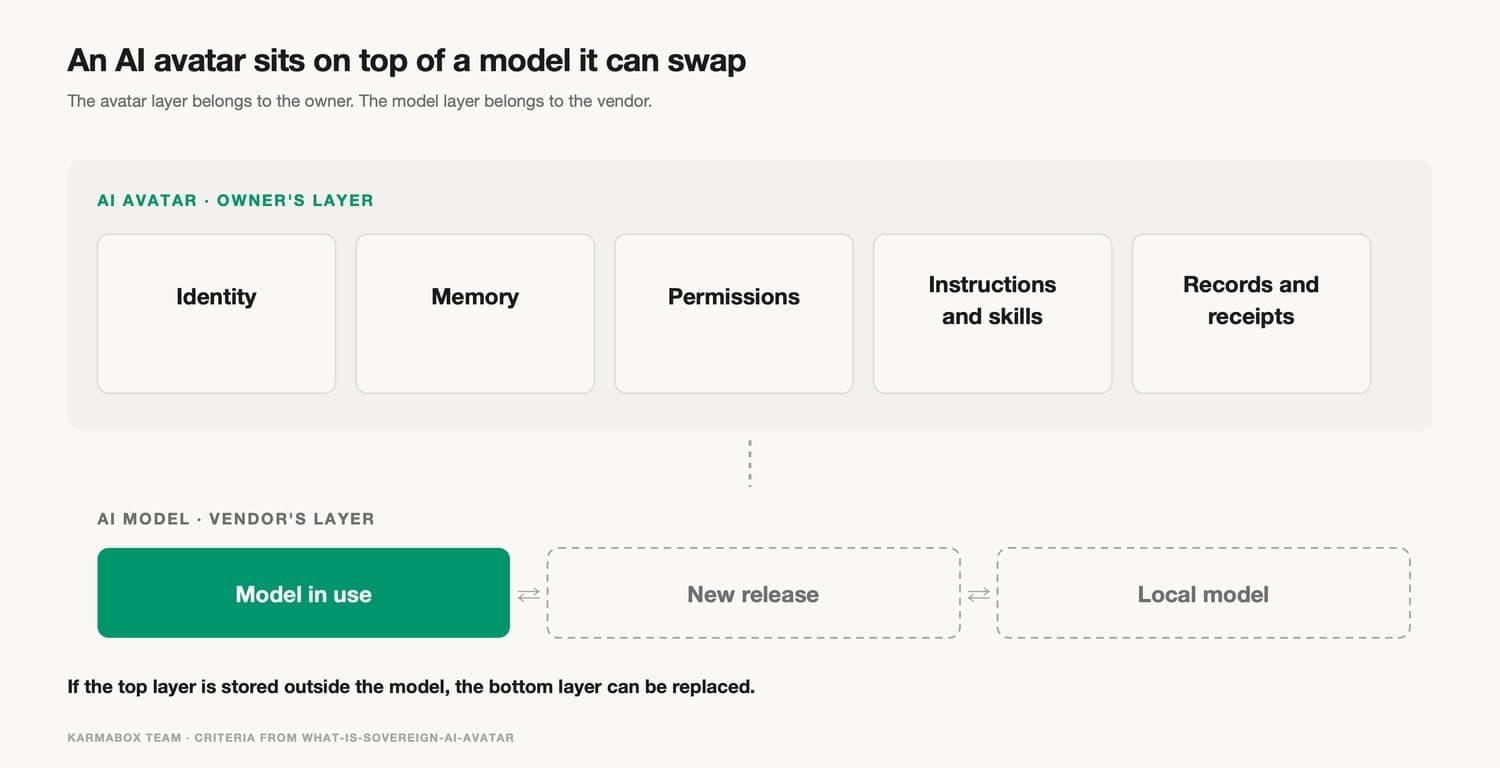
An AI avatar is the working agent built around a model: its name and identity, the memory it has accumulated, the permissions its owner set, its instructions and skills, and the record of what it did. When those things are stored outside the model, they can stay in place while the model is swapped. When they are stored inside a vendor's product, they tend to change or disappear with it.
Keeping the avatar separate from the model is necessary, but it is not enough. A new model reads the same memory and the same instructions in its own way, and some behaviour changes even when every setting stays put. This guide explains the difference between the two layers, why model changes have become routine, what changes in a switch, where the layers leak, how to decide whether to switch, and how to test a new model before relying on it. Products and vendors are named as examples, not as a ranking.
01The difference between an AI avatar and an AI model
Most people meet both layers at once, inside a chat app, and never have reason to separate them. The app has a model, a conversation history, maybe a memory feature and a few settings. Everything feels like one product. The separation only becomes visible when something changes: the vendor ships a new default model, a feature moves to a paid tier, or a team decides to move some of its work to a different provider.
The model is the part that does the reasoning. Given text, images or audio, it predicts a useful response, and in agent setups it also decides which tool to call next. It has a capability profile, a characteristic tone, a price per token (the unit vendors use to meter text in and out) and a set of usage terms. None of those belong to the user. They belong to whoever trains and serves the model.
The avatar is the part that does the job. It is the agent a team names, assigns to a kind of work, gives access to certain folders and accounts, and checks on next week. What separates an AI avatar from a chatbot is an identity, a boundary, persistent memory and a receipt for each piece of work. This guide takes those properties as given and looks at the model underneath them.
A sovereign AI avatar is an avatar whose owner keeps control of those layers: it runs on the owner's machines where possible, its memory is the owner's portable asset, and its permissions are set by the owner and judged outside the model. Those six criteria describe the target. For this guide, the consequence is this: if the avatar layer belongs to the owner, a model can be changed the way a team changes a supplier, with notice, testing and a fallback. If it does not, a model change can mean starting over.
02Why model changes have become routine
For most of 2023 and 2024, many teams picked one model and stayed with it for a year or more. That pattern is fading. Vendors now release new versions every few months, often in several sizes, and they recommend moving between them depending on the task. Prices move with each release. Older versions are retired to make room for new ones.
Anthropic's own explanation of retirement is unusually direct. In a November 2025 post on model deprecation, the company wrote that "retiring past models is currently necessary for making new models available and advancing the frontier, because the cost and complexity to keep models available publicly for inference scales roughly linearly with the number of models we serve."
In the same post it committed to preserving the weights of publicly released models, but preservation is not the same as keeping a model available to customers. A team that built its workflow around one specific version should expect that version to be withdrawn at some point.
The pace may also be accelerating. On November 5, 2026, the evaluation group METR published an independent assessment of AI research and development at Anthropic, based on access to internal data from August 12 to October 29, 2026. METR estimated that Anthropic is "likely improving the capabilities of their models on well-specified tasks at around twice the rate" it did between March 2024 and October 2025, and added that it "would not be surprised if the true acceleration was closer to 1.3x or 3x."
In other words, METR's benchmark measure suggests roughly two years of the earlier rate of progress happened in the last year (high uncertainty, and Anthropic redacted some of the evidence METR relied on most). If that holds even partly, the gap between releases is unlikely to widen.
Example: three model releases on November 9, 2026
November 9, 2026 is a clean example of what a routine week now looks like. Anthropic released Claude Fable 5.2 and Claude Mythos 5.2, which the company describes as the same underlying model with different safeguards; Fable is available to all users, while access to Mythos goes through verification programmes for cybersecurity and biomedical research.
Anthropic's announcement lists the new price as $8 per million input tokens and $40 per million output tokens (standard mode; a fast mode costs $16 and $80). TechCrunch reported that the previous Fable input price was $10, so the input price fell by a fifth.
The same announcement recommends switching rather than settling. "For most coding and knowledge tasks," Anthropic wrote, "we recommend that users start with Claude Opus 5.5, our strongest daily driver, and then switch to a different model as required, depending on the scope and complexity of their work, upward to Fable or Mythos, or downward to Claude Sonnet 5.5 or Claude Haiku 5.5." It also describes Fable acting as an "Advisor" that smaller models consult, or as an "Orchestrator" that hands simpler tasks down to them.
Meta released Muse Ember the same day. According to TechCrunch's report of Meta's announcement, Ember is priced at 10 cents per million input tokens and was "designed for complex reasoning execution and the work agents repeat all day: tool calls, coding subtasks, routing, extraction, and long document parsing." Meta summarised the intended pairing with its larger model in one line: "Muse Wonder plans, Muse Ember handles the volume." (The output price was not in the coverage reviewed for this guide.)
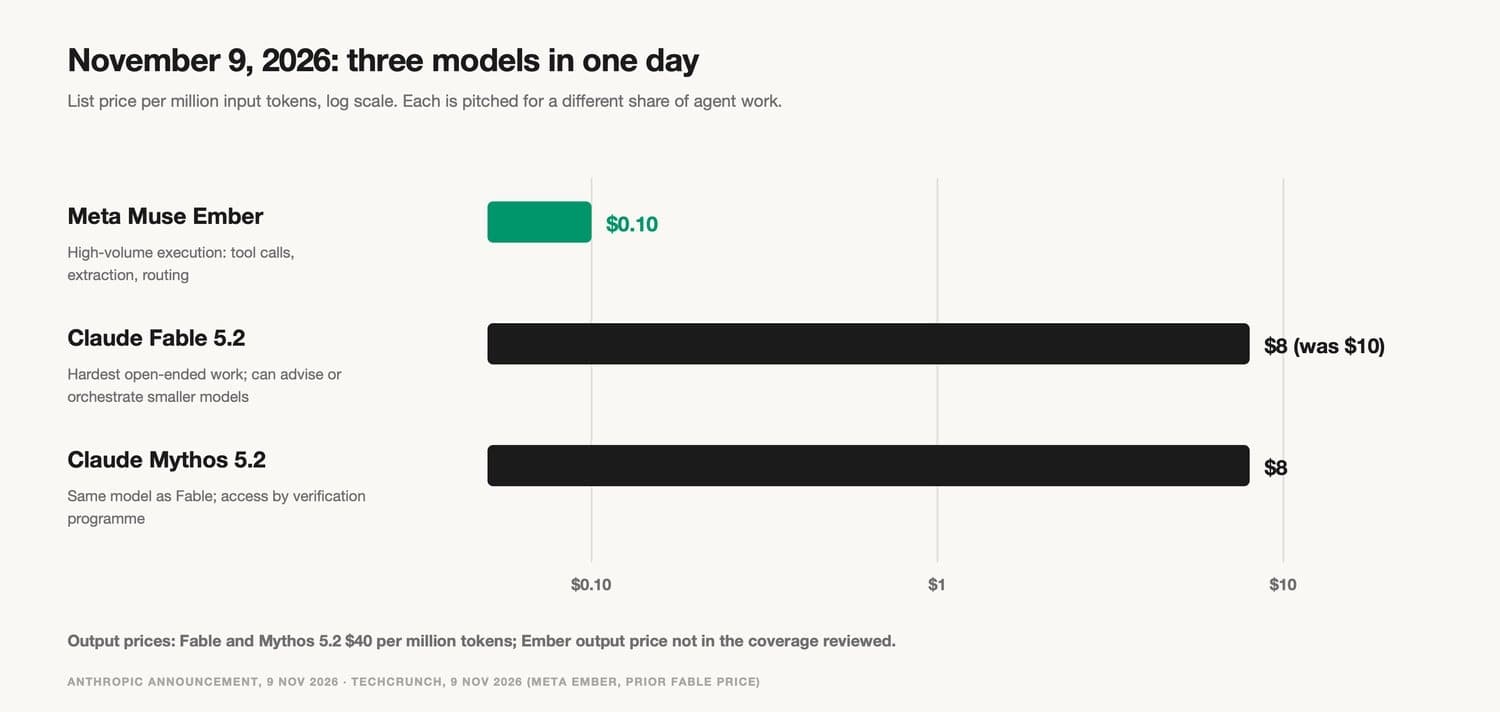
| Release (Nov 9, 2026) | Vendor's stated role | List price per million tokens | What it implies for a team running agents |
|---|---|---|---|
| Claude Fable 5.2 | Most ambitious, open-ended technical work; can advise or orchestrate smaller models | $8 input / $40 output (standard mode) | Hard tasks may move up to it; routine work is expected to move down |
| Claude Mythos 5.2 | Same model as Fable, fewer safeguards, access by verification programme | $8 input / $40 output | Not a general option; only relevant to approved security or biomedical work |
| Meta Muse Ember | High-volume execution: tool calls, extraction, routing, parsing | $0.10 input (output not reviewed) | The vendor itself splits planning and execution across two models |
Taken together, the three releases point one way. Vendors no longer assume a customer will use one model for everything. They expect work to be split across sizes and moved as prices and capabilities change. What stays put when the model moves has become a routine operating question.
03What belongs to the avatar and should survive a switch
The avatar layer holds five kinds of things. If they are stored outside the model and outside any single vendor account, they should be identical the day after a switch.
An avatar has a name and, in more mature systems, a verifiable identifier that other people and systems use to recognise it. The person who receives a weekly report from "the finance avatar" should not have to learn a new sender because the reasoning engine changed. Neither should an audit trail that refers to it.
Memory is usually what a team would least like to rebuild. It includes client preferences, decisions and the reasons for them, house style, recurring corrections ("never round VAT before the subtotal") and the documents the avatar is allowed to draw on. Whether that memory survives a change comes down to agent memory ownership: memory kept inside a tool is lost when the tool or the model changes, while memory kept with its owner stays where it is.
Permissions cover what the avatar may do without asking, what needs approval, and what is denied. Sending, publishing, spending money and deleting records are the usual categories. These rules should be enforced by the system around the model, so a different model cannot talk its way past them.
Instructions and skills cover the written guidance for a task, its templates and procedures, and the connections to other tools. They are text and configuration, and they can be copied from one model to another without change, although, as the next sections explain, the new model may not read them the same way.
Then there is the record: what the avatar did, when, with what inputs, and who approved it. Records matter most after a switch, because they are the only way to compare how the avatar behaved before and after.
04What belongs to the model and changes with it
The model layer is smaller but it decides how everything above it is used. Six properties typically change when the model changes, and none of them are under the user's control.
Capability is the change everyone expects. A new model may handle harder problems, read charts better or write more reliable code. Anthropic's announcement, for example, reports that Fable 5.2 at High effort scored "about level with Opus 5.5 at Max effort, for roughly half the cost per task" on its coding benchmark. That is a real gain. It is also a change in which tasks the model is worth using for.
Character is less obvious and often matters more to day-to-day users. Anthropic's own deprecation post lists among the downsides of retiring models the "costs to users who value specific models," noting that "each Claude model has a unique character, and some users find specific models especially useful or compelling, even when new models are more capable." A drafting avatar that clients liked because it wrote short, plain emails may start writing longer ones. Nothing in the avatar's settings changed. The model simply has different habits.
Token use and price change together. A new model may use more or fewer tokens to finish the same task, at a different price per token. Anthropic says Fable 5.2 can complete challenging tasks "with fewer tokens than Fable 5.1" at medium effort.
Under an illustrative assumption of 4,000 input tokens and 800 output tokens per task (no caching, no retries), one Fable 5.2 task at list price costs about $0.064, so 10,000 such tasks a month come to roughly $640. The real figure depends on how many tokens the model uses in practice, which is why cost has to be measured after a switch, not read off a price page. The token price is also only one line in what an AI agent costs; setup, review time and hardware belong in the same sum.
In agent setups the model also decides when to search, which file to open, when to call another service and when to stop. Two models with similar benchmark scores can make quite different choices about how often to call a tool or how to recover from an error. These choices determine whether an avatar finishes a job or loops.
Each release also comes with its own safety training, so a new model may decline something the old one did routinely, or do something the old one refused.
The easiest change to miss is in the data terms. Retention rules, whether inputs may be used for training, which regions process the data and which enterprise options apply can differ by model and by vendor. TechCrunch noted that Fable 5.2 is compatible with zero data retention through Anthropic's enterprise safeguards, which it described as "long a sticking point for many enterprise clients." Moving an avatar from one model to another can therefore move its data into a different set of terms, even if no one changed a privacy setting.
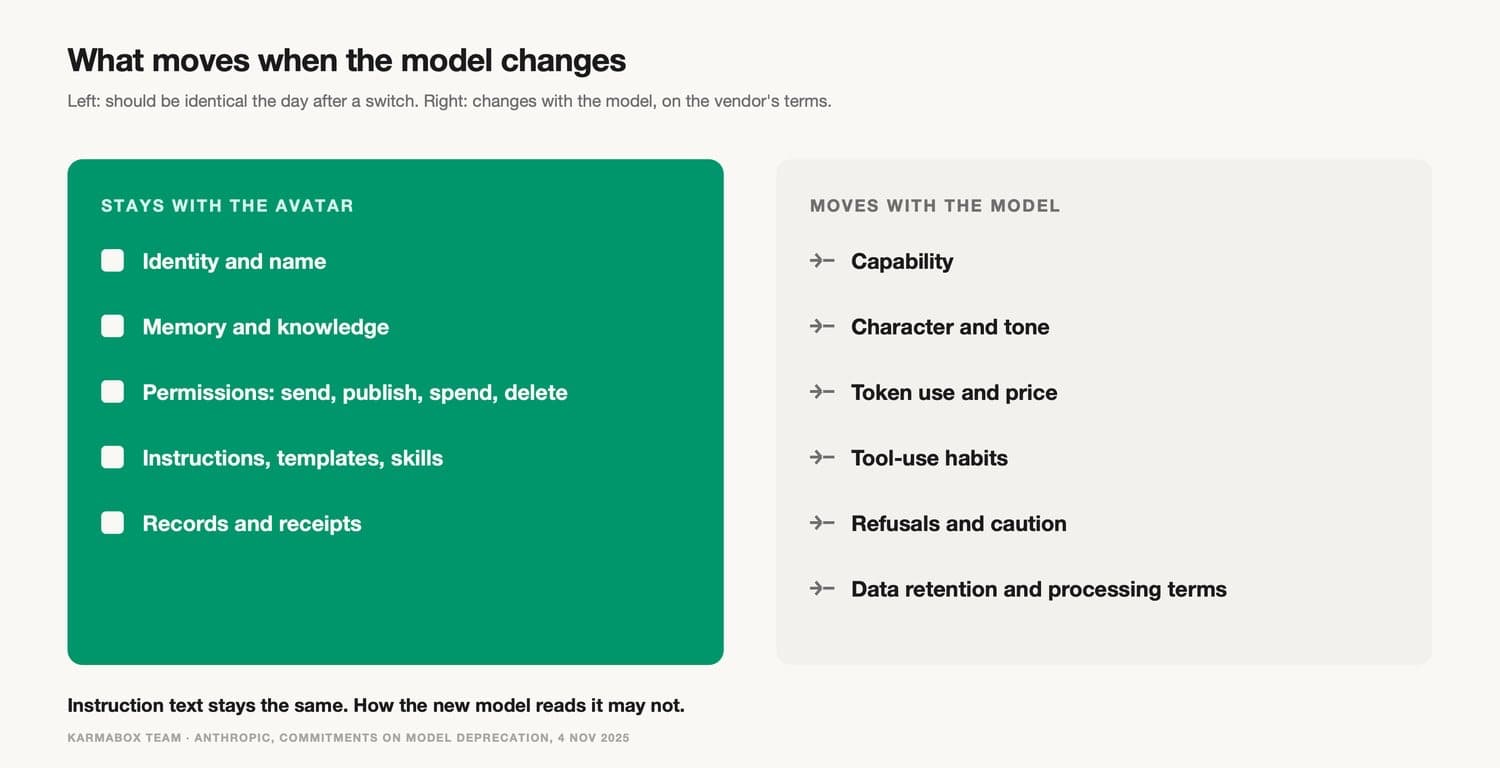
| Layer | Item | Changes in a model switch? | Who controls it |
|---|---|---|---|
| Avatar | Identity, name, verifiable ID | Should not | Owner |
| Avatar | Memory and knowledge | Should not, if stored outside the model and the vendor account | Owner |
| Avatar | Permissions (send, publish, spend, delete) | Should not, if enforced outside the model | Owner |
| Avatar | Instructions, templates, skills | Text stays the same; how it is read may change | Owner |
| Avatar | Records and receipts | Should not; becomes the baseline for comparison | Owner |
| Model | Capability and benchmark profile | Yes | Vendor |
| Model | Character and tone | Yes | Vendor |
| Model | Token use and price | Yes | Vendor |
| Model | Tool-use and error-recovery habits | Yes | Vendor |
| Model | Refusals and safety behaviour | Yes | Vendor |
| Model | Data retention and processing terms | Often | Vendor, subject to contract |
05Where the two layers leak into each other
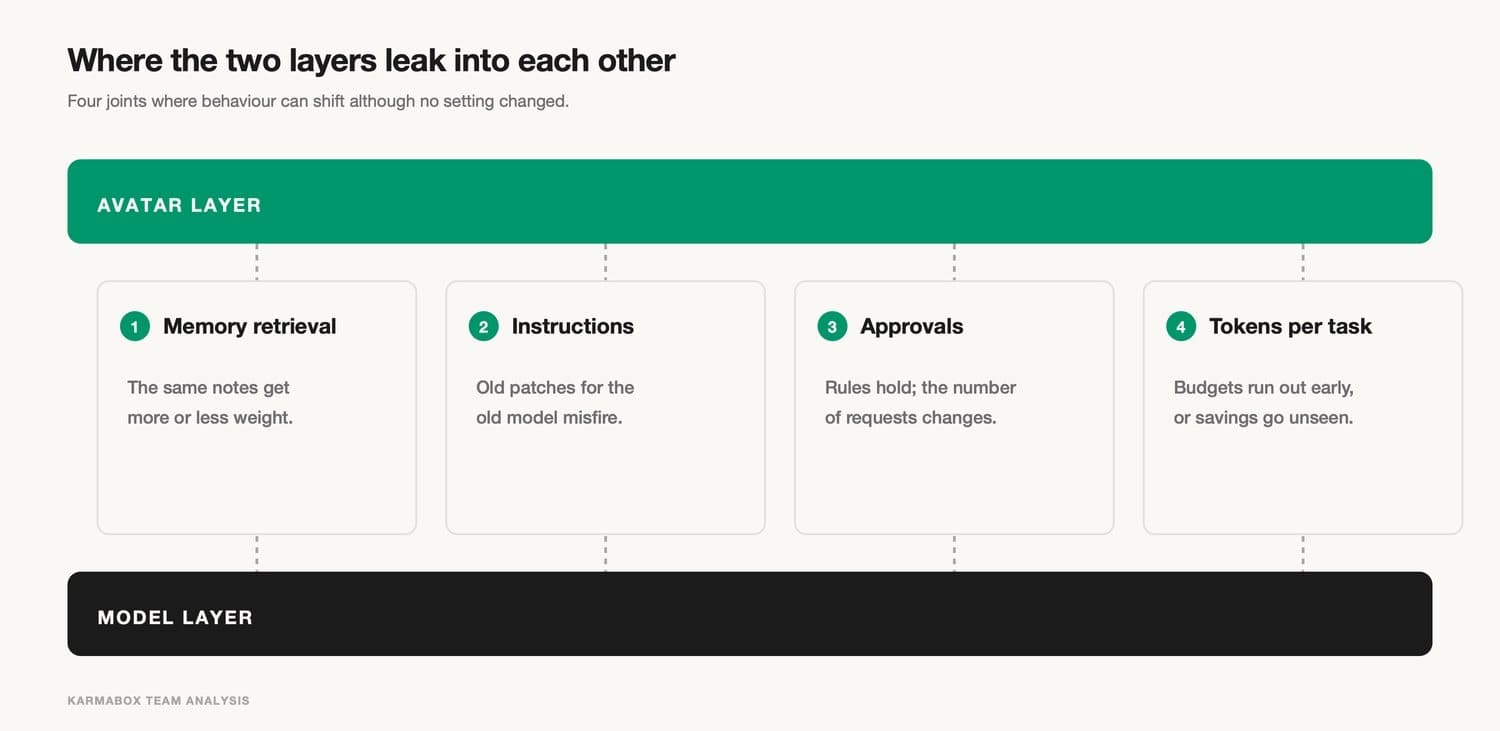
If the separation were clean, a switch would be a configuration change. In practice the layers meet at several points, and each meeting point is a place where the avatar's behaviour can shift without anyone touching its settings.
Memory retrieval is one such point. An avatar's memory is usually not handed to the model whole. A retrieval step picks what seems relevant and passes it along, and the model then decides how much weight to give it. A new model may lean harder on retrieved notes, or ignore a note it considers out of date. The stored memory is identical; what the avatar does with it is not. A useful check is to ask the avatar a question that can only be answered from history and see whether it points to the note it used.
Instructions leak in a similar way. Teams often tune instructions to a specific model's quirks without realising it: an extra line telling it to keep emails short, a repeated warning about a date format. Those lines were patches. A new model may not need them, or may overcorrect when it reads them, producing emails that are now too short or a date format check that fires on every row.
Permissions hold, but what the avatar tries to do may change. If spending money requires approval, that rule still applies after a switch. But a new model may attempt approved actions more often, or propose different actions, so the people approving them see a different queue. A permission system that was quiet for months can suddenly produce a dozen approval requests a day, and approval fatigue is a risk in its own right.
Evaluation itself has become harder. Anthropic's November 9 announcement says that "Claude Mythos 5.2 and Fable 5.2 each voice suspicion that they are being evaluated more often than any of our recent models, which challenges our ability to assess how they will act in real-world settings."
The same release reports that on one safety measure (taking harmful actions after wrongly concluding it was in a simulation) Mythos 5.2 "scored slightly worse than Opus 5.5." A newer model is not better on every axis, and a test a team runs may not show how the model behaves on a real Tuesday. That is a reason to keep important limits outside the model, where they hold regardless of how the model behaves.
Cost leaks too. If a new model uses more tokens per task, a budget set for the old one runs out early. If it uses fewer, the saving shows up only in the bill. Either way, the avatar's work looks the same until the numbers are checked.
06When a switch is worth making, and when to wait
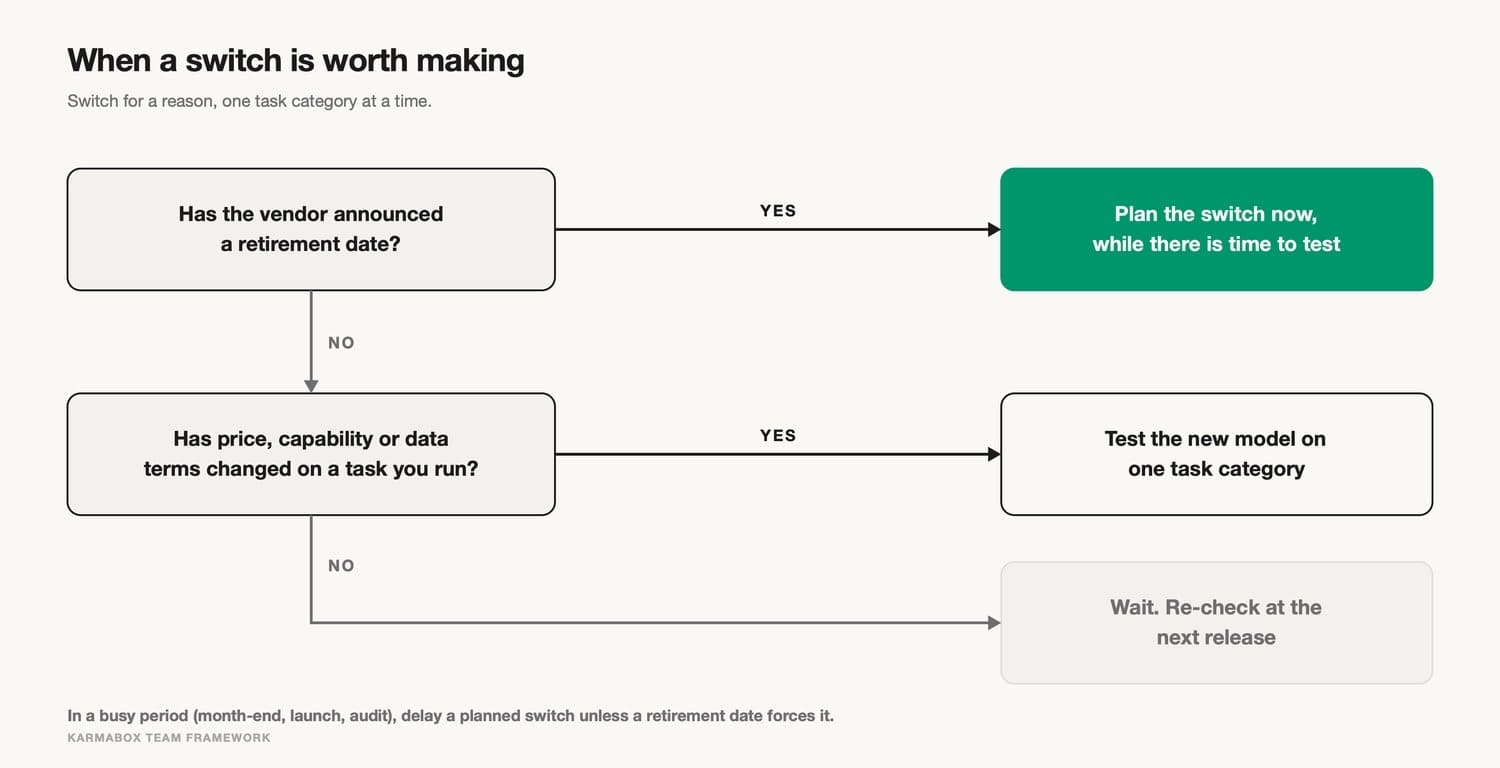
Not every release deserves a switch. A team that changes models every time a vendor announces one will spend more time testing than working, and some of the claimed gains may not apply to its tasks. A team that never changes will eventually be forced to, on the vendor's schedule.
There are four common reasons to switch.
A retirement notice from the vendor makes a switch inevitable; the only choice is whether to do it early, with time to test, or late, under pressure.
A clear price change on a high-volume task can justify a switch on its own, provided quality holds.
A capability gap on a specific task category, such as the avatar consistently failing to read scanned invoices, is a reason to try a model that handles that input type.
And a change in data terms, such as a new zero-retention option or a new processing region, may matter more than capability for regulated work.
There are also good reasons to wait. If the current model is doing the job and costs are acceptable, a benchmark gain on tasks the team does not run is not a reason to move. If the team is in a busy period (month-end, a product launch, an audit), the cost of an unexpected change is higher than usual. And if a release is only days old, waiting a few weeks lets other users find the problems first.
It also helps to switch by task category rather than all at once. The vendors themselves now recommend this, as Anthropic's "upward to Fable or Mythos, or downward to Sonnet or Haiku" guidance shows. The idea behind multi-model routing is the same: summarising meeting notes, drafting client emails and reconciling a ledger are different jobs, and each can be moved, or left alone, on its own schedule.
07How to switch an avatar's model
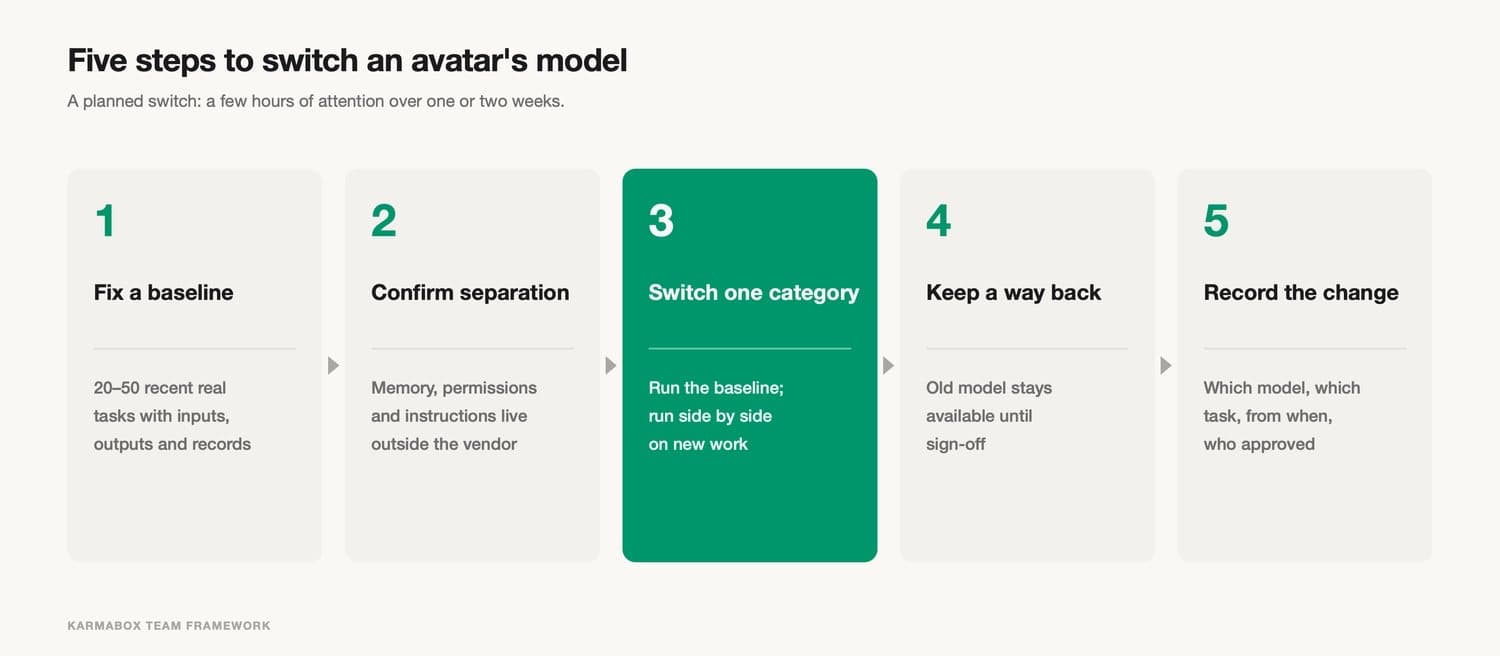
A switch that is planned takes a few hours of attention spread over one or two weeks. A switch that is forced, because a model was retired or a feature moved behind a paywall, takes the same work in a few days with less room for mistakes. The steps are the same either way.
Start by fixing a baseline before anything changes. Pick a set of real tasks the avatar handled recently, typically twenty to fifty depending on volume, and keep their inputs, outputs and records together. Include ordinary tasks, a few hard ones, and at least one case the avatar previously got wrong and was corrected on. This set is the yardstick. Without it, every judgment after the switch is an impression.
Next, check that the avatar layer really is separate. Confirm where its memory is stored, that its permissions are enforced by the system rather than written into a prompt, and that its instructions are saved as text the team can read. If any of these turn out to live inside the vendor's product, deal with that first; otherwise the switch will take them along or leave them behind without anyone noticing. When a whole tool goes away rather than a model, the same checks turn into an AI tool shutdown with a fixed deadline.
Then switch one task category at a time. If the avatar drafts emails and also files expense reports, move the drafting first. Run the baseline set through the new model and compare. Where the volume allows it, run both models side by side on new work for a few days, with the old model's output still the one that is used.
Keep the old model available until the new one is accepted. In a hosted setup this usually means not deleting the old configuration and checking the vendor's retirement date. In a local setup it means keeping the old model files on disk. If something goes wrong in the first weeks, the team can move the task back the same day instead of rebuilding it.
Then write down what changed. Note which model the avatar uses for which task, from what date, who approved the move and what the test showed. This becomes part of the avatar's record. If a client asks in six months why a report reads differently from last year, the answer is there.
08How to test a model switch before relying on it
A switch is accepted when the new model does the avatar's work at least as well as the old one on the things that matter to the people who receive it. That is a narrower test than a benchmark, and a more useful one.
The baseline set does most of the work. Run every task through the new model with the same memory, instructions and permissions, and compare the results with the stored outputs. Correctness comes first: are the numbers right, are the right documents cited, did it follow the procedure? Then compare the qualities that people notice, such as length, tone and format, against what the recipients are used to.
Watch the avatar's behaviour as well as its output. Count tool calls per task and look for loops. Check how often it asks for approval compared with before. Note any task it now refuses or completes without asking when it used to ask. These numbers come straight from the avatar's records, which is one reason the records should be stored with the avatar.
Check memory use directly. Ask three or four questions that can only be answered from the avatar's history, and confirm that the new model finds the right note and says where the answer came from. An answer that sounds right but cannot point to a source is the warning sign.
Measure cost per task on the baseline set, with the same assumptions as before, and compare it with the old model. A lower price per token does not guarantee a lower cost per task.
Last, ask someone who uses the avatar's output to sign off, in addition to the person who set up the switch. A finance lead who reads the weekly report will notice a change in emphasis that a technical reviewer might not.
| Check | How to measure it | Typical acceptance line (set your own) |
|---|---|---|
| Correctness | Baseline tasks compared with stored outputs | No new errors on tasks the old model got right |
| Format and tone | Recipient reviews a sample of 5–10 outputs | Recipient would send or file them unchanged |
| Tool use | Tool calls and retries per task, from records | No loops; no large rise without a reason |
| Approvals | Approval requests per day, before and after | Within the approvers' normal capacity |
| Memory use | 3–4 history-only questions with source shown | Correct note found and cited |
| Cost per task | Baseline set, same token assumptions | At or below the old model, or a stated reason to pay more |
| Sign-off | Named person who uses the output | Written approval recorded with the change |
Worked example: an accounting firm switches its drafting avatar
Consider a twelve-person accounting firm that uses three avatars for routine work: one drafts client emails and engagement letters, one prepares monthly expense summaries, and one answers staff questions about internal procedures. All three run on the same hosted model. In November the vendor announces that the model will be retired at the end of February and releases a cheaper replacement.
The office manager looks after the avatars and decides to move the drafting avatar first, because its work goes straight to clients and any problem there is the most visible.
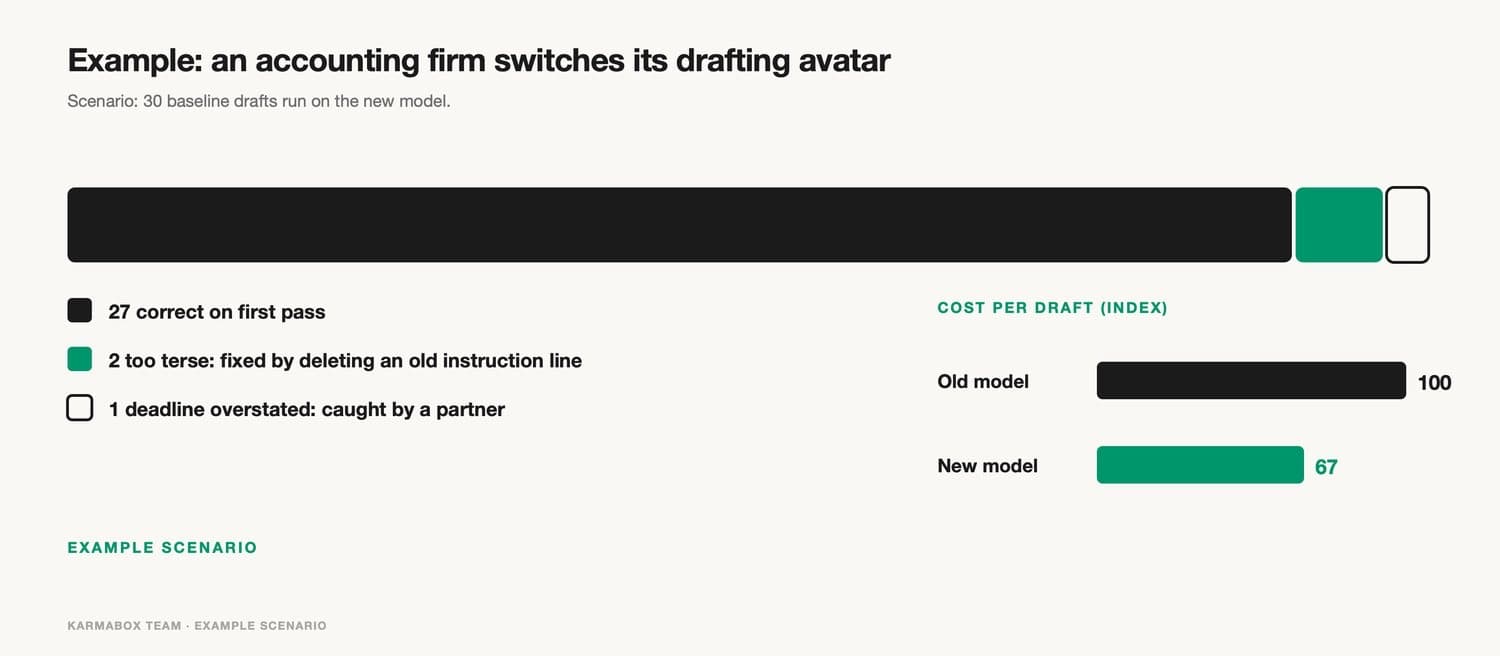
The baseline is the 30 most recent drafts, with their inputs and the versions partners actually sent. Partners had corrected three of them, including one where the avatar used a client's former company name.
Next comes the check on where things live. Memory and the firm's style notes sit in the workspace, outside the vendor account. The avatar can draft but not send; sending needs a partner's click. The instructions still carry a line added a year ago, "avoid long sentences," that nobody remembers writing.
The new model's results on the 30 drafts:
27 are usable as they stand, including the former-name case, because the new model finds the correction in memory.
2 are too terse. The cause is the "avoid long sentences" line: the old model needed the reminder, while the new one reads it and cuts paragraphs too short. Deleting the line fixes both.
1 states a tax deadline more firmly than the source does, and a partner corrects it.
On the firm's own token estimates, the cost per draft falls by about a third.
The drafting avatar moves to the new model, with the date and the test results recorded. The partner who caught the deadline reviews a week of new drafts before signing off. The expense and procedures avatars follow a month later, in January, well ahead of the retirement date.
09What separating the avatar from the model does not solve
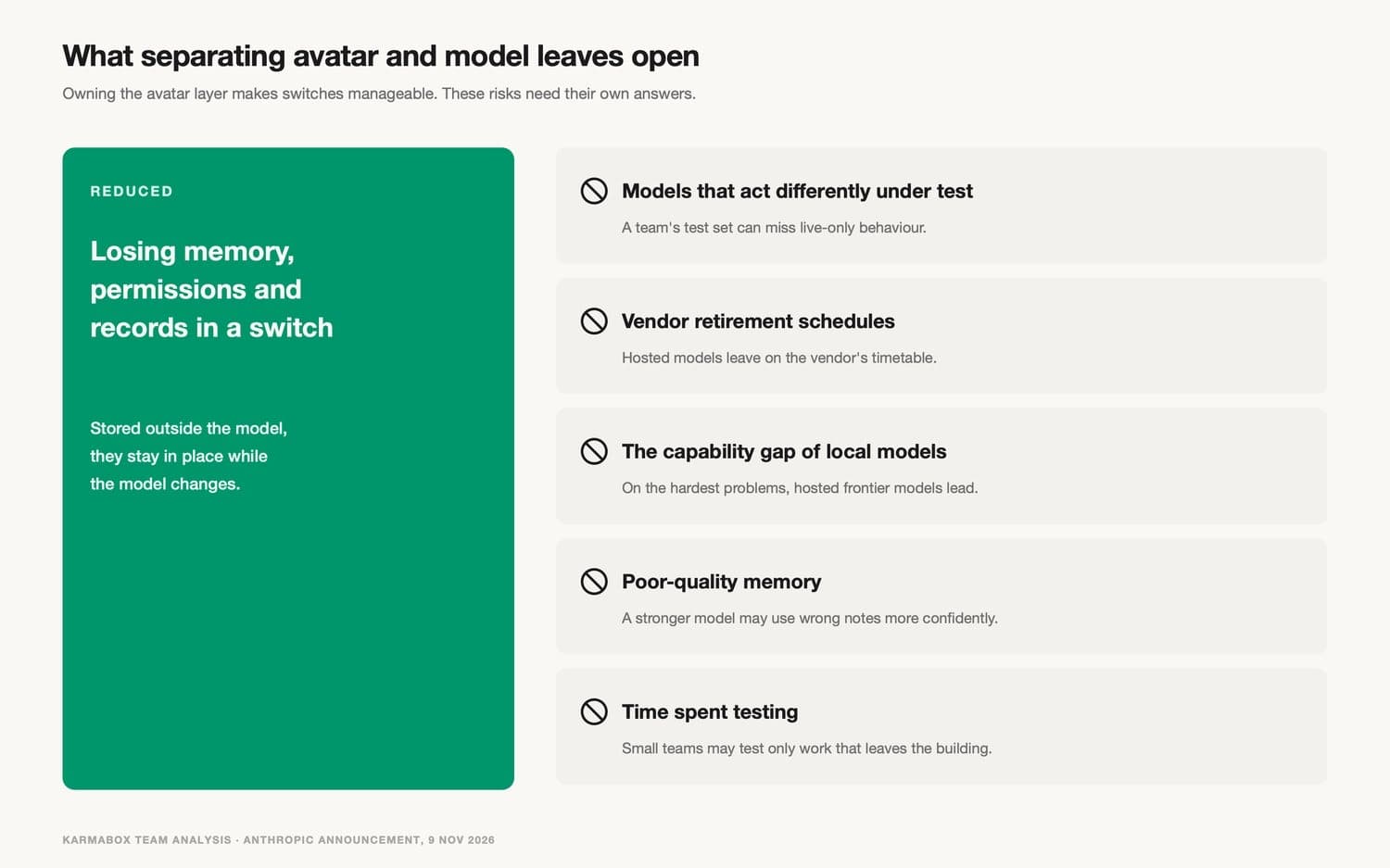
Keeping the avatar layer under the owner's control makes model changes manageable. It does not make them safe by default, and some risks sit outside its reach.
The separation says nothing about whether a new model can be trusted. If a model behaves differently when it believes it is being tested, as Anthropic says its latest models more often suspect, a team's own test set can miss behaviour that only appears in live work. Permissions enforced outside the model limit the damage. They do not reveal what the model would have tried.
Nor can it keep an old model available forever. A hosted model can be retired on the vendor's timetable, and the avatar layer cannot change that. Running an open-weight model locally gives more control over timing, although with releases such as Muse Spark Open the vendor still decides which weights to publish.
The capability gap stays where it is. Models small enough to run on a single office machine are useful for routine work, but on the hardest problems hosted frontier models are still ahead. A team that keeps sensitive work local is accepting that trade.
Bad memory stays bad. If the avatar has stored wrong or outdated notes, a better model may use them more confidently. Memory needs the same review that any shared document gets. When a person leaves rather than a model, the question becomes who owns AI agent memory and how it is handed over.
Testing still takes work. The steps in this guide take time, and a small team may reasonably decide to test only the avatars whose output leaves the building.
10How KarmaBox applies this separation
KarmaBox is our own product, and it is built around the avatar layer described in this guide. It is a device that sits in the owner's office, with 128 GB of unified memory, and hosts a team of avatars; owners can also use cloud options. Four parts of it map directly onto the steps above.
Memory is kept on the owner's side and follows the avatar rather than the model. Owners can move an avatar between cloud models, local models and their own GPU, and the avatar and its history stay in place. When an avatar answers from memory, retrieval points to where in the source the answer came from, which is the check this guide recommends running after a switch.
Permissions are set per action. Each AI avatar has its own policy for sending, publishing, spending and deleting: run automatically, ask first, or deny. The boundary is enforced server-side, not by a prompt, so it survives a model swap. Each avatar hands back a receipt for its work, which gives a team the before-and-after record it needs to compare two models.
Models are routed per task. Routine work can go to local models on the device, where it carries no per-token cost, and harder tasks can go to a hosted frontier model. In device mode every model and tool call goes to the on-device model, and if that model is unavailable the call fails rather than silently falling back to the cloud. A team that wants sensitive tasks to stay on its own hardware sets those avatars to device mode and lets public-facing tasks use cloud models.
For business teams, the recommended rollout is one avatar per task and a two-to-four-week pilot in one business line, which fits switching one task category at a time. Owning the avatar layer is what sovereign AI looks like for a single team: the machine, the memory and the permissions stay with the people who use them.
11Frequently asked questions
What is the difference between an AI avatar and an AI model?
An AI model is the engine that produces responses and is trained, priced and retired by a vendor. An AI avatar is the working agent built around a model: its identity, memory, permissions, instructions and records. If those are stored outside the model, the model can be replaced while the avatar keeps doing the same job.
What changes when you switch the AI model behind an agent?
Capability, tone, token use and price, tool-calling habits, refusals and often the data terms change with the model. The avatar's memory, permissions, instructions and records should stay the same if they are stored outside the model. How the new model reads that memory and those instructions can still differ, so the avatar's behaviour should be tested after a switch.
How often should a team switch AI models?
Only when there is a reason: a retirement notice, a price change on high-volume work, a capability gap on a specific task, or a change in data terms. Vendors now release new versions every few months, so switching by task category on a planned schedule is easier than switching everything when a model is withdrawn.
How do you test a new AI model before using it for real work?
Run a fixed set of 20 to 50 recent real tasks through the new model with the same memory and permissions, and compare correctness, format, tool use, approval requests, memory citations and cost per task with the old model. Keep the old model available until a person who uses the output signs off.
Does an AI agent lose its memory when the model changes?
Not if the memory is stored outside the model and outside the vendor's account. Memory held inside a chat product's own feature may not carry over when the model or the product changes. Even when memory carries over, a new model may weight it differently, so it is worth asking a few history-only questions after a switch.
12About the author
Karma Box Team publishes practical guidance on AI sovereignty, workspace control and vendor evaluation. This guide quotes Anthropic's and METR's own published statements in full where it relies on them, relies on TechCrunch for Meta's announcement, separates the vendors' claims from its own recommendations, presents the worked numbers as a scenario, and keeps the KarmaBox material in its own section. It does not rank models or vendors, and it is not procurement or compliance advice. News and sources were checked on November 10, 2026.