A working API key can become unusable while your application, network, and payment account are all functioning normally. The model provider may still be in business. The service may even be technically healthy. Access can nevertheless change because a government directive, eligibility rule, or provider decision changes who may use a particular model. For builders, this is a different failure mode from an ordinary server outage.
AI model access risk is the possibility that a workflow loses access to a model it depends on, even though the workflow itself has not changed. The June 2026 suspension of Anthropic's Fable 5 and Mythos 5 provides a concrete example. The engineering lesson is to identify critical dependencies, maintain lawful alternatives, and define useful reduced service before the preferred model disappears. A second API address alone does not establish independence.
This guide distinguishes the documented event from broader design recommendations. It explains access-risk categories, fallback patterns, and hybrid routing without suggesting ways to bypass restrictions. Whether a particular use is permitted depends on applicable rules and contracts; obtain qualified advice for your situation. The aim is business continuity within those boundaries, with clear records of which providers process each task and what changes when a route becomes unavailable.
What happened in June 2026
On June 12, 2026, Anthropic announced a suspension after receiving a US export-control directive concerning Fable 5 and Mythos 5[1]. Its statement said the directive restricted access by foreign nationals inside and outside the United States. Anthropic disabled those two models for all customers to ensure compliance and explicitly said other Anthropic models were unaffected. This was not a shutdown of every Claude model or the company's entire service.
CNBC reported the same-day disruption[3], providing independent reporting alongside the company's account. The distinction between the directive and the operational response matters: the stated restriction concerned foreign-national access, while the provider's implementation affected all users of the two models. Builders should therefore examine actual service impact rather than assuming the legal category and the technical blast radius will be identical.
Anthropic's redeployment notice, published June 30 and updated July 1, said the controls had been lifted and access restored[2]. It explained that immediate implementation and the lack of reliable real-time nationality verification had led to the wider suspension. The notice distinguished Fable's global return from Mythos access for selected organizations and indicated that partner-platform re-enablement required additional work. Restoration was not one uniform entitlement for every channel and customer.
The Record's July 1 reporting also described the lifting of controls while noting continued limits on Mythos availability[4]. This chronology supports a bounded conclusion: specified models experienced a regulatory access interruption from June into July. It does not establish that every future restriction will be temporary, that all alternatives were unaffected, or that any customer was entitled to continue through another intermediary.
Earlier withdrawals show different mechanisms
In June 2024, Rest of World reported that OpenAI would block API access from China starting July 9[5]. This illustrates enforcement of provider-supported territory boundaries, not proof of the same legal mechanism used in June 2026. A developer building on access from an unsupported region could face interruption even if the underlying model remained available elsewhere. Supported-region policies belong in dependency review, not only in account setup.
Anthropic's December 2025 Senate testimony described a September terms update extending restrictions to companies majority-owned by entities headquartered in restricted regions[6]. That example concerns corporate ownership as well as location. It shows why a server's geography alone may not answer eligibility questions. These historical examples identify different access mechanisms; they should not be collapsed into a claim that every provider withdrawal is an export-control order.
Types of AI model access risk
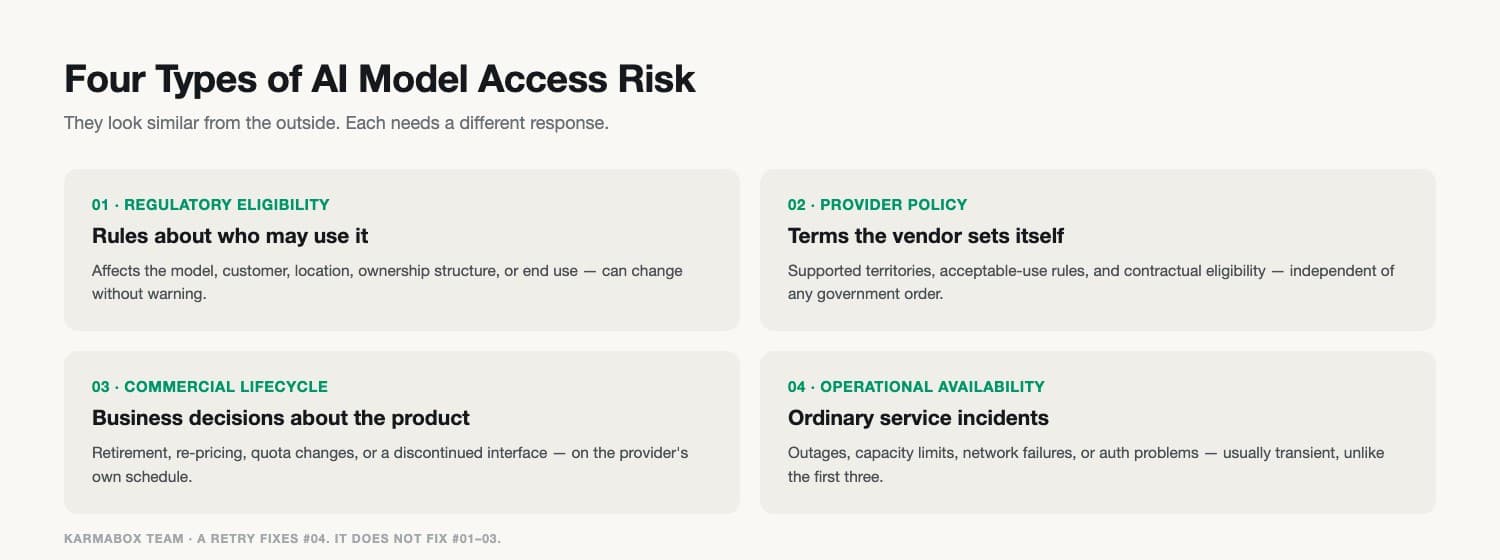
The first category is regulatory eligibility: rules may affect the model, customer, location, ownership structure, end use, or other relevant facts. The second is provider policy: supported territories, acceptable-use rules, and contractual eligibility can change independently of a new government order. Both deserve a compliance-aware response. A fallback should be checked for permission to use it, not treated as a technical workaround merely because a request succeeds.
The third category is commercial lifecycle risk. A provider may retire a model, change pricing, alter quotas, or discontinue an interface. The fourth is operational availability: incidents, capacity limits, network failures, or authentication problems. These categories can look similar to an application, but they need different actions. Repeated retries may help with a transient connection problem; they do not resolve a deliberate access restriction or a retired model identifier.
Map the dependency behind the endpoint
Two cloud platforms can expose the same underlying model, and two gateways can depend on the same upstream provider. Those routes may improve resilience to a gateway outage while remaining exposed to a model-wide restriction. Record both the endpoint operator and model developer. Also identify shared identity services, billing accounts, retrieval infrastructure, and external tools. A dependency map should show where apparent diversity still converges on one decision or technical failure point.
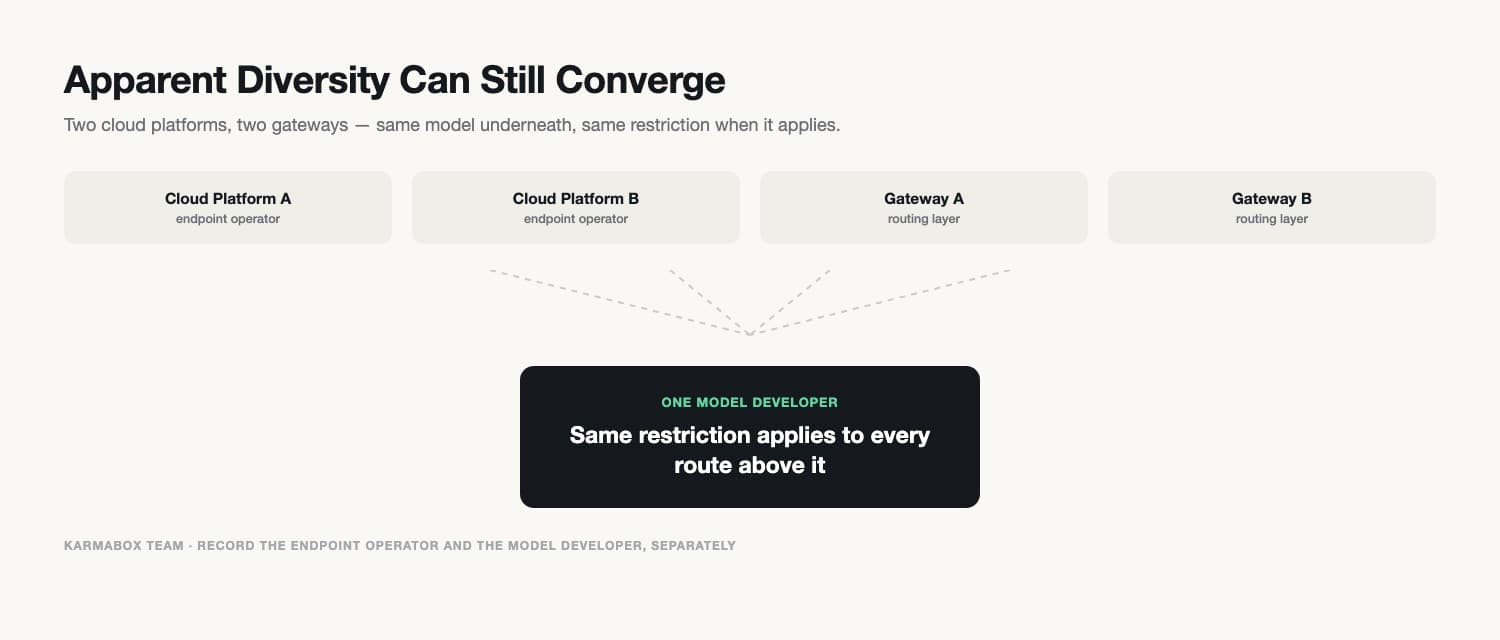
Avoid reducing this analysis to the provider's headquarters. Different providers can share exposure to a jurisdiction or infrastructure, while different models from one provider may have different restrictions. Assess the specific scenario and evidence rather than claiming total independence from a corporate label. The practical question is whether the backup remains legally available and operationally useful when the primary dependency fails for the reason being considered.
Define the service your business actually needs
An application may not need its strongest model for every task. It may need reliable document retrieval, basic classification, or a draft that a human can review. Define the minimum useful service separately from the premium experience. This lets a team preserve essential work without pretending a weaker model is equivalent. If a critical judgment cannot be supported safely by the available alternative, the correct fallback may be a queue or human decision.
Assign priorities before an incident. Which activities must continue immediately, which can wait, and which must stop when evidence or capability is missing? Identify the owner authorized to change routes and the person who approves consequential output. Without these decisions, engineers can be pressured to restore a green status indicator while silently weakening the product's quality or moving data to an unapproved destination. Seen from another angle, these are the same questions as what a real AI off-switch actually costs you — a more general version of this exercise worth working through once.
Fallback patterns that preserve useful work
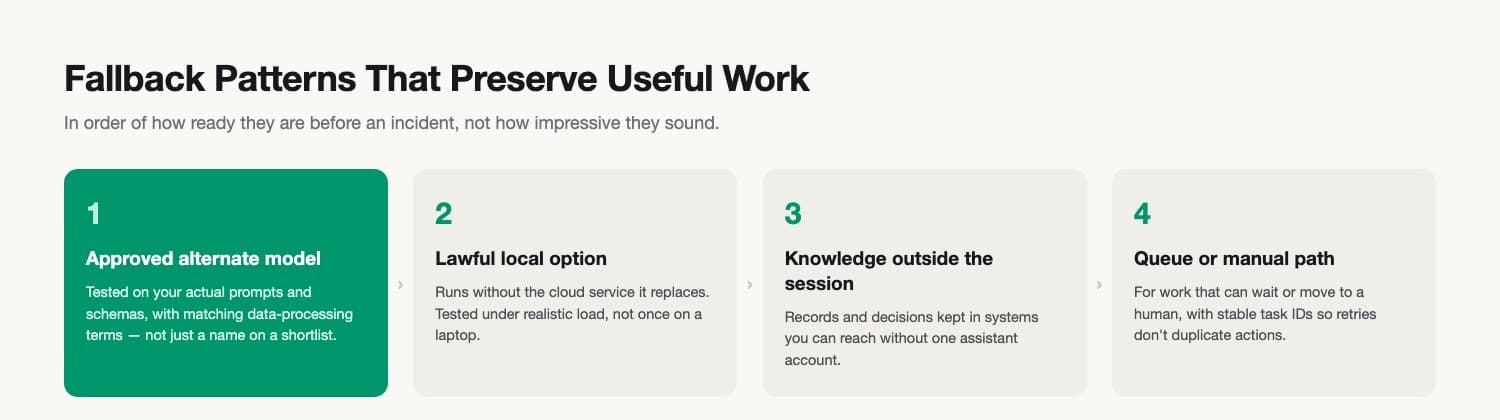
Keep an approved alternative model ready
An alternative is ready only when it has passed the tasks it will be asked to perform. Test prompts, output schemas, citations, tool use, languages, and context limits. Document capabilities that are absent or unreliable. Maintain the account, credentials, and capacity needed for an actual switch. A shortlist of model names is research; a working fallback is an operational capability with evidence, ownership, and a defined scope.
Compare the full data-processing arrangement. The backup may have different retention terms, processing locations, subcontractors, or logging defaults. Approve those differences before an outage rather than discovering them after confidential content has moved. The system should refuse a route that violates the task's data policy even when that route is technically healthy. Availability is only one condition for choosing a destination.
Maintain a lawful local option where it fits
A locally deployed model can reduce dependence on a remote inference service for supported tasks. It still requires sufficient hardware, usable model files, runtime dependencies, and permission to use the model. Local deployment does not erase export, licensing, or other applicable restrictions. The continuity advantage is operational control over an approved deployment, not immunity from law or an assurance that every frontier capability can be reproduced on a small machine.
Test the local option without relying on the cloud services it is supposed to replace. Download approved dependencies in advance, verify that required documents remain accessible, and identify any external authentication or tool calls. Record throughput under realistic load. A model that runs once on a developer's laptop may not support a team during a prolonged interruption, especially if memory, storage, or concurrent requests become the bottleneck.
Preserve knowledge outside the model session
Keep authoritative project records, approved instructions, and task state in systems your organization can access independently of one assistant account. Store source references and decisions in readable formats. This makes a model change less dependent on reconstructing context from an inaccessible conversation history. An export should preserve enough structure to continue work, but it should not include credentials or unrelated personal information simply because a bulk download is available.
Separate knowledge portability from behavioral compatibility. The same prompt may produce a different result on another model, and a tool schema accepted by one service may need adaptation elsewhere. Keep provider-specific behavior behind a small integration layer where practical. Validate the resulting workflow rather than assuming that a standardized API makes models interchangeable. Compatibility is established through tests, not through similar request syntax.
Use queues and manual work deliberately
Some tasks can wait without harming the user. Preserve them in a durable queue with clear status and a sensible expiry rule. Others can move to a human using the same source documents and an explicit checklist. This approach can be more reliable than forcing an unsuitable model to answer. Explain the reduced service honestly, including which actions are delayed and what the user can do next.
Plan for side effects when retrying. If an agent can send a message, update a record, or place an order, a timeout does not prove the action failed. A fallback that repeats the action may create duplicates. Use stable task identifiers, check execution status, and require review when the result is uncertain. The goal is to resume a business process safely, not merely obtain a second model response.
Hybrid routing in practice
A hybrid design can assign ordinary private work to an approved local model and reserve approved cloud models for tasks that need additional capability. The routing policy should consider data classification, user eligibility, required capability, cost, and availability. It must also define what happens when no destination meets all conditions. A stop or request for review is a legitimate result; the router should not invent permission because a task is urgent.
KarmaBox's guide to sovereign AI for individuals and teams discusses this local-first, cloud-on-demand deployment choice within a broader sovereignty framework[7]. Apply it as a decision process, not a blanket guarantee that every task stays local or every model can be replaced automatically. Confirm the actual runtime, permissions, and model configuration before assigning a production workload to a fallback path.
An illustrative routing decision
Imagine a team summarizing confidential project notes locally, then using an approved external model to refine a public presentation. If the external model becomes unavailable, the team can still retrieve project material and create a basic draft locally. The polished presentation waits for review or another approved route. This is a hypothetical design example, not a report of a tested feature or evidence of measured recovery time.
The policy should prevent the confidential notes from being sent to a new cloud provider merely to preserve convenience. It should also record which model generated the fallback draft so reviewers know that the normal evaluation assumptions may differ. If the local model cannot support the task adequately, the system should say so. Preserving access to information is useful even when the highest-quality generation step must pause.
How to test a switch-off plan
Run an authorized exercise that makes the primary model unavailable to a test workflow without changing real customer permissions. Use synthetic or approved data. Record how the application detects failure, whether it distinguishes temporary errors from denied access, and which route it selects. Check that routing rules remain enforced under pressure. An exercise should show what the service can still deliver, not simply demonstrate that a backup endpoint returns text.
Measure recovery in business terms. Can staff find the latest approved document? Can a queued task resume without duplication? Can users identify that an answer came from a reduced-capability route? How long does a reviewer need to correct the result? Record both successful continuity and unsupported tasks. A short technical recovery time can hide substantial manual work if the fallback output is difficult to trust or integrate.
Prepare for a longer interruption
A backup that works for one hour may not work for several weeks. Estimate capacity, cost, support coverage, and review workload over a realistic interruption period. Confirm that alternative accounts are eligible and funded. Identify hardware replacement and maintenance needs for local deployments. The June timeline is evidence that interruptions can last beyond a routine retry window; it is not a forecast of how long the next event will last.
Assign ownership for monitoring changes in provider terms, supported regions, model lifecycle notices, and relevant regulatory developments. The role need not require every engineer to interpret export law. It should ensure that qualified reviewers receive material changes and that operational owners know when an approved route needs reevaluation. A continuity plan is only current if someone is responsible for keeping its assumptions current.
Restore the primary route deliberately
When access returns, verify entitlement, model identity, behavior, and processing terms before switching every task back. A redeployed model may have changed safeguards or usage conditions. Reconcile queued work and identify tasks already completed on another route. Use a controlled return rather than duplicating activity across both paths. Restoration should be treated as a deployment change with validation, not merely as the disappearance of an error message.
Build an access-risk register before an incident
A useful register is short enough to maintain and specific enough to guide a decision. For each critical workflow, record the model developer, serving platform, account owner, eligible users, allowed data categories, and approved alternatives. Add the source and review date for each eligibility assumption. The register should point to the relevant contract or provider notice, rather than relying on a remembered conversation with a salesperson. Assign a person who can investigate changes and coordinate the response. This register and a more general vendor sovereignty checklist can share the same review cycle: the checklist asks whether a provider is trustworthy in the first place, this register asks whether you have a way out if it changes its mind.
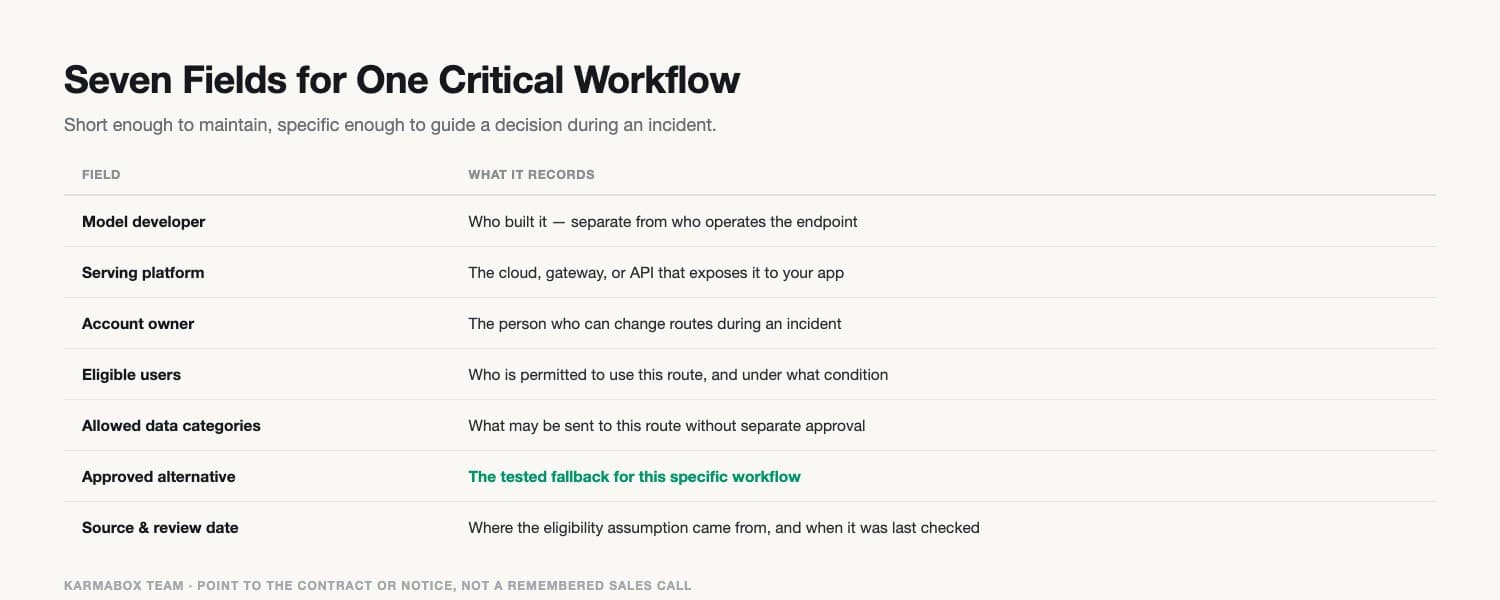
Include dependencies that are easy to overlook. An application may use one model for the visible answer, another for embeddings, and a third service for document extraction. Losing the embedding endpoint can disrupt search even if the chat model remains available. A continuity exercise should therefore start at the business task and trace every required component. Otherwise, a team may prepare an excellent replacement generator while leaving the unavailable retrieval step untouched.
Ask procurement questions that engineering can test
Ask how the supplier communicates a restriction, whether notices identify affected models and channels, and what customer support can clarify during an incident. Ask which export and data-access functions remain available if inference access is suspended — this is the same checklist as rescuing an agent workspace before a tool shuts down, just triggered by a regulatory order instead of a commercial retirement. Do not assume that an account suspension and a model suspension preserve the same features. Document the answers as contract or product statements with dates, and verify technical functions where the supplier provides a safe test mechanism.
Discuss notice periods and transition assistance without treating them as protection against every event. A commercial migration window may be useful for scheduled retirement, while an immediately effective directive can create a different situation. Ask counsel to interpret any contractual exceptions. Engineering should build around realistic interruption scenarios rather than assuming a service-level commitment guarantees continued eligibility. A credit for downtime is not the same thing as the ability to complete an urgent customer task.
Distinguish an alternate route from an unauthorized workaround
A legitimate fallback is approved for the user, organization, data, and task involved. It does not depend on hiding the customer's identity or misrepresenting where a request originates. If eligibility is uncertain, pause the affected route and obtain a determination rather than moving requests through a different account in the hope that they will succeed. This boundary protects the continuity plan itself: an alternative built on unstable or unauthorized access is another hidden dependency.
Keep this distinction visible in the incident runbook. An operational alert should identify whether the cause is known, which policy decisions apply, and who can authorize a change. Engineers should not have to infer legal eligibility from a successful HTTP response. Equally, a generic error should not automatically trigger a permanent compliance conclusion. Record uncertainty, investigate through the proper channels, and choose a safe temporary service state while the cause is being resolved.
Budget for continuity rather than duplicate subscriptions
The cost of a fallback includes evaluation, integration, monitoring, spare capacity, and human review. Buying a second subscription covers only part of that work. Estimate the cost of the reduced service you actually intend to provide and compare it with the consequences of stopping. A small team may sensibly maintain one tested alternative for a narrow task rather than attempting to reproduce every capability of its primary system across multiple providers.
Make the limits explicit to customers and internal users. A reduced service might provide draft text without automatic publication, or retrieve approved documents without generating a recommendation. Explain what continues, what pauses, and who handles exceptions. This is better than silently substituting a model and leaving users to discover that important behavior changed. Clear expectations also help reviewers concentrate on the tasks that genuinely require additional oversight during an interruption.
After each exercise or real event, update the register with the evidence collected. Record missing permissions, performance problems, and steps that depended on one person's memory. Rehearse the corrected process with someone who did not design it. A plan that another authorized colleague can execute is more durable than a collection of clever integration tricks. Access resilience is an organizational capability, supported by software, contracts, and repeatable decisions.
Frequently asked questions
Can export controls interrupt access to an AI model?
Yes. Anthropic's June 2026 notices document an interruption affecting Fable 5 and Mythos 5 following a US directive. The scope of any restriction depends on the specific rules and provider response. Do not infer a universal ban from one incident.
Did every Claude model stop working in June 2026?
No. Anthropic's June 12 statement identified Fable 5 and Mythos 5 and said other models were unaffected. Recovery also differed by model and access channel. Use the dated notices to understand scope rather than describing a company-wide shutdown.
Does a second cloud provider guarantee a fallback?
No. It may expose the same underlying model or share other dependencies. Confirm eligibility, upstream independence for the relevant scenario, data-processing approval, and task performance. A reachable endpoint is not enough to establish a usable fallback.
Are local models exempt from access restrictions?
No. Local execution can reduce operational dependence on remote inference, but applicable law and licence terms still matter. Verify lawful use and the actual dependencies of the deployment. Local hardware is not a compliance exemption.
What should a small team do first?
Identify one critical workflow, record its model and provider dependencies, and define the minimum useful service. Test one approved alternative plus a manual or queued path. Keep the required knowledge accessible outside a single model account and assign an owner to maintain the plan.
About the author and disclosure
Karma Box Team publishes practical guides to AI deployment and control. This article uses the dated primary statements and reporting below; it does not report original failover measurements. Research reviewed November 11, 2026. Qualified legal review should confirm any jurisdiction-specific claims or interpretation of eligibility requirements.