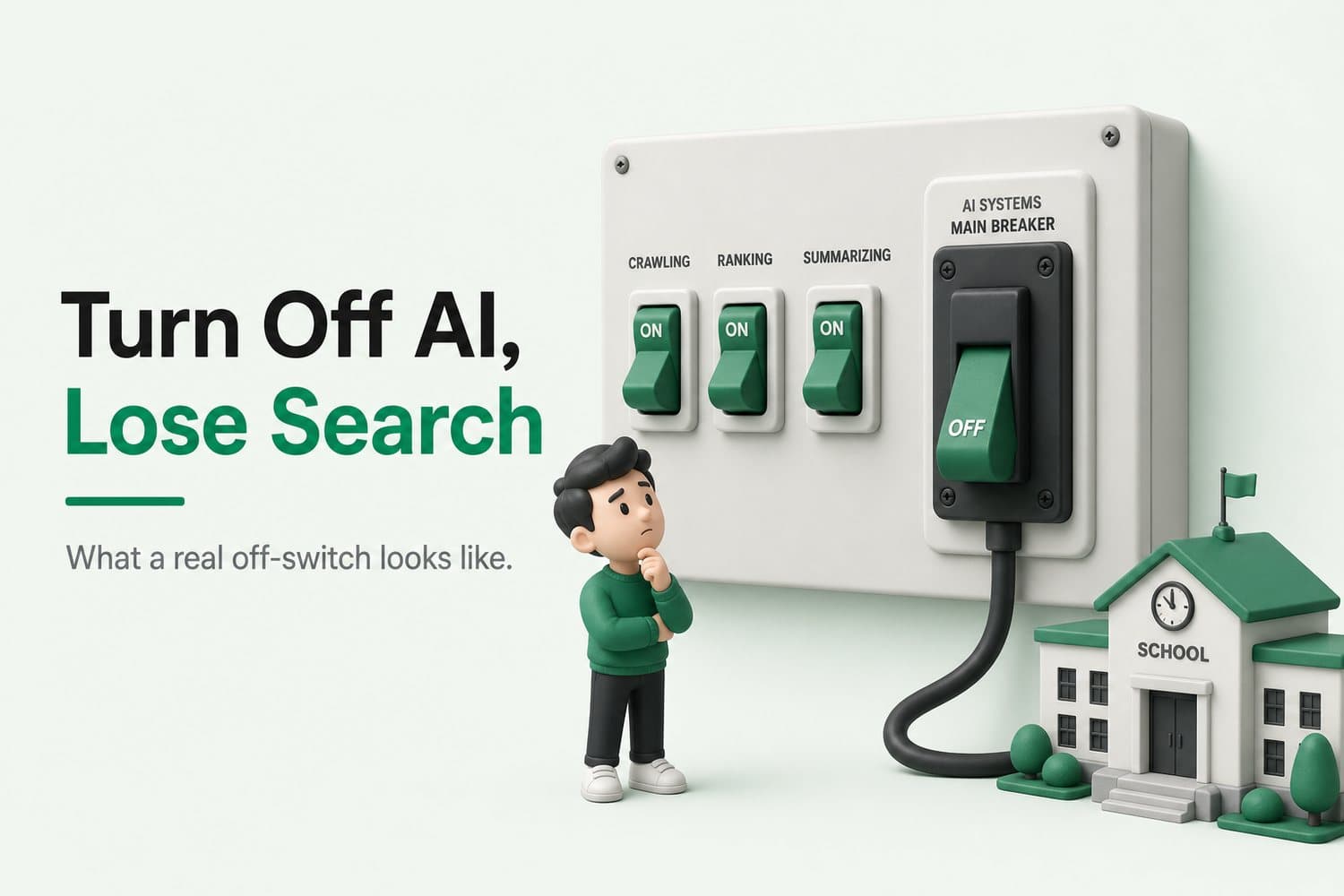
Every building has a breaker panel. One switch per circuit. If the kitchen lights fail, you flip the kitchen switch — the bedroom stays lit. Nobody wires a single lamp to the main breaker, because then "turning off the lamp" would mean turning off the building.
On Monday, Google told 150 million students and teachers that this is exactly how its products are wired.
Here is the whole argument in one sentence:
A real AI off-switch turns off one capability and nothing else. If flipping it takes down something you need — your search, your files, your other tools — it isn't an off-switch. It's a hostage arrangement with a toggle drawn on it.
Now the news that makes this worth saying.
01What Google actually announced
On 3 November 2026, Google said that starting next year, AI tools for K-12 student accounts — Gemini, NotebookLM, Gemini in Classroom — will be off by default, until school administrators explicitly turn them on [1]. On its face, that is the respectful version of a default: nothing runs until someone responsible says yes.
Then comes the wiring. Schools that choose to keep AI off lose Google Search entirely. Not AI-flavored search. All of it. Google's VP of education, Chris Phillips, said the quiet part on the record: "Search and AI are deeply integrated," and students at schools that disable AI "will not have access to Search, and they'll see a message from their school that indicates it's not available" [2].
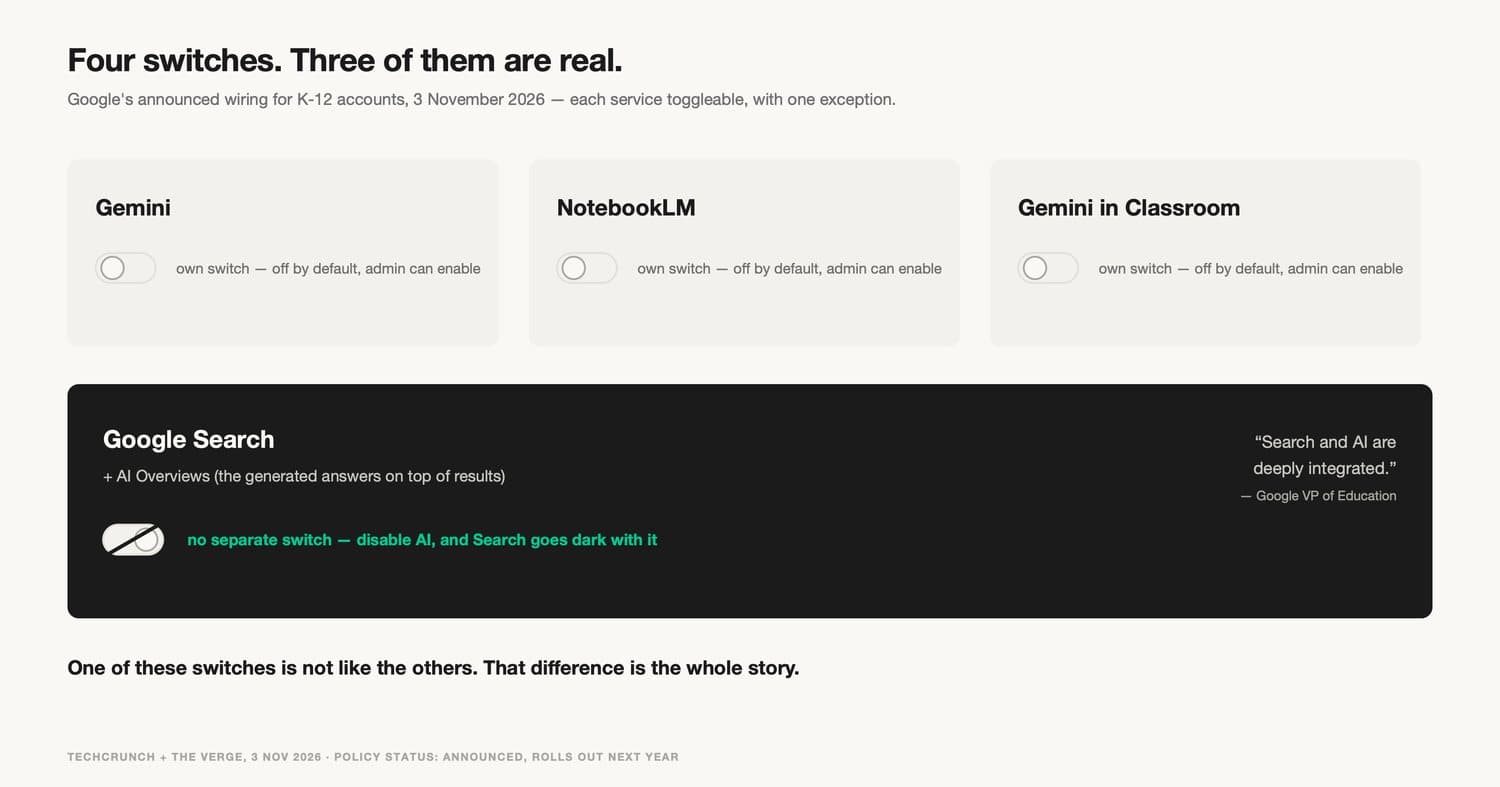
Google's new wiring for schools: Gemini, NotebookLM and Classroom each get their own switch — but the AI inside Search is welded to Search itself. One of these switches is not like the others.
The reaction was immediate and crossed party lines of every kind. Senator Bernie Sanders called it "extortion." New York City Mayor Zohran Mamdani: "no corporation should have the power to dictate how we teach our children." Rohit Chopra, California's Secretary of Business & Consumer Services, said Big Tech shouldn't be able to "strong-arm schools" (all quoted by The Verge, 3 November 2026) [2]. These are political characterizations, not findings of any investigation.
Two details make this more than a one-day outrage story. First, the context: Google turned Gemini on by default inside Google Classroom — used by more than 150 million teachers and students — just months ago, and only reversed the default after lawmakers pressed the company about potential harms in October [2]. The new policy is the reversal. The Search bundling is the price tag attached to it. Second, Google's own defence: the company says the change gives schools "more choice, not less," because each service can be toggled individually [2]. Read that carefully, because it is almost true — and the "almost" is the entire story. Gemini: own switch. NotebookLM: own switch. Classroom AI: own switch. The AI inside Search: welded to Search itself.
A note on status: this is an announced policy, rolling out next year, with details still to come.
02How we got here: a short history of the default
The bundling decision lands differently once you see the sequence that produced it, so here is the year in four steps — all from the published record.
Step one, earlier this year: Gemini arrives inside Google Classroom switched on, by default, for a user base of more than 150 million teachers and students [2]. Nobody at a school had to approve it; it was simply there on Monday morning.
Step two, through the year: skepticism builds. Reports of declining test scores and concerns about AI's impact on how students learn accumulate around the rollout [2]. Teachers discover the hard version of a question this article keeps asking: what exactly can we turn off, and what does it cost?
Step three, October: lawmakers formally press Google about the "potential harms" of its AI products in schools [2]. The default becomes a political liability.
Step four, 3 November: Google reverses the default — and attaches the condition. AI off by default is the concession to October. "Turn it all off and lose Search" is the new line of defence behind it.
Read as a sequence, the pattern is instructive for anyone watching their own vendors: the default arrived silently, the opt-out arrived under pressure, and the opt-out came priced. Each step was individually defensible. The sum is a system where refusing AI costs more this year than accepting it cost last year — without the sticker price changing at all.
03“Deeply integrated” is a decision, not a law of physics
The engineering claim — Search and AI can't be separated — deserves one honest paragraph, because it is not crazy. AI Overviews (the generated answers at the top of results) now sit inside the search results page, share infrastructure with it, and are, in Google's architecture, one product. Unbundling them would cost engineering effort and would create a second code path to maintain.
But notice what kind of claim that is. It is not "this cannot be separated." It is "we built it so that separating it is expensive — for us." For twenty years, Search existed without generated answers; the capability to show ten blue links did not disappear when AI Overviews arrived. Somewhere in the system, the overlay has an on/off state — Google itself tested Search with and without these features. The decision was to stop exposing that state as a switch.
And there is a plain commercial logic to that decision, which you don't need to be a cynic to see. Defaults drive usage numbers; usage numbers justify the AI spend to investors. An opt-out that costs nothing gets used. An opt-out that costs you Search — the one tool no school can function without — does not get used. Making the exit expensive is the strategy, and it has a name older than AI: bundling. The off-switch exists. It was just wired, deliberately, to the main breaker.
Once you see the wiring, you can price it:
| When the switch is per-capability | When the switch is wired to the bundle |
|---|---|
| Refusing one feature costs you that feature | Refusing one feature costs you the suite |
| You can audit what is on, item by item | “On” is the only auditable state |
| A bad feature creates pressure on that feature | A bad feature hides behind the features you need |
| Leaving a vendor is a decision about one tool | Leaving is a migration project you'll defer forever |
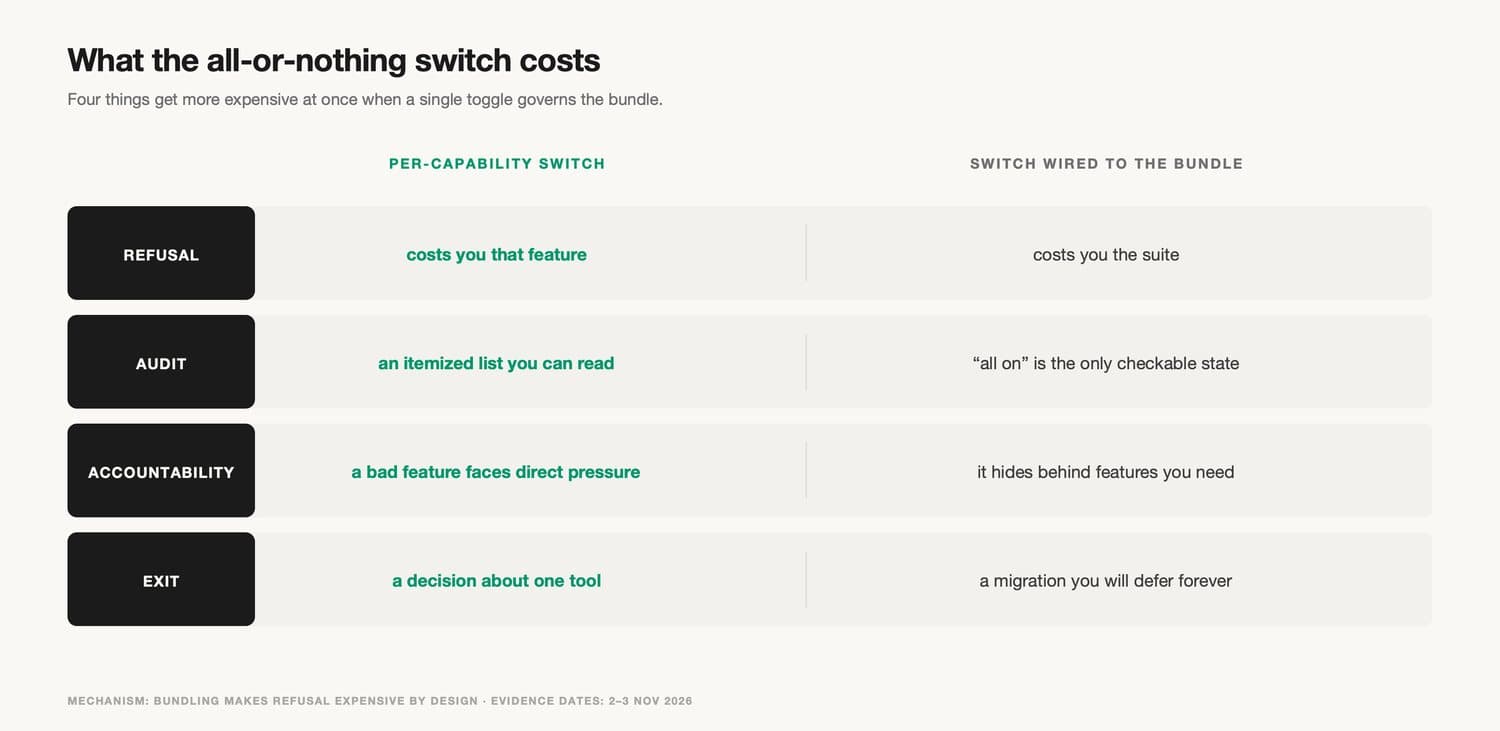
What the all-or-nothing switch costs: refusal, audit, accountability and exit all get more expensive when one toggle controls the bundle.
04This is not a school story
It is tempting to file this under education news. The reason it belongs in your work planning is that the same wiring is being installed everywhere, and the same week supplied the receipts.
Two days earlier, on 2 November, OpenAI told users that ChatGPT and Codex will draw from one shared allowance pool — two products you paid for separately, now metered together [4]. The same weekend, Grok users learned their usage quotas could be cut retroactively, overnight [5]. Pooled allowances, bundled capabilities, welded switches: three versions of one direction. Fewer controls, held by the vendor, covering more of what you use.
For a business, the school scenario translates directly. Your team uses a productivity suite. The vendor adds AI features inside the tools you depend on — the document editor, the spreadsheet, the inbox. Your compliance needs, your client contracts, or your own judgment say: not this one, not yet. The precedent set this week is the answer you should expect: you can turn it off — along with the editor it lives in. If your plan for that conversation is "our vendor wouldn't," note that 150 million students had the same plan in October, when Gemini arrived in their classrooms switched on.
05Run the same test on your own stack — a twenty-minute audit
You don't need to wait for your vendor's version of the November 3 announcement. The school story gives you the test; here is how to run it on your own tools this week.
Not products — capabilities. "AI summaries in the inbox," "generated answers in the document editor," "meeting transcription with AI notes," "AI autocomplete in the spreadsheet." Ten minutes, one column.
Open the admin console and look for the control that disables that capability alone. Write down one of three answers: has its own switch; shares a switch with something else; no switch found.
What else goes dark if you flip it? That list — not the AI features themselves — is your actual exposure.
Announced in a blog post, present in the console, or verified by someone on your team actually flipping it in a test account? A switch nobody has ever flipped is a hope.
Shared switches and missing switches belong in the risk register next to supplier concentration, with an owner and a review date — not in a Slack thread that scrolls away.
A worked example of what the table tends to look like:
| Capability | Own switch? | What else goes dark? | Status |
|---|---|---|---|
| AI summaries in inbox | Shared | The inbox's smart filters | Verified in test |
| Generated answers in editor | None found | — | Confirmed absent |
| Meeting AI notes | Own switch | Nothing | Verified in test |
| AI in enterprise search | Shared | All of enterprise search | Announced only |
The fourth row is the school story wearing your company's logo. Most teams that run this audit find at least one of them.
Finding it before renewal season is the entire point.
06The counter-evidence arrived the same day
Here is why "that's just how integrated systems are" doesn't survive the week: on the very same Monday, Anthropic published research showing how much more separable and verifiable AI can be than anyone ships today.
The system is called FlashProve, released as an open-source specification with working code [3]. What it does, in plain terms: it gives a mathematical proof that a specific output came from a specific model. A lab publishes a "fingerprint" of each model — without revealing the model's weights, the internal numbers it keeps private. Later, anyone can verify, even on a local device, that the answer they received really came from the model they were promised. The researchers name the failure it prevents: an AI company secretly swapping in a cheaper model to cut costs — even when the impostor is the lab itself. No deployment plans yet; it is published as intermediate progress for others to improve.
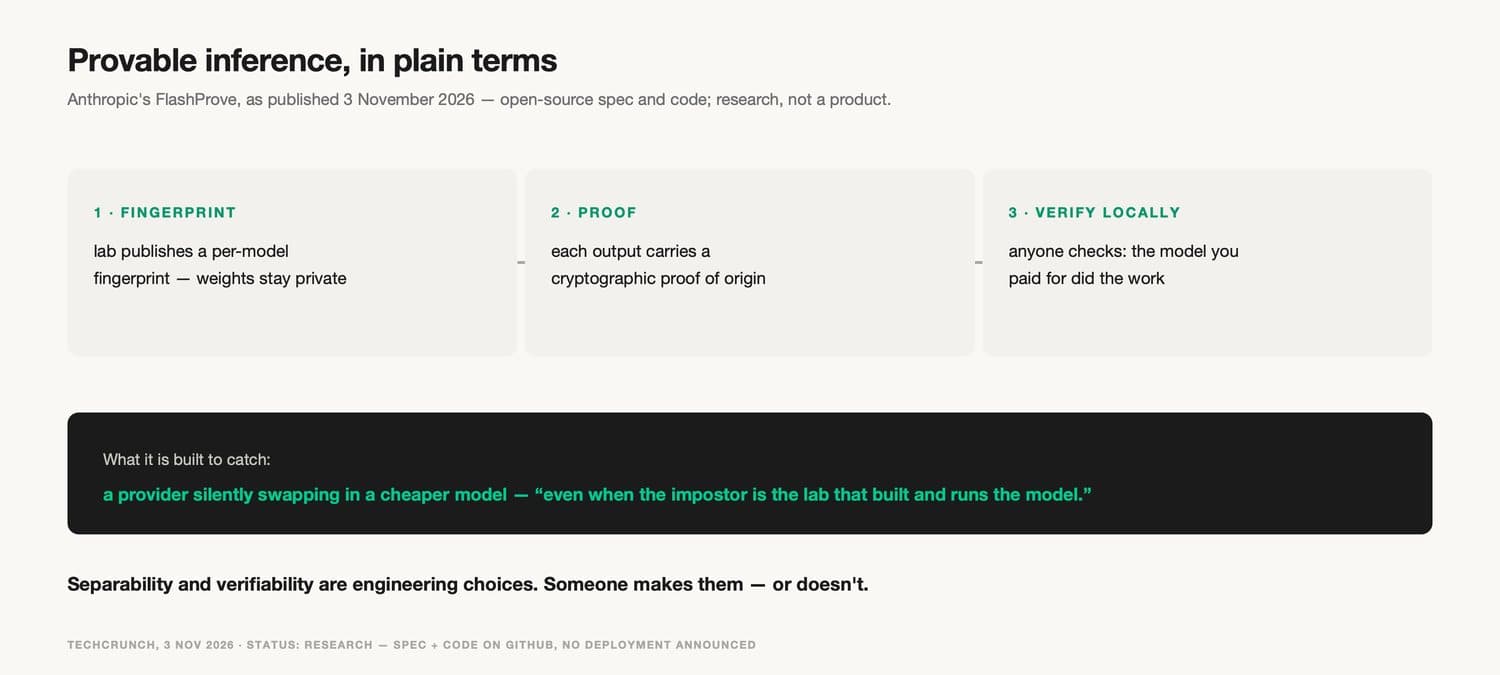
Provable inference, in plain terms: the lab publishes a model fingerprint; your output carries a proof; you verify locally that the model you paid for is the model that did the work.
Put the two Monday announcements side by side and the contrast does the arguing. One company says capability and product cannot be separated, so refusal must cost you everything. Another publishes working code whose entire purpose is separation — proving exactly which model did exactly which work, capability by capability, output by output. Verifiability and separability are not science fiction. They are engineering choices that someone made, or didn't.
07What verification would change in practice
It is worth making the research concrete, because "cryptographic proof" sounds abstract until you attach it to three ordinary situations — all three named or implied in the published research [3].
The silent downgrade. You pay for a frontier model. Serving costs spike — this exact week showed how vendors respond to that. Today, if a provider quietly routes your requests to a cheaper model, your only detection method is vibes: "the answers feel worse lately." With provable inference, the output either carries a valid proof from the model you paid for, or it doesn't. The Grok weekend was about quotas; the same cost pressure points at model substitution, and the researchers name that scenario explicitly.
The borrowed credential. A developer claims their library "was scanned by a frontier cybersecurity model." A company claims its plan "was approved by an appropriate model." Today those claims are unfalsifiable marketing. With verification, they become checkable statements — the research post uses both examples.
The acceptance test. A procurement team today accepts "the vendor says the capability is off" as the final answer, because there is nothing behind the assertion to inspect. A verification layer turns switch states and model identity into things an auditor can confirm. That is the end state the three tests below point toward — and it is also the test this article's own publisher cannot yet pass.
08The three tests of a real off-switch
So what should you actually demand — from an education vendor, a SaaS suite, or an AI workspace? Three tests, in increasing order of strictness.
Test one: one switch per capability. Turning off the thing you don't want cannot cost you a thing you need. If the vendor's answer couples them — "AI and Search are deeply integrated" — you are not looking at a switch. You are looking at the main breaker with a feature's name written on it.
Test two: "off" means absent, not hidden. There are two ways to build "off." One hides the feature behind a flag: the capability still exists, still connected, waiting for a config change, an A/B test, or a persuasive prompt to wake it. The other removes the connection: the capability is not reachable, by anyone, through any instruction. The difference sounds academic until something goes wrong at 2 a.m. — a hidden capability can fail into the on state; an absent one cannot. (The fuller argument for why this distinction decides real-world failures is in our piece on the private AI capability paradox.)
Test three: you can verify what actually ran. A switch you cannot audit is a promise, not a control. This is what makes the FlashProve direction matter: the end state of a trustworthy system is not "the vendor says it was off." It is "here is the proof of what ran, checkable by you."
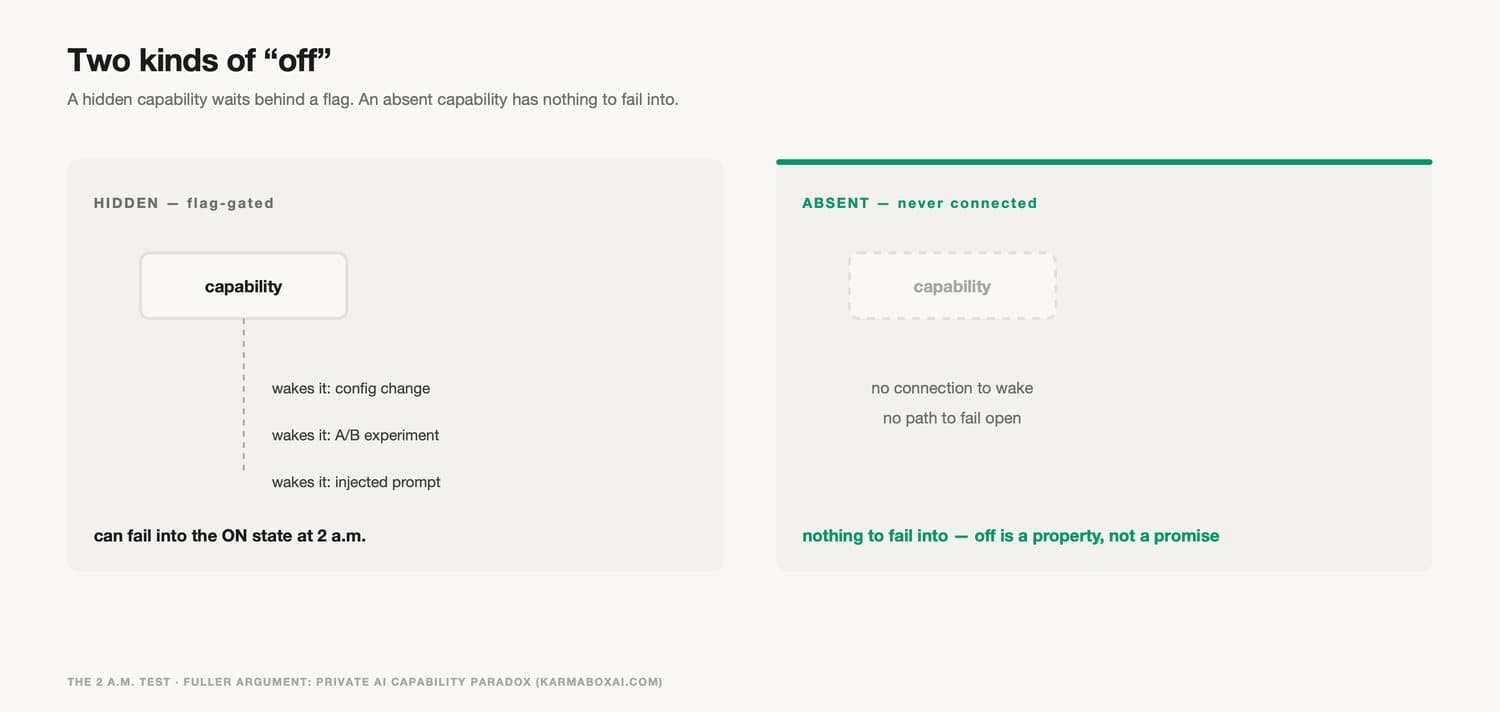
Two kinds of off: a hidden capability waits behind a flag and can fail into the on state; an absent capability has nothing to fail into. Only one of these passes the 2 a.m. test.
09Why bundling keeps winning anyway
If unbundled switches are so clearly better for customers, it is fair to ask why the market keeps producing the opposite. The honest answer has three parts, and none of them is "customers are fools."
Integration genuinely improves the product — at first. AI answers inside search results are faster than a separate tool. Summaries inside the inbox beat copy-pasting into a chatbot. The bundled version wins the demo and often wins the first six months. The costs this article describes — audit, refusal, exit — arrive later, and they arrive as someone else's problem: the buyer who approved the suite has often moved on by the time the exit bill comes due.
Buyers reward bundles at purchase time. One contract, one invoice, one vendor to call: procurement is scored on consolidation. Every incentive at signing points toward fewer, bigger switches. Every pain point after signing points the other way. The asymmetry is structural, which is why it repeats across industries that have never heard of AI Overviews.
And refusal is expensive to organize. A school district that wants Search without AI has to argue with Google. A customer who wants the editor without the assistant has to argue with the suite vendor. Individually, almost everyone folds — which is rational, and which is exactly what makes this week unusual: 150 million users is a big enough block that senators argue instead.
What would change the incentives is not outrage but demand-side discipline: procurement teams asking the three tests above before signature, the way they already ask about data residency; and competition — vendors who pass the tests saying so, loudly, in terms buyers can verify. The second of those is the commercial bet this article's publisher has made, which is one more reason to check our claims rather than take them.
10What per-capability switches do and don't fix
This section keeps the claim specific — including against us.
Per-capability switches fix bundling risk: refusing one feature no longer costs you the suite, so your refusals can actually be used. They fix audit risk: "what is on?" becomes a list you can read, item by item, instead of one all-or-nothing state. And absence — the stricter kind of off — fixes the 2 a.m. risk: a capability that is not connected cannot be talked, misconfigured, or injected into turning itself on.
They do not fix judgment risk: deciding which capabilities should be off, for whom, is still a human call, and a wrong call with perfect switches is still wrong. They do not fix data-already-shared risk: a switch flipped today does nothing about what went out yesterday. And they do not, by themselves, fix verification risk: unless the system can prove what ran — the FlashProve direction — even good switches operate on trust. We ship the first two fixes and have opinions about the third; we have not solved it either.
11How this looks on KarmaBox
Now, the product paragraph — with the news as the measuring stick.
KarmaBox is a workspace you buy once and run on your own hardware, staffed with 19 built-in avatars — bookkeeping, outreach drafting, support, review — and the wiring is the opposite of Monday's announcement, by design. Every avatar's permissions come in three tiers, enforced in the system rather than in a prompt: actions it does directly, actions that stop and ask you first, and capabilities that are simply absent — not connected, for anyone, under any instruction (19 avatars, 7 categories, 60 playbooks, 241 regression cases: our reference page, 15 October 2026 — vendor content, our own figures) [6]. One concrete example from our own catalogue: the Music avatar cannot publish at all. That is not a policy we promise to enforce. There is no publish button for it to press. Turning one avatar off costs you exactly that avatar; Search — or anything else — stays lit, because nothing here is wired to the main breaker.
What this does not give you, to keep the ledger honest: it will not un-bundle the vendors you already use, it does not decide for you what should be off, and until verifiable-inference work like FlashProve matures across the industry, "prove what ran" remains a promise we also make on trust plus logs, not cryptography.
12FAQ
Can schools turn off Google's AI without losing Search?
No. Per Google's own statements on 3 November 2026, Gemini, NotebookLM and Classroom AI can each be toggled individually, but disabling AI entirely means Google Search becomes unavailable for K-12 student accounts — students see a message that Search is turned off. Google's stated reason: "Search and AI are deeply integrated."
Why do vendors bundle AI features with core products?
Defaults drive usage, and usage justifies AI investment. An opt-out that costs nothing gets used; an opt-out that costs you the core product does not. Bundling makes refusal expensive by design — the same logic as pooled allowances (OpenAI, 2 November 2026) and retroactive quota changes (Grok, 2 November 2026).
What is provable inference (FlashProve)?
An open-source research system published by Anthropic on 3 November 2026. Labs publish a cryptographic "fingerprint" of each model, without revealing weights; outputs can then be verified — even locally — as genuinely coming from that model. It is designed to catch vendors secretly swapping in cheaper models. Not deployed anywhere yet; published as intermediate progress.
What should a real AI off-switch look like?
Three tests: one switch per capability (refusing one thing costs only that thing); "off" means the capability is absent, not hidden behind a flag; and what actually ran can be verified, not just promised. Most products today pass none of the three.
Is “deeply integrated” ever a legitimate engineering claim?
Partially. Separation has real engineering cost, and maintaining two code paths is work. But "expensive for the vendor to separate" is a different statement from "impossible to separate" — Search ran without generated answers for twenty years, and the vendor controls which internal states become customer-facing switches.
Does turning an AI feature off protect data that was already processed?
No. An off-switch controls what happens from now on; it has no effect on what earlier configurations already transmitted or stored. If a capability ran enabled for months, the questions about that period — what was sent, where it lives, how long it is retained — are retention and deletion questions, governed by the vendor's data terms, not by the switch.
One question to leave with: go down your own tool list — which AI feature could you actually turn off tomorrow, and which one would take the whole building's power with it?
13About the author
Karma Box Team publishes practical guides to AI sovereignty, workspace control, and responsible vendor evaluation. This article separates reported facts from editorial interpretation, quotes the vendor's own defence in full, and states its evaluation criteria so they can be applied to any vendor — including KarmaBox. It does not assess Google's motives, certify any product's compliance, or constitute legal or procurement advice. News coverage was reviewed on November 4, 2026.