Downloading a model changes your relationship with an AI supplier. You may be able to run inference on equipment you control, keep a tested version, and move between hosting arrangements. Those are meaningful advantages. But a downloadable model does not automatically give you permission for every use, disclose its training history, protect private files, or provide a team that can maintain it.
Open weights can reduce dependence on a particular service. Sovereign AI requires the authority and practical ability to govern the whole workflow: data, models, permissions, infrastructure, and exit. The most useful question is therefore what a specific release lets you do, and whether your deployment can turn those permissions into reliable control. A model's brand or an "open" badge cannot answer that question alone.
This guide separates open weights, open-source AI, and closed services, then examines specific Llama, Qwen, and Mistral licence examples. It explains what openness can contribute to private work and how to evaluate the gaps. The examples are selected to illustrate licensing differences, not to rank current models or recommend a universal winner. Always review the exact artifact and intended use before deployment.
01Open-weight versus open-source versus closed
Model weights are learned numerical parameters used with a model architecture and runtime to produce outputs. An open-weight release makes those parameters available to others, generally under specified terms. Access may enable local inference and modification, but the phrase does not describe one universal licence. Some releases permit broad reuse; others impose conditions on commercial activity, distribution, acceptable uses, or eligible users.
Open-source AI is a stronger claim under the Open Source Initiative's Open Source AI Definition 1.0. That definition requires freedoms to use, study, modify, and share, together with the preferred form for modification. It includes parameters, relevant code, and sufficiently detailed training-data information. It does not simply equate downloadable weights with an open-source system [5].
Closed models typically keep weights unavailable to customers and expose capabilities through a product or API. That can limit independent hosting and modification while providing managed operations and contractual support. A closed service can still offer useful privacy controls. An open-weight model can still be hosted by a third party. Licensing openness and deployment location are separate dimensions, and both need examination.
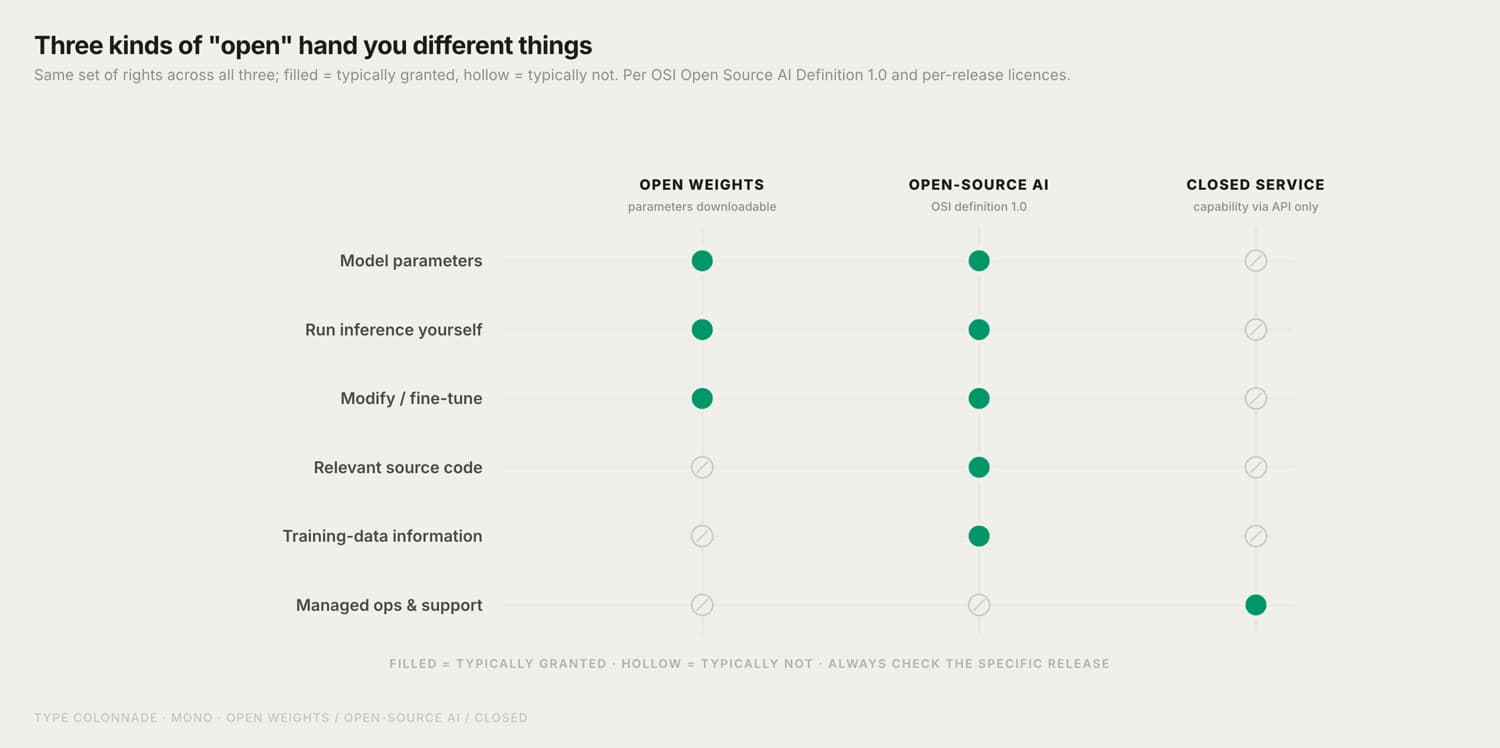
Open weights hand over parameters, inference and modification. Open-source AI additionally requires relevant code and training-data information. A closed service trades those for managed operations. Always check the specific release [5].
An open API is different again. It may mean a documented interface or compatibility with a familiar request format. Neither necessarily provides weights, training materials, or a right to operate the underlying model yourself. When a vendor says its platform is open, ask which components are available, which rights apply, and which dependencies remain. Record the answer as an inventory rather than a binary label.
Why the definition debate matters to buyers
The debate concerns what people need to exercise meaningful freedom over an AI system. Weights can be enough to run a trained model without reproducing its development. Studying how it was built or recreating a substantially equivalent system requires more information and resources. Those are different goals. A buyer should describe the desired capability before deciding how much openness is necessary to achieve it.
OSI's approach requires training-data information rather than insisting that every underlying dataset must always be freely redistributed. This distinction reflects the difficulty of dealing with data that cannot be shared. It remains important to distinguish a published definition from a legal certification or a universal agreement among developers. Refer to the definition you use, and list the available artifacts instead of treating terminology as evidence of completeness.
For private work, this means two questions belong beside each other: can we legally run and adapt this model, and can we govern the resulting service? The first concerns licence scope and release materials. The second concerns architecture, people, and operating practices. A permissive answer to the first does not automatically resolve the second. Both should appear in a procurement or deployment decision.
02What the Llama Qwen and Mistral licences actually show
Licences attach to particular releases and materials. A model family can include different terms across versions, sizes, or products, so a family name is an unreliable shortcut. The following examples were reviewed on November 4, 2026. They illustrate permission structures rather than establish that every associated tool, dataset, derivative, or hosted service uses the same terms. Preserve the licence and revision alongside your deployment record.
| Release | Terms | Practical implication |
|---|---|---|
| Llama 3.3 70B Instruct | Custom Community License | Check attribution, acceptable use and additional commercial conditions. |
| Qwen3-8B | Apache 2.0 text | Broad reuse under conditions; does not guarantee the complete AI system meets OSAID. |
| Mistral Small 3.1 24B Instruct 2503 | Model card identifies Apache 2.0 | Review the Apache text and the surrounding runtime and service terms. |
Permission structures across three releases. Reviewed 4 November 2026; applies only to the specific releases named [1][2][3].
Llama 3.3's Community License permits use and modification subject to its conditions. It includes attribution and distribution requirements, an incorporated acceptable-use policy, and a separate permission requirement for the specified very-large-user scenario. The latter refers to more than 700 million monthly active users under the licence's release-date test. That is a custom permission structure, not Apache 2.0 [1].
Qwen3-8B's repository includes the Apache 2.0 licence text [2]. Mistral's official Small 3.1 24B Instruct model card identifies Apache 2.0 for that release [3]. Apache 2.0 provides broad permissions subject to its conditions, including applicable notice and redistribution duties. It also contains warranty disclaimers. Commercial permission is not a promise of accuracy, privacy, support, or fitness for your use case [4].
These examples are a reason to keep a licence checklist, not to assume that one familiar label settles all legal questions. Check intended use, redistribution, modifications, attribution, and any incorporated policies. Review separately the application, runtime, connectors, and data you use with the model. Seek qualified advice where the deployment or redistribution makes the interpretation material; this article is a technical purchasing guide, not legal advice.
03What open weights give you
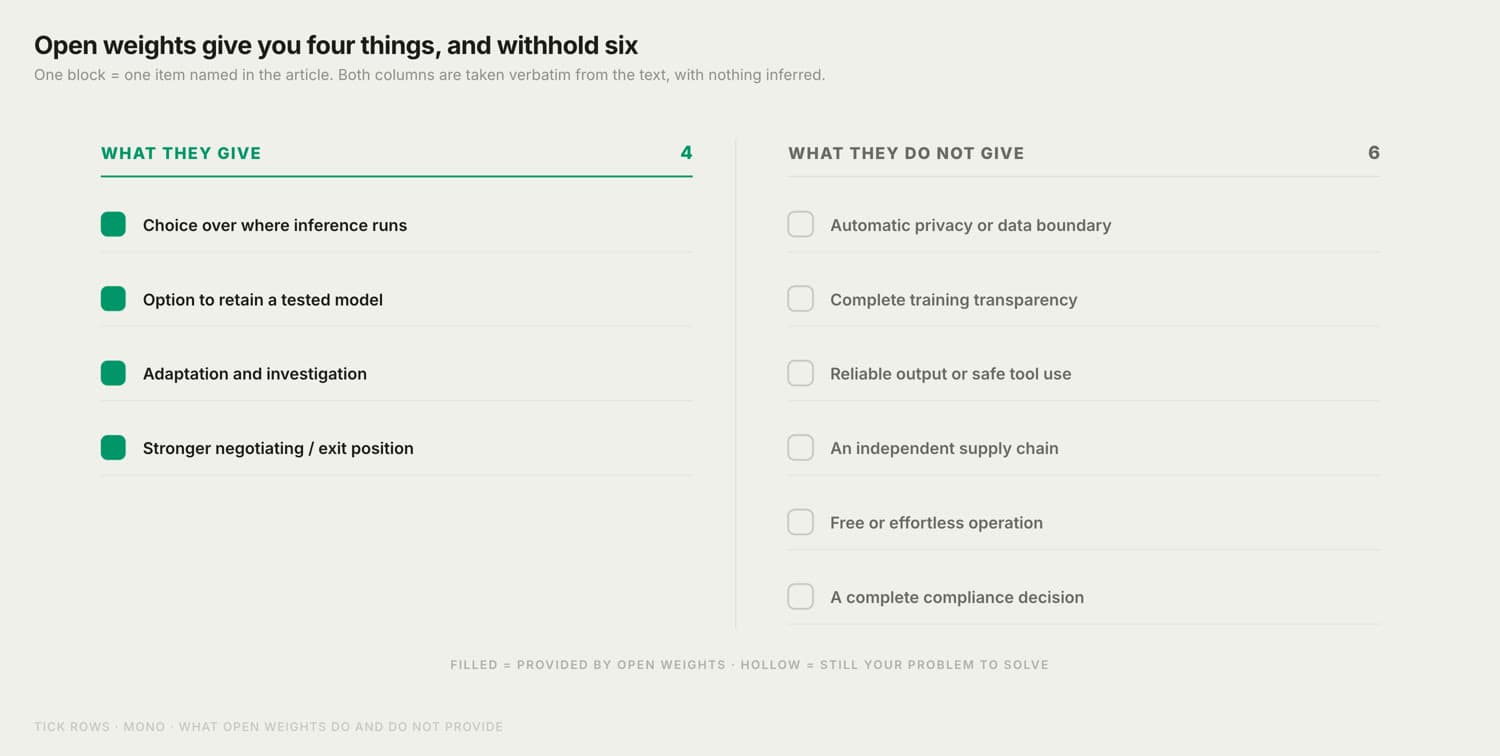
The next two sections take these item by item. Filled on the left is what open weights provide; hollow on the right is what you still have to solve.
More choice over where inference runs
With compatible software and sufficient hardware, available weights can let you operate inference on your own device, a private server, or a hosting provider you select. This creates an alternative to consuming one mandatory endpoint. The benefit is especially relevant when sensitive inputs must remain within a defined environment. Verify the complete workflow, however: an application may still call external embedding, search, speech, or monitoring services.
A practical option to retain a tested model
Holding an approved copy can reduce exposure to a hosted provider's model-retirement schedule. You can decide when to evaluate a replacement instead of accepting an immediate migration. The option remains subject to the applicable licence and to your ability to maintain a compatible runtime. It also creates work: vulnerabilities, changing business requirements, and deteriorating task performance still need attention even when the weights remain unchanged.
Adaptation and investigation opportunities
Depending on the release and its terms, weights can support fine-tuning, quantization, experimentation, and inspection that a remote-only service does not expose. You can compare variants on your own evaluation set or investigate failures in a controlled environment. These opportunities do not make every modification beneficial. Document what changed, preserve the baseline, and measure whether a tailored version improves the actual task without introducing unacceptable errors.
A stronger negotiating and exit position
An alternative deployment path can make it easier to respond to price changes, service restrictions, or a change in supplier strategy. You may be able to move the same approved model to another environment. That is a narrower and more defensible claim than saying there is no lock-in. Workflow definitions, embeddings, monitoring, identity, and stored conversations may still require conversion or rebuilding when you leave a platform.
The strongest evidence of portability is a completed migration exercise. Export the customer assets, restore the runtime, run the evaluation set, and confirm the permissions. Measure the time and labor involved. A downloadable weight file is one ingredient in that process. A recovery procedure that another qualified colleague can follow is what turns the ingredient into a usable option for the organization.
04What open weights do not give you
Automatic privacy or a complete data boundary
A local model can process a confidential file while its surrounding application uploads diagnostics, synchronizes conversation history, or invokes a cloud tool. The model's licence does not configure those behaviors. Map inputs, retrieved documents, outputs, logs, backups, and connectors. Identify which components can access plaintext and which services receive metadata. Privacy depends on those paths and controls, not on the location of the weight file alone.
Complete training transparency
Weights do not function as a readable ledger of every training example or decision. A model card can explain intended uses and limitations without providing enough material to recreate training. Distinguish what the publisher documents from what your team can independently verify. If provenance or reproducibility is essential to the project, specify the required evidence before choosing the model rather than discovering the gap after integration.
Reliable outputs or safe tool use
Availability of weights does not establish factual accuracy, fair performance across groups, or resistance to malicious instructions in retrieved material. A model that drafts a useful paragraph may still be unsuitable for controlling an account or sending a document. Evaluate the whole agent workflow. Limit tool permissions, separate trusted instructions from untrusted content, and require human approval where the consequences justify it. Openness creates testing opportunities; it does not replace testing.
An independent supply chain
Self-hosting still depends on processors, memory, drivers, inference libraries, power, maintenance, and people. Some configurations work across several environments; others depend heavily on a particular accelerator or software stack. Identify the components that would be difficult to replace. A model can be portable in principle while the chosen deployment is expensive to move. Sovereignty improves when the alternative path has been demonstrated under realistic constraints.
Free operation or effortless maintenance
A model download may have no purchase price while the service remains costly to operate. Include hardware, energy, storage, backups, engineering, security updates, and support time in the comparison. Utilization matters: an expensive machine used occasionally can have a very different cost profile from a well-used shared service. Compare cost per acceptable completed task, including review and correction, rather than focusing only on licence fees or token prices.
A complete compliance decision
The ability to use a model commercially is separate from obligations attached to personal data, professional services, employment decisions, or other regulated activities. Hosting locally does not eliminate those responsibilities. Keep the relevant assessments, authorized data uses, and human decision roles visible. A permissive licence can simplify one part of the evaluation, but it should not be presented as certification that the application is lawful or suitable.
05How to choose a model for private work
Start with the task and the information it touches
Describe a narrow workflow before selecting a model. Identify the input, expected output, languages, document lengths, users, and consequences of failure. Separate public material from confidential business information and personal data. Decide which information may leave the chosen environment. These requirements help determine whether local, managed private, or approved cloud processing is appropriate; a popular model name should not make that decision for you.
For an existing deployment comparison, see our guide on moving from cloud dependence to AI independence. Use its comparison as a starting point for questions about your actual setup. A local path should be checked end to end, and a cloud path should be assessed against its processing terms and controls. The choice can differ between tasks within the same team.
Record the exact release and its dependencies
Keep the model identifier, source repository, revision, licence copy, tokenizer, inference runtime, and relevant settings. If using a community conversion or quantization, identify its origin and relationship to the original release. Review any required executable code before enabling it. This inventory makes later troubleshooting and licence review possible. Without it, a model name in a settings menu can conceal substantial uncertainty about what is actually running.
Test quality on the exact hardware and configuration
Use representative examples and define unacceptable errors before comparing candidates. Include incomplete documents, conflicting evidence, sensitive context, and requests that should be declined or escalated. Measure accuracy, latency, memory pressure, and concurrent use. Results from a larger version or a different precision do not establish the performance of the artifact you deploy. Record the evaluation settings so a future update can be compared fairly.
Check the surrounding workflow for unintended transfers
Run a controlled pilot with synthetic or approved data and inspect available network and application records. Check embeddings, document parsing, search, analytics, synchronization, and fallback routing. A fallback should respect the same data policy as the primary path. If private input must remain local, a failed local request should not silently become a cloud request. Document what users will see when an allowed processing path is unavailable.
Assign maintenance and prove recovery
Name the person responsible for model updates, runtime patches, access, and incident response. Keep a tested rollback path and decide how long older versions remain supported. Then restore a sample workflow into a clean environment using your saved records and assets. A system is easier to govern when recovery does not depend on one person's memory or an undocumented installation that nobody else understands.
06A worked example of choosing control over a label
Imagine a small consultancy comparing two hypothetical assistants for internal document summaries. One uses downloadable weights but sends document embeddings to an external service and has no tested export. The other uses a managed model with documented processing, restricted access, and a verified migration process. The first option is more open at the model layer; that fact alone does not make its full workflow more controllable.
The consultancy could improve the first option by moving embeddings into the approved environment, limiting connectors, and testing recovery. It could reject the second if its contract or processing locations fail a mandatory requirement. The decision depends on evidence and workload constraints. This example does not compare real vendors. It illustrates why an openness label should be one input to a decision, alongside operational controls and legal permissions.
A practical review can record five separate findings: licence fit, data boundary, task performance, maintenance ownership, and exit readiness. Mark each as demonstrated, partially supported, or unresolved, with evidence and an owner. Do not average away a mandatory failure. A model that scores well on quality cannot compensate for a prohibited data transfer, and a local deployment cannot compensate for an unapproved licence use.
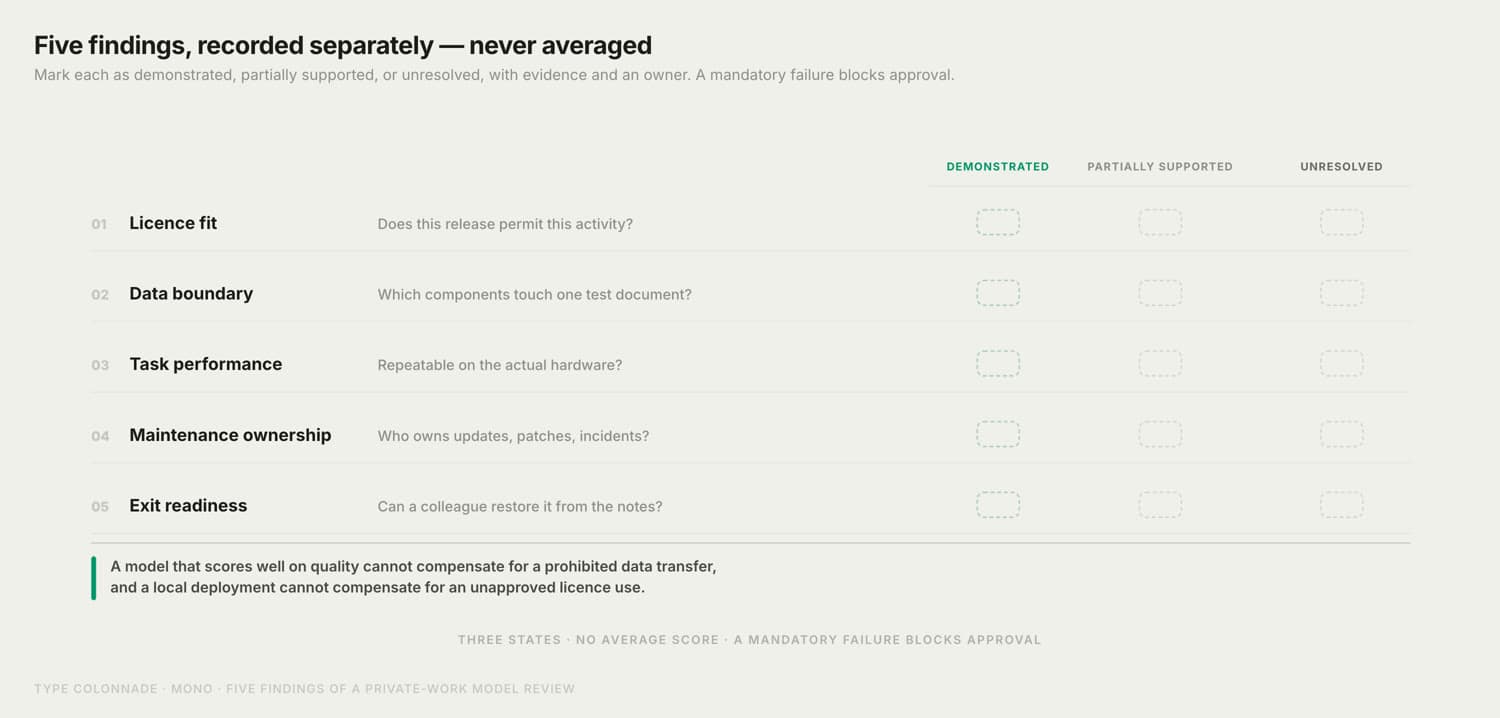
The state cells are left blank because the answers can only come from your own configuration. The point is that the five are recorded separately: no average score, and a mandatory failure blocks approval.
07A model evaluation worksheet for private work
Create one assessment record for each candidate configuration. The record should name the model release, runtime, hardware, document-processing components, and intended users. Treat a change in any important component as a reason to review the assessment. This prevents evidence collected for a desktop experiment from being reused without thought for a shared production service. The model may be identical while the access risks, workload, and operating responsibilities have changed substantially.
For licence fit, record the relevant document and explain how the intended activity fits its terms. Internal inference, distributing a modified model, and providing a customer-facing service may raise different questions. Keep uncertainty visible and assign someone to resolve it. A checkbox reading "commercial use allowed" loses important context if it does not say which version, which activity, and which conditions were reviewed. The record should help a future colleague understand the reasoning.
For data control, draw the path of a single approved test document. Follow it through ingestion, parsing, retrieval, generation, storage, and deletion. Include temporary files and the records kept for troubleshooting. Check whether a different user can retrieve the same material through search or conversation memory. This exercise is more informative than asking whether the main model is local, because private information can cross a boundary before or after inference takes place.
For performance, distinguish an impressive demonstration from repeatable task completion. Define what counts as correct, what requires a human, and what must never happen. Record representative failures as well as successful examples. When comparing candidates, use the same inputs and review criteria, and note differences in settings or available context. The evaluation does not need to be large to be useful, but it should reflect the work the team will actually perform.
For operations, ask another qualified person to use the recovery notes. Can they identify the approved artifacts, restore the service, confirm permissions, and run the acceptance examples? If the process stops because a password, setting, or dependency is missing, fix the documentation and repeat the relevant step. A recoverable deployment makes the organization less dependent on an individual maintainer as well as less dependent on an external model provider.
Finish with a decision tied to a scope: approved for which task, which data, and which users? List unresolved conditions and the next review trigger. A model can be suitable for drafting internal summaries while remaining unsuitable for autonomous external actions. Preserve that distinction in the user interface and operating instructions. Sovereignty becomes useful when people understand the boundaries they control and the decisions that still require a responsible human owner.
08Making openness useful in a KarmaBox workflow
Our existing guide to open-source models and sovereign AI explains the broader local-workspace approach. This article adds a release-specific licensing lens. Start with the task you want to control, then verify which model, runtime, and integrations the selected configuration actually uses. Product descriptions should lead to testable questions about the deployment, rather than replace those questions.
Use the KarmaBox documentation to prepare the configuration review. Confirm model availability, routing behavior, permissions, and export for the product you will use. Begin with one low-risk workflow and retain a human review step until the evidence supports expanding it. Apply the same standard to KarmaBox that you would apply to another supplier: describe the control, find the evidence, and test the important limits.
The broader principle applies beyond any product. Open weights are valuable because they can widen your choices. Sovereignty emerges when those choices remain lawful, usable, and maintainable under real conditions. Keep the licence, data boundary, evaluation results, and recovery procedure together. That collection of evidence says more about control than the word "open" printed beside a download button.
09Frequently asked questions
Are open-weight models the same as open-source AI?
No. Available weights describe access to learned parameters. Under OSI's Open Source AI Definition 1.0, open-source AI also requires relevant freedoms and the materials needed for modification, including code and training-data information. Review the exact release rather than assuming the labels are interchangeable.
Can open-weight models be used commercially?
Many releases permit commercial use under conditions, but there is no universal open-weight licence. Check the exact licence, incorporated policies, redistribution requirements, and intended deployment. Do not infer permission from the model family name or from another release's terms.
Does running a model locally guarantee privacy?
No. Local inference can keep model processing within a chosen environment, but applications may still use external tools, telemetry, synchronization, or backups. Verify the complete data path and access controls before treating the workflow as private.
Do all Llama Qwen and Mistral models have the same licence?
No. Licences must be checked by release. This article examines Llama 3.3's custom Community License and Apache 2.0 examples from Qwen3-8B and Mistral Small 3.1. It does not assign those terms to every model or service from the same developers.
What is the first step toward a more sovereign AI workflow?
Choose one task and document its data, model, permissions, and recovery requirements. Check the licence and test the actual configuration. Open weights can help, but evidence of lawful use, controlled data flows, acceptable performance, and a workable exit is what supports the decision.
10About the author
Karma Box Team publishes practical guidance on AI sovereignty, model choice, and workspace control. This article uses named releases to illustrate licensing differences and separates those facts from operational recommendations. Sources were reviewed on November 4, 2026. Model licences and product configurations should be checked again before deployment. Nothing here is legal advice.