
Governments can fund AI infrastructure, research teams, and companies. Whether that spending creates sovereignty depends on who controls the resulting systems, who can use them, and what happens when an important supplier changes its terms. Money expands the available options. Governance, supply-chain resilience, and adoption determine whether those options become durable control.
That distinction matters when a national AI announcement reaches the headlines. A large investment can be strategically useful without making a country technologically independent. It can improve domestic access while leaving hardware, software, or commercial decisions dependent on external actors. To understand the announcement, follow the money into specific assets, contractual rights, operational responsibilities, and services that people can actually use.
This guide examines Canada's October 29, 2026 commitment to Cohere, the company's separate fundraising target, and the UK's confirmed Sovereign AI programme. It then explains how to distinguish capacity from control, and what that distinction means for organizations, small teams, and individuals. The objective is to evaluate what a funding programme delivers, rather than judge its success by the size of its headline alone.
01What is a sovereign AI fund?
A sovereign AI fund is a public investment mechanism intended to strengthen a country's ability to develop, deploy, or govern artificial intelligence. The label does not describe one standard financial instrument. A programme may invest in companies, subsidize computing access, finance infrastructure, support research, or create demand through procurement. Its mandate and contractual terms reveal more than the name attached to it.
An equity investment gives the public investor a financial stake, with rights determined by the investment agreement. A grant pays for eligible activities under specified conditions. A loan must generally be repaid, while a guarantee changes who carries a financing risk. A procurement contract buys a service or deliverable. These mechanisms can support the same policy goal, but create different incentives and obligations.
A dedicated AI fund should also be distinguished from a sovereign wealth fund that happens to invest in AI. The latter may prioritize portfolio returns across many industries. An AI-specific programme can pursue strategic objectives such as domestic research access or public-service capability. Neither structure guarantees good governance. The important question is whether its decision rules, accountability, and measurements match the outcomes it promises.
Before comparing programmes, classify each figure as announced, authorized, committed, disbursed, or operational. A financing target belongs in a different category from money already invested. A planned data center differs from an energized facility with usable capacity. A signed customer agreement differs from demonstrated adoption. Keeping these stages separate prevents an attractive story about future capability from being mistaken for evidence of present control.
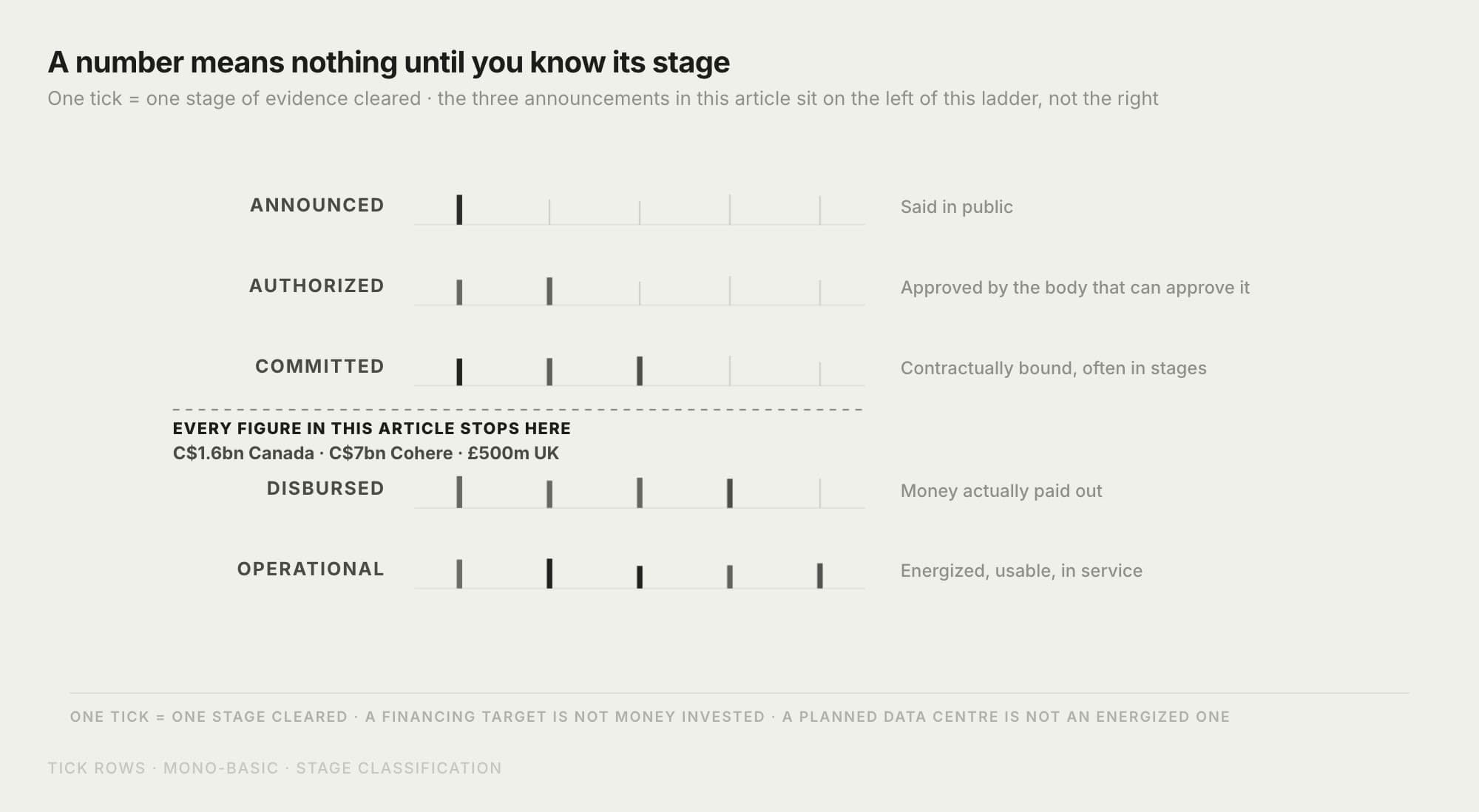
One tick = one stage of evidence cleared. Every figure in this article stops at committed — not a criticism, but a reminder that a contractual bind is not an energized facility.
02Country snapshots and the funding figures that matter
The snapshots below use information reviewed on November 3, 2026. They compare the type and status of selected initiatives, not total national AI spending. Amounts retain their original currencies. The two Canadian entries describe related parts of one financing story and must not be added together as separate public spending. The UK entry concerns a different investment mechanism with a different mandate.
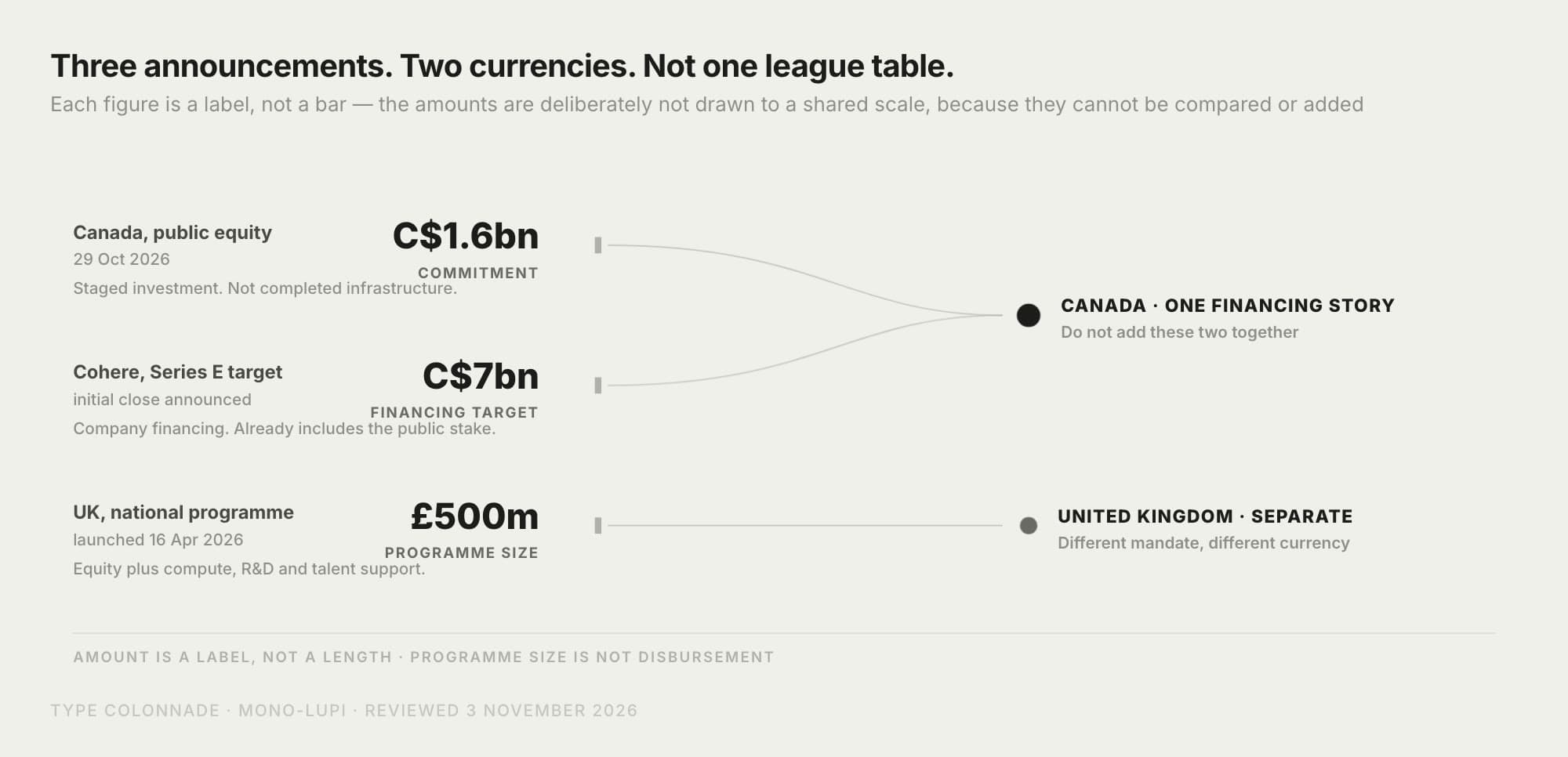
The amounts are deliberately not drawn to a shared scale: two currencies, three instruments, neither comparable nor addable. The two Canadian threads converge on one node because the C$7bn already contains the C$1.6bn.
| Country / instrument | Amount and status | What to verify |
|---|---|---|
| Canada / public equity | Up to C$1.6bn commitment; October 29, 2026 | Staged investment, not completed infrastructure [1] |
| Canada / Cohere financing | Up to C$7bn Series E target; initial close announced | Company financing, not a separate government fund [2] |
| United Kingdom / national programme | £500m programme; launched April 16, 2026 | Equity and supporting measures; programme size is not disbursement [3] |
A comparison of the type and status of selected initiatives, not total national AI spending. Amounts retain their original currencies.
Canada is making an investment with conditions
On October 29, Canada's government announced an equity commitment of up to C$1.6 billion in Cohere. Its official release describes staged investment and reporting against company commitments. Those commitments include retaining Canadian incorporation and headquarters and investing at least C$1.7 billion in new Canadian computing infrastructure by 2030. These are announced commitments, not proof that the infrastructure is already operational [1].
For policy evaluation, the structure matters as much as the amount. Staging creates opportunities to check delivery before further capital is released. Reporting can make a domestic-investment promise more accountable. However, the public announcement does not establish every governance right, technical safeguard, or customer entitlement. Evaluators should distinguish the disclosed conditions from assumptions about voting power, intellectual property, or preferential access to future services.
The practical test is what becomes available after investment: usable computing resources, maintainable models, qualified operators, and products that customers choose. Local incorporation can support a national strategy, but it cannot substitute for those capabilities. Nor does a financial stake automatically establish operational command over every system. A credible assessment follows delivery milestones and control arrangements instead of assuming that ownership settles the whole question.
Cohere's C$7 billion target is a different number
Cohere announced an initial close of a Series E financing targeting up to C$7 billion. Its company-issued release identifies a fundraising ambition, rather than saying that the entire target has already been received. Canada's commitment is connected to that round; it is not another C$7 billion government fund. Keeping the target, public contribution, and company valuation separate is essential [2].
This distinction prevents a common analytical error: adding a government commitment to a financing total that already includes it. It also prevents confusing a company's market valuation with its cash budget. Valuation describes the price implied by an investment transaction; it does not mean an equivalent sum is available to purchase equipment or hire engineers. For this article, the relevant comparison is financing purpose and control, not valuation rankings.
The UK programme combines capital with practical support
The UK's £500 million Sovereign AI programme is confirmed by the government's April 16, 2026 launch announcement. The release combines direct investment with support involving computing access, research, and talent. It identifies Callosum as the first equity investment and six further startups receiving supercomputing access. This is a verified programme announcement, not evidence that the full envelope has been spent [3].
The programme's own FAQ describes equity investments typically ranging from £1 million to £10 million, alongside access to public compute, R&D funding, talent support, and procurement opportunities. That wider package recognizes that capital is only one obstacle to scaling. Nevertheless, access to an opportunity is not a guaranteed contract, customer, or commercially successful product [4].
The broader lesson is to compare how funds remove bottlenecks. A research team may need compute allocation more urgently than a larger office. A startup may need a first customer, while a public agency may need procurement expertise and integration support. A fund creates more public value when its instruments address identifiable constraints, with evidence that beneficiaries can turn the support into functioning services.
03Capacity versus control
Capacity is the ability to perform work: computing resources, researchers, engineering teams, data infrastructure, and deployable services. Control is the authority and practical ability to decide how that capacity operates. It includes access rules, model changes, data handling, accountability, continuity, and exit. These concepts overlap, but neither is a reliable substitute for the other. A useful national strategy should measure both explicitly.
Consider a hypothetical country that subsidizes a large local data center. The facility creates useful capacity and may improve latency or access. But if external administrators control essential software, a single supplier controls replacements, and customers cannot move their workloads, important dependencies remain. Conversely, a smaller shared facility with clear operating rights and tested migration may provide stronger control for a limited set of critical services.
This is an illustrative comparison, not a claim that smaller facilities are always better. Scale can reduce unit costs and support demanding research. The point is that a procurement decision needs an intended workload and a defined threat or disruption scenario. Without those, “more sovereign” becomes an untestable label that can be attached to almost any domestic spending proposal.
Governance turns money into enforceable responsibilities
Governance begins with a clear answer to who can decide. Who approves eligible users? Who changes a model? Who investigates an incident? Who can suspend a harmful application? A funding agreement can establish milestones and reporting, while operating contracts define responsibilities after delivery. These arrangements should connect, so financial success does not conceal weaknesses in how the resulting service is managed.
Independent evaluation matters because beneficiaries and programme sponsors have reasons to emphasize progress. Evaluators should be able to examine evidence relevant to the claimed outcome, while respecting security and commercial confidentiality. Public reporting can disclose utilization, delivery delays, eligibility rules, and unresolved risks without publishing sensitive technical details. Accountability requires enough information to judge performance, not unrestricted disclosure of every system component.
Supply chains set the limits of independence
Domestic facilities still need equipment, spare parts, energy, networks, software maintenance, and skilled operators. The relevant question is which dependencies could interrupt essential work and how quickly alternatives could be used. A dependency map should identify concentrated suppliers and difficult substitutions. Purchasing equipment once does not resolve future refresh cycles, maintenance access, or the availability of people capable of operating the system safely.
Partnerships can therefore strengthen sovereignty when they provide credible alternatives and negotiated access. They can also create fresh concentration when every funded company relies on the same underlying stack. Diversification should be assessed at the layers that matter, rather than by counting vendor logos. Two providers using an identical critical supplier may not offer the resilience that a headline customer count suggests.
Adoption makes infrastructure economically useful
An installed cluster is an input. Useful adoption is an outcome. Researchers need understandable access procedures; businesses need dependable services and support; public agencies need integration, training, and accountable human review. If those conditions are missing, a technically impressive investment may be difficult to use. The cost of making AI useful therefore extends beyond the visible hardware purchase and initial model development.
Adoption should not mean encouraging every organization to use AI for every task. It means helping suitable users solve appropriate problems, with measured quality and acceptable risk. A public fund can support evaluation tools, implementation skills, and reusable integration patterns. These less visible investments may determine whether the infrastructure reaches smaller organizations or remains concentrated among a few technically sophisticated beneficiaries.
04What independent analysts add to the debate
Chatham House's analysis of middle powers treats sovereignty as the ability to preserve policy choices and avoid unhealthy dependence. Its February 2026 summary argues that countries should assess where they can build capability and where reliance on others remains necessary. This supports a selective approach to autonomy, rather than treating complete national self-sufficiency as the only meaningful outcome [5].
In a separate July commentary, Chatham House's Alex Krasodomski argues for sufficient onshore capacity for critical inference and for cooperation with other countries. Inference is the computation used to run a model after training. His view offers a practical alternative to making every national programme compete at the largest frontier-training scale. It is an analyst's policy recommendation, not proof that a particular fund has delivered sovereignty [6].
Our interpretation is that public funding should buy decision-making options matched to real needs. A country might prioritize secure inference for essential services, research access for universities, or specialized models for domestic industries. Those priorities can coexist with foreign partnerships. The test is whether the arrangement leaves the country able to continue, adapt, and hold providers accountable when circumstances become less favorable.
05How to judge whether a fund buys sovereignty
Start with the public problem. A programme designed to attract research talent should not be judged only by data-center spending. One designed to secure essential services should demonstrate continuity and governance, not only startup valuations. State the desired outcome before choosing measures. Otherwise, whatever is easiest to count becomes the definition of success, even when it has little connection to the policy's stated purpose.
Next, separate the dashboard into capacity, control, and use. Capacity measures can include usable compute hours, delivery milestones, and staffed operating capability. Control measures can include tested recovery, enforceable access rights, and alternatives for critical dependencies. Use measures can include completed deployments and quality-adjusted service outcomes. These are proposed evaluation categories, not a universal certification standard or an assertion that current programmes report all of them.
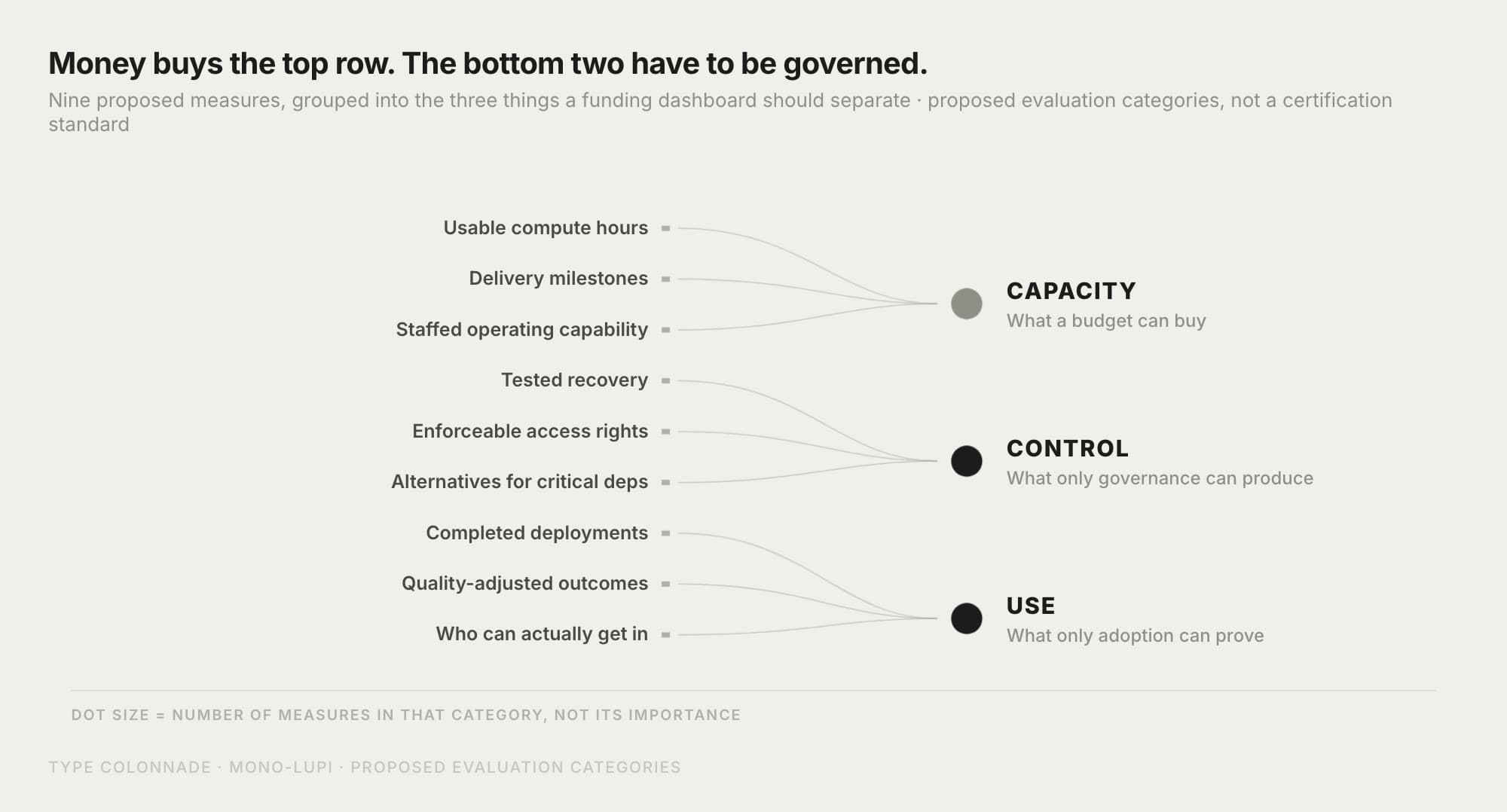
A budget can buy the first category. The other two can only be produced by governance and adoption. These are proposed evaluation categories, not a certification standard.
Ask what would happen under a disruption. If a supplier restricts access, can essential workloads move? If an operator fails, who has the documentation and authority to restore service? If a model becomes unsuitable, can users replace it without losing their records? Answers should include responsibilities, timeframes, costs, and test results. A policy aspiration becomes more credible when it survives an operational exercise.
Finally, examine the opportunity cost. Money allocated to one flagship project is unavailable for other infrastructure, skills, or public services. This does not make a large project wrong. It means that its expected benefits should be compared with plausible alternatives and revisited when assumptions change. Funding that cannot be redirected after persistent non-delivery may protect a project more effectively than it protects national options.
06What sovereign AI funding means for businesses and individuals
Businesses should treat national funding as a possible source of new options, not a substitute for vendor evaluation. A supported provider may offer useful local capacity or specialized services. Your organization still needs to examine actual processing locations, access, retention, model changes, and export. A government investment does not automatically rewrite the customer agreement or give every customer the same control the public investor negotiated.
Small organizations should watch for practical access conditions. Who is eligible for subsidized compute? Is implementation help included? Can a team without specialist engineers use the service responsibly? What happens when a subsidy ends? A low introductory price can hide later operating costs or migration work. Assess the workflow's full cost, including evaluation, training, support, and the labor needed to maintain control over time.
Individuals experience dependency at a different scale, but the underlying questions are familiar. Where do personal files and project memory live? Which model processes them? Can the workflow continue if a subscription changes? Our guide to sovereign AI for individuals and teams connects the national discussion to those everyday choices. A country's infrastructure strategy and a person's control over their workspace are related, but they are not interchangeable.
For a team considering KarmaBox, begin with a bounded workflow rather than a broad promise of independence. Review the KarmaBox documentation, identify the required deployment and model options, and test them with approved data. Check which actions stay local and which use external services. Confirm the specific product configuration before relying on a general description of local or hybrid operation.
Then compare the operating evidence with the KarmaBox service terms, just as you would for any other supplier. Keep a copy of essential prompts, source files, and instructions in a usable format. Assign an owner for permissions and model changes. These modest practices do not recreate a national AI programme, but they can make day-to-day AI dependence more visible and manageable.
07What a useful public-value scorecard would show
A public-value scorecard should distinguish delivery from publicity. For every funded asset, record the promised service, the expected users, the delivery date, and the evidence that it is usable. Then record who controls access, who carries operating responsibility, and what recovery arrangements exist. This creates a chain from the funding decision to the public benefit. The proposed method is deliberately simple enough to apply to a research-access programme or a commercial equity investment without pretending they have identical objectives.
For example, a hypothetical compute-access programme might report a large number of registered organizations. That number becomes more informative when accompanied by active usage, waiting times, completed projects, and the cost of support. If only a small group can navigate the allocation process, broad eligibility on paper may conceal narrow access in practice. The remedy might be training or simpler onboarding, rather than buying additional machines. This is why adoption evidence should influence the next funding decision.
An equity-backed AI company needs a different lens. Financial performance matters, but a strategic investment may also promise local engineering capability or specific infrastructure commitments. Those outcomes should be tracked separately rather than folded into a single valuation figure. A company could increase in value while missing a particular domestic delivery goal. It could also deliver useful technical capability before achieving strong financial results. Transparent reporting makes those differences visible and allows a more honest debate about trade-offs.
Control should be demonstrated through exercises as well as documents. An evaluator could ask an operator to restore a service from approved backups, revoke a test administrator's access, or move a sample workload to a permitted alternative. The exercise should use synthetic or otherwise authorized data, with success criteria agreed in advance. Its result does not prove that every disruption can be handled, but it gives stronger evidence than a promise that continuity and portability will be addressed later.
These checks should remain proportionate. A small research grant should not carry the same administrative burden as infrastructure supporting essential public services. Excessively complicated reporting can exclude the very teams a programme intends to help. The goal is enough evidence to support a responsible decision, with deeper scrutiny where failure would have larger consequences. A well-designed fund can make accountability predictable, so applicants understand the conditions before they invest time in pursuing support.
08A practical way to follow the next funding announcement
When the next headline appears, write down five things: the financial instrument, the delivery stage, the intended beneficiary, the control rights disclosed, and the evidence still missing. Resist comparing different currencies or financing categories as though they were a single league table. A smaller programme with clear access and adoption outcomes may answer a specific public need better than a larger promise without a delivery path.
Return to the announcement after implementation begins. Look for changes in the promised timeline, capacity actually available, utilization, and the ability of users to exercise their rights. This follow-up is where the sovereignty claim becomes testable. Funding can create the conditions for control, but durable sovereignty is demonstrated in how systems are governed, maintained, used, and replaced when necessary.
09Frequently asked questions
Do national AI funds automatically create sovereignty?
No. They can finance infrastructure, companies, research, and access. Sovereignty also depends on governance, operational authority, supply-chain resilience, and useful adoption. Assess the rights and capabilities created by the investment, rather than treating the funding amount as a measure of control.
Did Canada announce a C$7 billion government AI fund on October 29?
The announcements reviewed here describe an equity commitment of up to C$1.6 billion from Canada's government and a Cohere financing round targeting up to C$7 billion. These are related figures with different meanings. The fundraising target is not the amount of government spending.
Is the UK's Sovereign AI fund confirmed?
Yes. Official UK sources confirm the £500 million programme and its April 16, 2026 launch. Its support includes equity investment and other assistance. The announced programme size should not be confused with the amount already disbursed or the total of all UK AI spending.
Can a country be sovereign while using foreign AI suppliers?
It can preserve meaningful control over selected functions while using international suppliers. The relevant tests are enforceable rights, practical alternatives, continuity, and the ability to govern deployment. Sovereignty does not require eliminating every dependency, but it does require understanding and managing the dependencies that matter.
What should a small business do now?
Inventory important AI workflows, identify sensitive data and external services, and test export and recovery. Evaluate providers using their actual configuration and agreements. National funding may create useful new options, but your team's control still depends on the tools, permissions, and working practices you choose.
10About the author
Karma Box Team publishes practical guides to AI sovereignty, workspace control, and responsible vendor evaluation. This article distinguishes announced funding from delivered outcomes and separates source reporting from editorial analysis. It does not assess investment returns or certify any programme's sovereignty. Funding information was reviewed on November 3, 2026.