Storing AI workload data in a jurisdiction does not mean the jurisdiction is the only authority that can reach it. Where data rests and who can compel access to it are distinct questions, and conflating them is one of the more reliable ways to arrive at a compliance programme that satisfies an auditor while leaving a material exposure.
AI data residency is the physical location where data is stored and processed. AI data sovereignty is control over who can access that data, compel its disclosure, or determine its handling. Residency describes geography. Sovereignty describes authority.
For organizations deploying AI systems, this distinction matters in contract review, infrastructure decisions, and incident response. Choosing an EU data center for a US-based cloud provider addresses residency. It does not address the CLOUD Act. Certifying compliance with GDPR's cross-border transfer rules establishes a lawful basis. It does not prevent a second jurisdiction from issuing a demand. The EU AI Act imposes data governance obligations that extend well beyond storage location. Each framework answers a different control question, and a compliance plan built on only one leaves the others unmanaged.
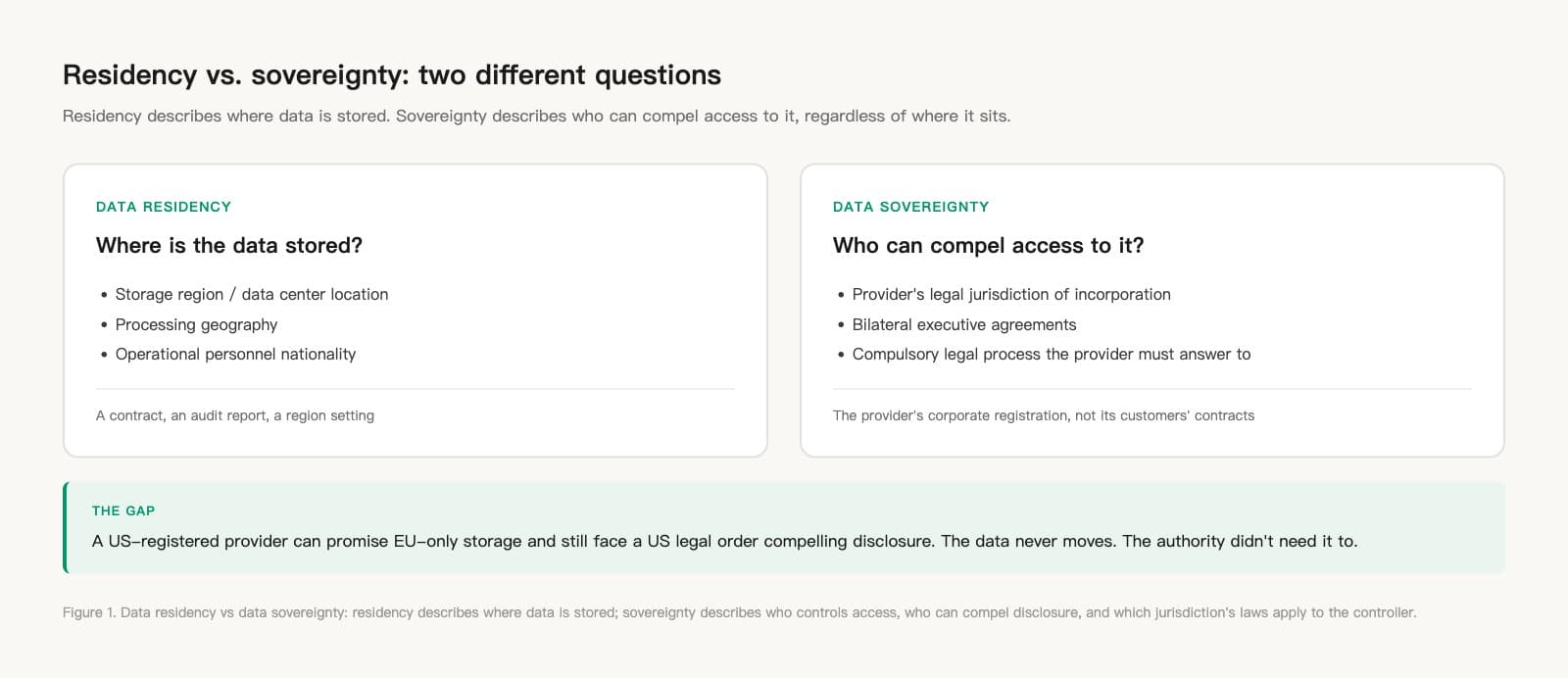
Figure 1. Data residency vs data sovereignty: residency describes where data is stored; sovereignty describes who controls access, who can compel disclosure, and which jurisdiction's laws apply to the controller.
Residency and sovereignty are not the same control
Residency agreements specify storage location, processing region, and sometimes operational personnel nationality. A provider commits that customer data will not leave a defined geography. Audit reports verify the commitment. The arrangement addresses one regulatory question (where is the data) and stops there.
Sovereignty begins where residency leaves off. It asks who holds the authority to issue binding orders about that data, and which legal system governs the entity controlling it. A subsidiary incorporated in Ireland may promise EU-only data handling while its US parent faces compulsory disclosure orders from American courts. The data never moved. The authority did not need it to.
The practical test is simple. If a government in jurisdiction A can legally compel a company to hand over data physically stored in jurisdiction B, residency and sovereignty have diverged. The storage location met one rule. The control structure failed another.
This gap has been documented for years in financial services, health care, and public sector procurement. It is newer to AI deployment, where vendors often use "EU hosting" and "GDPR compliance" interchangeably in sales material, and where rapid adoption has sometimes moved faster than legal review. The exposure becomes visible during incident response, regulatory inquiry, or, as several cases since 2024 have shown, when a government requests data that a compliance officer believed was unreachable.
The gap is not an accident of AI technology. It was present before AI processing was common and has become more consequential as more sensitive processing has moved to AI tools. The same financial services organization that maintained strict data localization for its core banking systems may be processing commercially sensitive client information through AI productivity tools that run entirely on US infrastructure. The banking system's compliance status does not extend to the AI tool.
Sovereignty, in a governance context, requires more than a contract. It requires that the organization retains the ability to independently determine what happens to its data under its own authority, not merely under a contractual commitment from a party subject to other authorities. That distinction is the reason organizations in regulated industries, national security-adjacent sectors, and sectors handling particularly sensitive personal data are increasingly examining their AI stacks with a question that goes beyond "where is the data" to "who could reach it and how fast?"
What GDPR Chapter V actually governs
GDPR Chapter V (Articles 44–49) regulates transfers of personal data from the European Economic Area to third countries. It establishes the legal basis on which such transfers may occur, not the technical or jurisdictional control over data once transferred.
Article 44 sets the baseline: transfers must ensure the level of protection guaranteed by GDPR is not undermined. Article 45 allows transfers to countries with an adequacy decision from the European Commission. Article 46 permits transfers under appropriate safeguards such as standard contractual clauses or binding corporate rules. Article 49 lists derogations for specific situations.
What Chapter V does not govern is demands issued by other legal systems after data has been lawfully placed. If a US-registered entity hosts data in Frankfurt under a valid standard contractual clause and the US Department of Justice issues a subpoena, the GDPR adequacy analysis does not resolve that conflict. Article 48 offers a partial response: transfers required by a foreign court or authority may only proceed through established mutual legal assistance treaties, absent other grounds. But Article 48 creates a procedural requirement for the European entity; it does not control the American proceeding.
That procedural requirement matters. Without the MLAT route, a European data processor faces competing obligations and no automatic resolution. The organization's legal counsel must weigh each order on its facts, with no guarantee of outcome. GDPR makes that conflict visible. It does not eliminate it.
The EU has sought to manage this conflict through transfer mechanisms and, more recently, through the EU-US Data Privacy Framework adopted in 2023 following the Court of Justice's invalidations of Privacy Shield and Safe Harbour. The DPF establishes binding commitments from US intelligence agencies on the use of EU personal data and creates an independent redress mechanism. The framework has reduced some of the residual exposure for EU-to-US transfers under GDPR. It has not resolved the structural tension between GDPR Article 48 and the CLOUD Act, which operates outside the DPF's scope.
For AI deployments specifically, two additional points from Chapter V deserve attention. Personal data processed during inference (a user query, a document the model reads, a generated output containing personal information) may qualify as a transfer if it flows to a model hosted outside the EEA. The host geography matters for Chapter V purposes, not the user's location. Organizations that route AI queries to US-based cloud inference endpoints while maintaining EU data storage may have addressed residency and overlooked the transfer question.
Standard contractual clauses can establish the lawful basis for such transfers, but they come with ongoing obligations. The 2021 Standard Contractual Clauses require the data importer to notify the exporter if it receives a request for disclosure from a public authority that might conflict with the contractual commitments. They also require the importer to challenge access requests where there are reasonable grounds to do so. Signing a DPA with an EU data processing addendum satisfies the documentation requirement. Actually maintaining the commitments under changing government demand patterns is the operational part that contracts alone cannot guarantee.
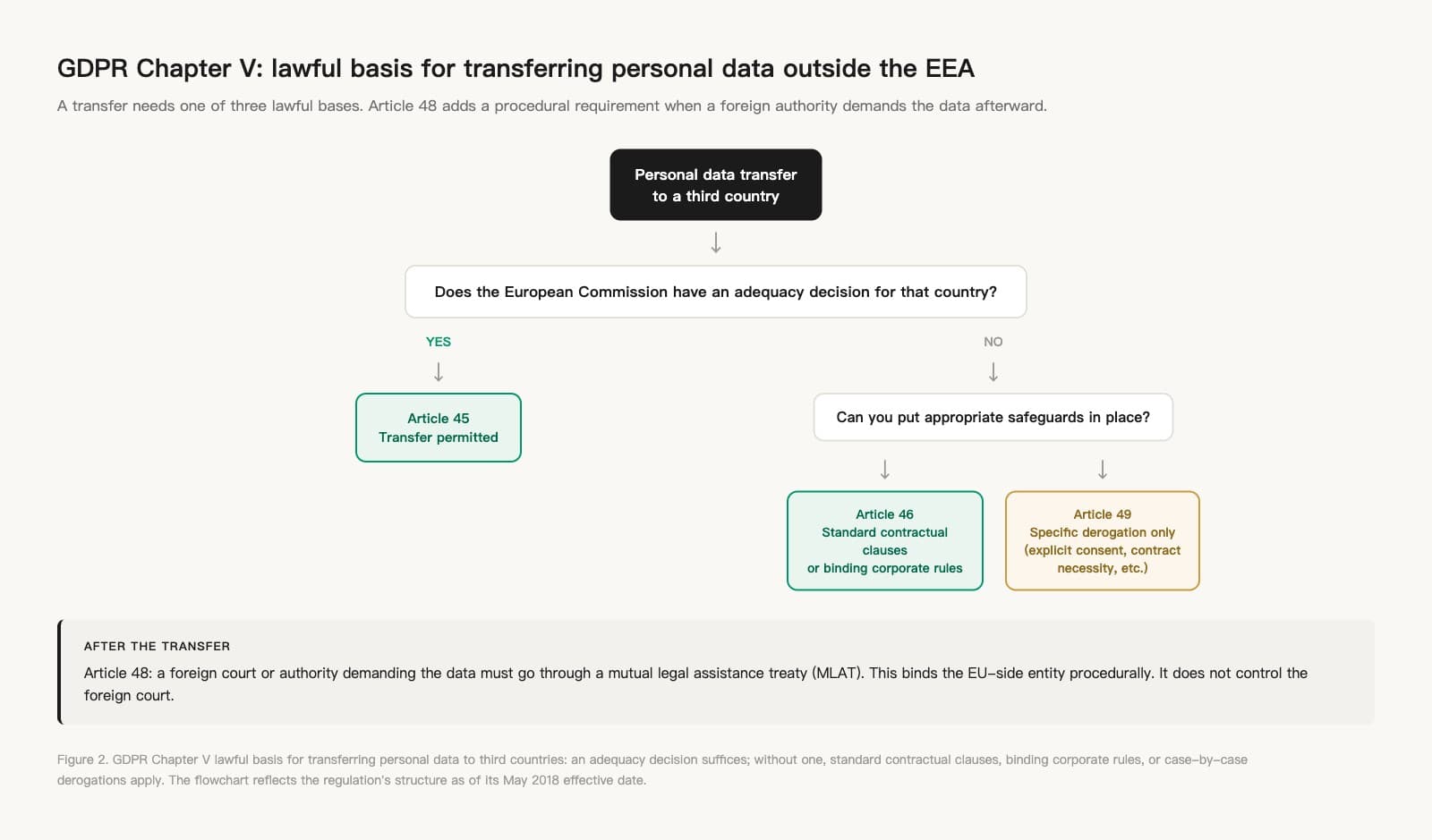
Figure 2. GDPR Chapter V lawful basis for transferring personal data to third countries: an adequacy decision suffices; without one, standard contractual clauses, binding corporate rules, or case-by-case derogations apply. The flowchart reflects the regulation's structure as of its May 2018 effective date.
Why jurisdiction alone does not answer the CLOUD Act question
The Clarifying Lawful Overseas Use of Data Act (Pub.L. 115-141, signed March 23, 2018) allows the US government to issue legal process directly to US-based cloud providers requiring production of data stored anywhere in the world. The provider's obligation runs to US law, not to the storage location.
Section 2523(c) of the Act establishes that covered providers must comply with legal process that meets the statute's criteria regardless of where the data is physically stored. A US company operating an EU data center for a European customer can receive a valid CLOUD Act order and face a binding obligation to produce customer data, subject to procedural challenges and bilateral executive agreement provisions.
The EU-US Data Privacy Framework (2023) and earlier transfer mechanisms govern the lawful basis for data flowing to US providers. The CLOUD Act operates on a different axis. It describes the government's ability to compel US entities, not the entity's contractual commitments to customers.
This creates a practical exposure for AI deployments. Many major AI inference providers, cloud GPU services, and foundation model vendors are US-registered entities. An organization that routes AI processing through such a provider, even using EU-only data centers, has placed its workload within reach of CLOUD Act process. The EU data center was not irrelevant; it may satisfy GDPR residency requirements. But it does not change the provider's nationality, and it does not remove the government's ability to issue a valid order.
A parallel development illustrates that this is now a broadening risk class. As reported by TechCrunch (Ram Iyer, November 16, 2026), the US Commerce Department published an interim rule requiring licenses for AI chip exports and overseas data center transfers where the infrastructure might provide compute to companies in restricted countries (Federal Register docket pending confirmation of precise citation). The logic of the rule is that physical location of compute does not determine effective control or intended beneficiary: the same logic that makes CLOUD Act exposure possible in the first place.
The question to put to any AI provider is not "where is my data stored" but "where are you incorporated, and what legal process have you received or could you legally receive?" That question may not appear in a standard data processing agreement. It should.
The CLOUD Act also allows the US government to enter bilateral executive agreements with other countries that enable those countries' authorities to issue legal process directly to US providers for data about their own nationals. The UK has had such an agreement since 2022. Australia and Canada are in negotiations. The bilateral agreement framework expands, rather than constrains, the scope of compulsory access from additional jurisdictions, by giving more governments a formal legal path to data held by US-registered providers. A European organization that chose a US cloud provider to gain access to frontier AI infrastructure should understand that the bilateral agreement framework may eventually give its own government's law enforcement a faster route to its data than it expected.
Whether AI chat logs are discoverable under compulsory process depends on who holds them and under which jurisdiction's law.
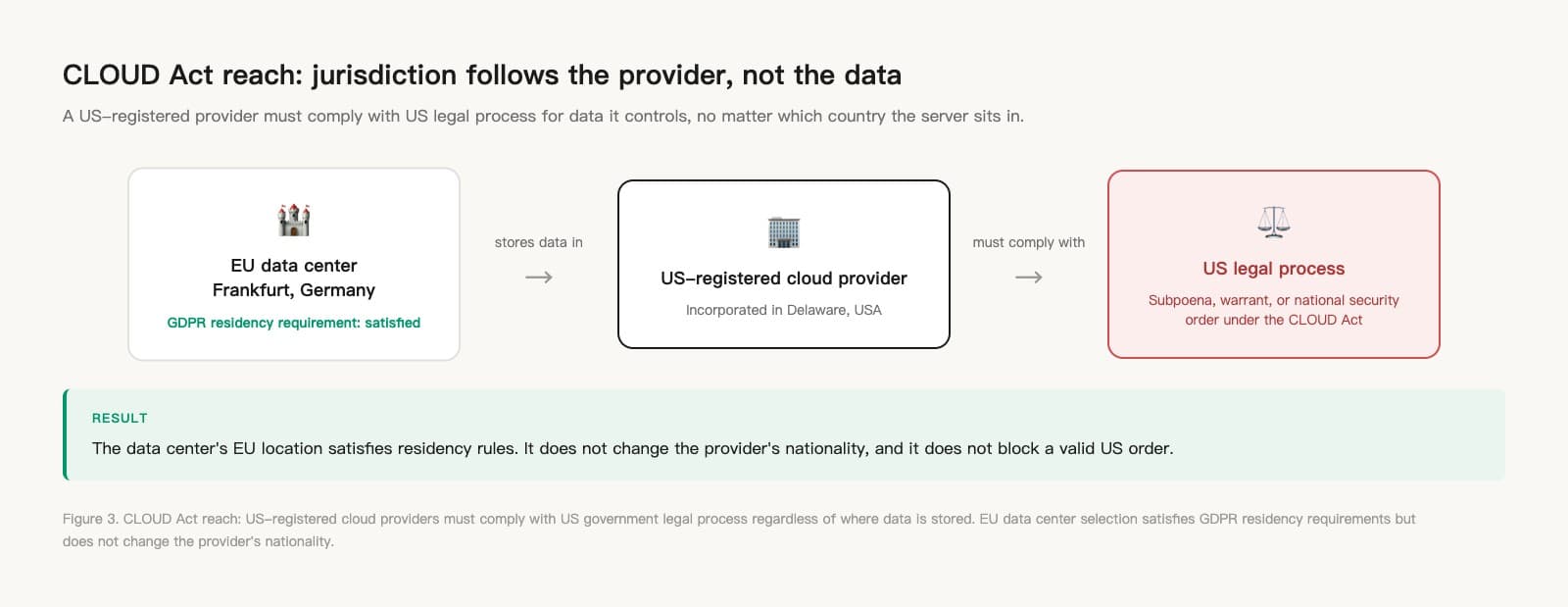
Figure 3. CLOUD Act reach: US-registered cloud providers must comply with US government legal process regardless of where data is stored. EU data center selection satisfies GDPR residency requirements but does not change the provider's nationality.
EU AI Act: the data governance obligations beyond location
The EU AI Act (Regulation (EU) 2024/1689, entered into force August 1, 2024) imposes obligations on high-risk AI systems that go considerably beyond storing data in the right place. Articles 9 through 17 establish a risk management system, technical documentation requirements, data governance practices, human oversight provisions, and accuracy, robustness, and cybersecurity standards.
Article 9 requires providers of high-risk systems to establish, implement, document, and maintain a risk management system throughout the lifecycle. Data governance under Article 10 specifies that training, validation, and testing data must meet quality criteria, be examined for possible biases, and be managed according to documented practices. Neither article is satisfiable by contract language about storage geography.
The practical implication for data residency is that Article 10 may require organizations to know, in detail, what data their AI systems were trained on, where that data originated, and what safeguards governed its collection. For teams using foundation models from external providers, this demands documentation beyond a data processing agreement. It requires visibility into the provider's own training data governance, which many providers have been reluctant to supply in verifiable form.
Article 13 (transparency) and Article 14 (human oversight) further require that high-risk systems be designed to allow effective oversight by natural persons. An AI system that generates consequential outputs without an auditable chain connecting output to data, model version, and prompt is non-compliant with Article 13 regardless of where the data sits.
A residency commitment satisfies none of these requirements. It is a necessary component of a broader compliance structure for EU-based organizations, but not a sufficient one.
What counts as a high-risk system for EU AI Act purposes is a legal question for qualified advisers. The classification criteria appear in Annex III of the regulation, which lists specific application areas including biometric identification, management of critical infrastructure, employment decisions, essential private and public services, law enforcement, migration and border control, administration of justice, and democratic processes.
There is an important practical implication for teams that have deployed AI systems on the assumption that they are not high-risk. Annex III has an amendment mechanism, and the European Commission has authority to update the list by delegated act. A system that falls outside Annex III today may be caught by a subsequent amendment. Organizations that have made compliance assessments should track EU AI Act delegated acts and revisit their classification at each significant change to system scope or capability.
The EU AI Act also contains general obligations that apply to all AI systems, not only high-risk ones. Article 52 requires certain transparency obligations for AI systems intended to interact with natural persons, including disclosure that the person is interacting with an AI. This is relevant for customer-facing AI deployments regardless of whether they fall into the high-risk categories, and it is a data governance obligation with behavioral consequences that have nothing to do with where data is stored.
Before you decide where AI data should live, what does each option actually control?
Three deployment configurations appear regularly in enterprise AI planning: fully cloud-hosted (data and inference at a provider), hybrid (data stored locally, inference through cloud APIs), and on-premise (data and inference on infrastructure the organization controls). Each configuration controls different things. None controls everything.
Fully cloud-hosted deployments offer operational simplicity, global access, and access to frontier models. Residency is determined by the provider's region settings and the customer's data processing agreement. CLOUD Act exposure applies if the provider is US-registered. GDPR transfer rules apply if queries or stored data cross EEA borders. Human oversight under EU AI Act Article 14 depends on whether the customer has sufficient visibility into the system's behavior.
Hybrid configurations (local data storage with cloud inference) reduce residency exposure for stored training data, documents, and outputs. They do not eliminate cross-border transfer risk during inference: the prompt sent to a cloud model typically contains or implies the data being processed. A document summarization task sends the document, or a substantial portion of it, to the inference endpoint.
On-premise deployment, where both data and the inference engine run on hardware the organization controls, moves control over residency and much of the sovereignty exposure to the organization's own decisions. CLOUD Act process cannot reach a device the requesting government does not know about and cannot serve. GDPR transfer rules apply only to transfers outward from the system. The tradeoff is capability: locally hosted models currently lag frontier models in several task categories, and maintaining local inference adds operational responsibilities.
No configuration eliminates regulatory exposure entirely. Any configuration that includes human personnel with access from multiple jurisdictions, any third-party service integration, or any outbound network connection reintroduces vectors that must be managed separately.
The broader sovereignty questions that arise when choosing between these configurations, including what it means in practice to maintain meaningful control as models and infrastructure change, are explored in the data sovereignty in generative AI context.
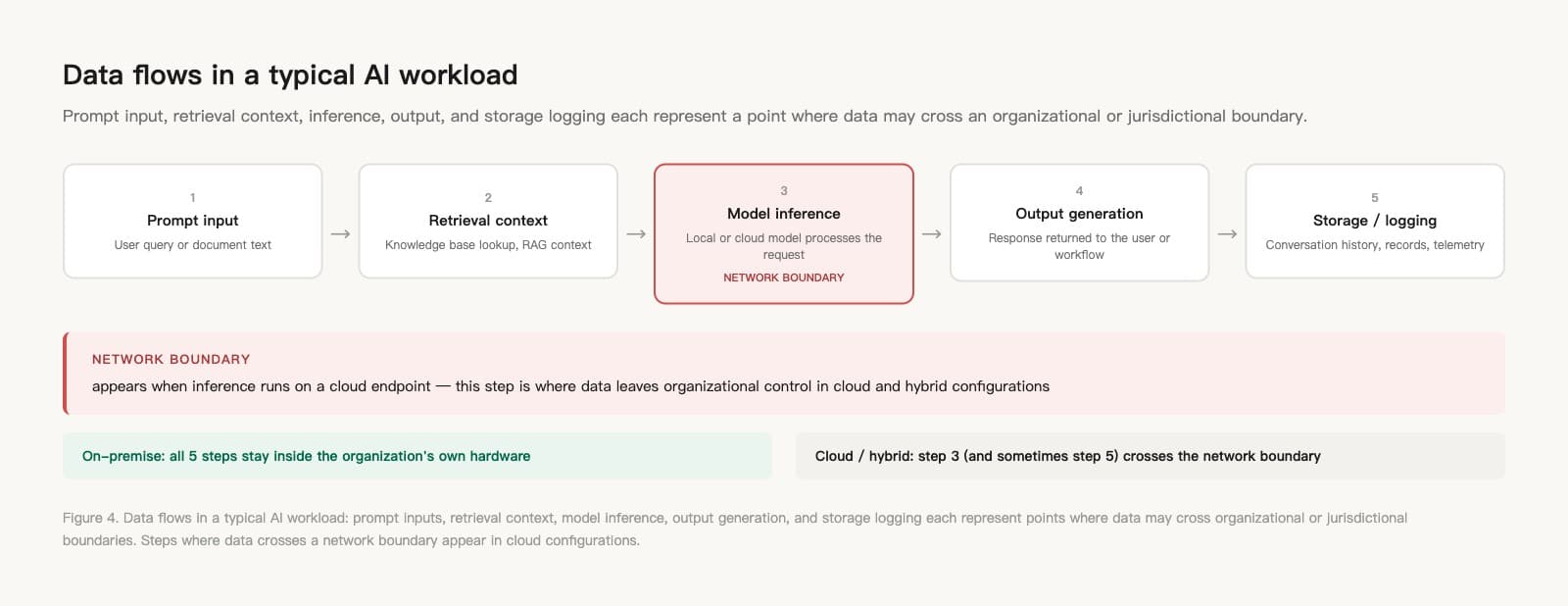
Figure 4. Data flows in a typical AI workload: prompt inputs, retrieval context, model inference, output generation, and storage logging each represent points where data may cross organizational or jurisdictional boundaries. Steps where data crosses a network boundary appear in cloud configurations.
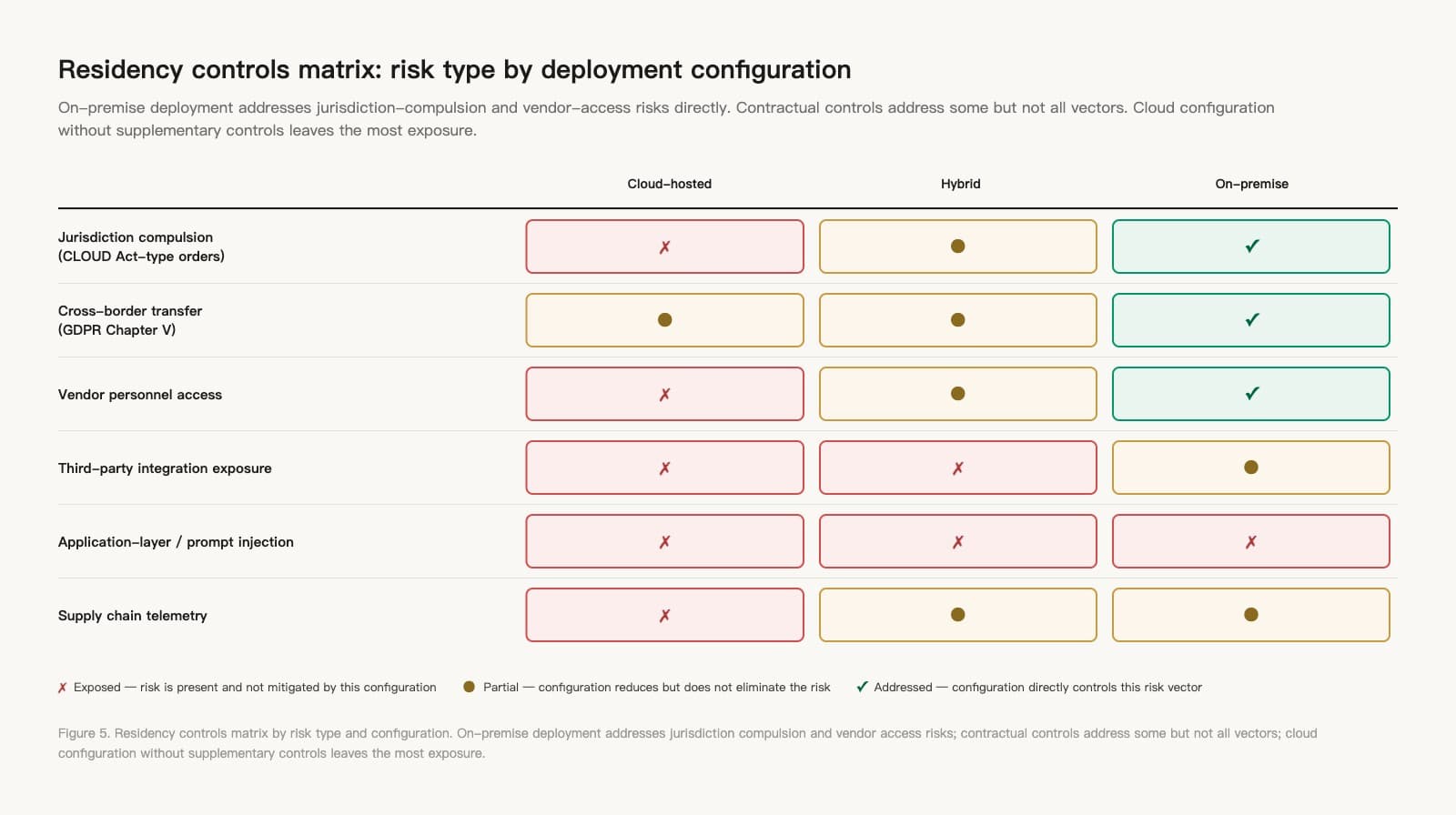
Figure 5. Residency controls matrix by risk type and configuration. On-premise deployment addresses jurisdiction compulsion and vendor access risks; contractual controls address some but not all vectors; cloud configuration without supplementary controls leaves the most exposure.
How to audit your current AI stack for residency and sovereignty exposure
Before evaluating new configurations, it is worth mapping what already exists. Most organizations that have adopted AI tools in the last two years have done so at a pace that outran systematic assessment. The result is a scattered set of subscriptions, integrations, and data flows, some of which were reviewed and many of which were not.
A useful starting point is a list of every AI tool, service, and API the organization's personnel use, not just the ones IT provisioned. Shadow AI adoption is widespread. Research published by enterprise security vendors consistently finds that employee AI tool use outruns centralized procurement by a factor of two or more. Each unsanctioned tool is a data flow the residency audit did not capture.
For each tool, determine three things. Where is the company behind the tool incorporated? Where does the tool process data (inference endpoint geography)? What data is transmitted: documents, queries, outputs, metadata, usage telemetry? The last category is often overlooked. Some AI tools transmit detailed usage telemetry, including query content or semantic embeddings, to home servers even when the user believes their data stays in a regional deployment.
A practical test: take any AI tool the organization uses regularly and check whether its standard privacy policy or data processing agreement specifies inference endpoint geography separately from storage geography. Many do not. The absence of a specific commitment about inference geography is itself an answer about where data may go.
After listing the tools and their characteristics, group them by risk level for the organization's data types. An AI tool that processes only publicly available information with no connection to internal systems occupies a different position than one with calendar access, email access, or access to customer records. A structured question set for this assessment appears in the AI vendor sovereignty checklist.
One thing worth checking today: open the data processing agreement for your primary AI productivity tool and find the section on government access and law enforcement requests. If the section addresses only EU-to-US transfers under the DPF and does not mention what the provider would do in response to a CLOUD Act order, that is a gap in the contractual documentation. It does not mean the provider would comply with every order (most large providers have published policies on challenging overbroad government demands), but it means the organization lacks a written commitment on the point. That is different from a written commitment that the organization can verify.
A worked example: three configurations, one dataset
Suppose a four-person legal advisory team uses an AI assistant to help draft client-facing documents. The team operates under EU law, serves clients across Germany, France, and Austria, and handles documents that may contain personal data about individuals and commercially sensitive information about corporate clients.
Under a fully cloud-hosted configuration, the team's documents and queries go to a US-registered AI provider operating an EU data center. GDPR residency requirement: met, assuming a valid data processing agreement. CLOUD Act exposure: present. The provider is US-registered and subject to valid US legal process. GDPR Article 48 would govern any attempt by the US government to access data via MLAT; the team's contracts offer no protection against a valid CLOUD Act order directly to the provider. EU AI Act compliance status depends on whether the AI system meets the high-risk criteria (if it assists in legal advice, Annex III is relevant) and whether the provider's documentation satisfies Articles 9–13.
Under a hybrid configuration, documents stay on the team's local server. Only the prompt, which may summarize or quote a document, goes to the cloud inference endpoint. GDPR transfer risk: present during inference. CLOUD Act exposure: present, reduced to the content of prompts rather than stored documents. This is meaningfully different for some threat models and not for others: a well-constructed prompt may contain as much sensitive information as a stored document.
Under an on-premise configuration, documents and inference both run on hardware the team controls. GDPR transfer risk: limited to outbound connections the team chooses to make. CLOUD Act exposure: absent for data the team holds itself. EU AI Act documentation requirements: the team's responsibility, using their own configuration records. The tradeoff: on-premise models available in late 2026 are capable for many legal drafting tasks but may require more careful review than frontier cloud models for complex analytical work.
The choice between configurations is not a one-time audit decision. As model capability changes and new providers emerge, the configurations available will evolve. The team's decision in this scenario should be revisited at each vendor renewal and at each significant change in the data types the AI system handles.
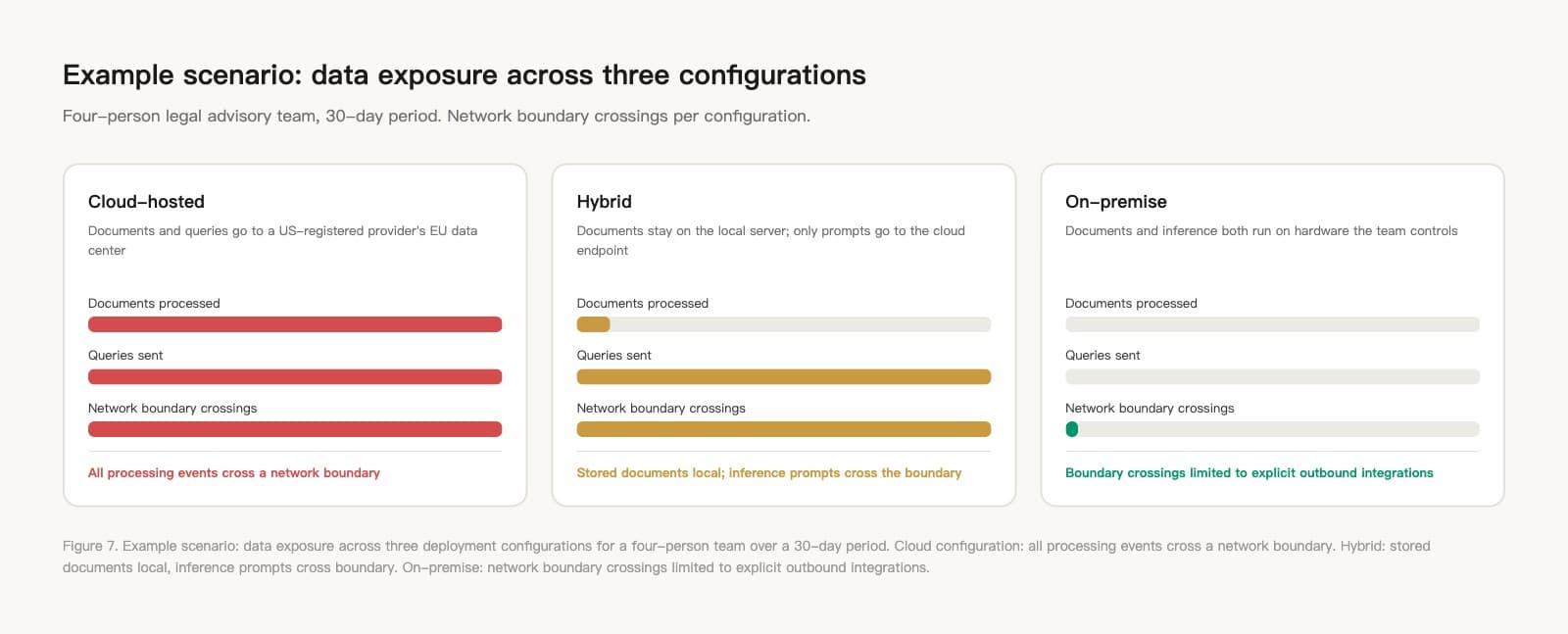
Figure 6. Example scenario: data exposure across three deployment configurations for a four-person team over a 30-day period. Cloud configuration: all processing events cross a network boundary. Hybrid: stored documents local, inference prompts cross boundary. On-premise: network boundary crossings limited to explicit outbound integrations.
How KarmaBox addresses the residency and sovereignty gap
KarmaBox is a platform for running AI avatars on hardware you control. The residency question resolves to a default: when avatars run on a KarmaBox device, business data (documents, conversations, knowledge bases, task records) stays on that device under the team's physical control.
The specific residency and sovereignty issues described above map to the following platform behaviors:
| Residency / sovereignty question | How KarmaBox handles it | What you configure |
|---|---|---|
| Where is inference data processed? | On the KarmaBox device (1×GB10, 128 GB unified memory, ~170 W) for local-model tasks; data does not leave the device unless you route a task to a cloud model | Choose which avatars use local vs cloud models in avatar settings |
| What happens if the local model fails: does data fall back to cloud? | No. The local closure gate fails closed: if local inference fails, the system reports failure rather than silently rerouting to a cloud provider (deployed October 22, 2026) | No action required; enabled by default |
| Where do documents and conversation history live? | On the device; business objects, documents, and knowledge bases are stored locally (LIVE) | Confirm data location in the device settings panel |
| What about cloud model calls: do they create transfer exposure? | Yes. When an avatar calls a cloud model, that inference crosses a network boundary. Cloud models are built in and need no API key configuration; the platform charges for cloud model usage. Data sent to a cloud model leaves the device. | Assign sensitive tasks to local-model avatars; confirm cloud model routing before enabling for sensitive workflows |
| Can an avatar send, publish, or delete data without approval? | Each action class has its own gate: send and publish default to "ask first," payment is not permitted without explicit owner approval, deletion defaults to "ask first" | Review and confirm action gates for each avatar; gates are enforced server-side, not by prompt |
| Does model switching lose the data boundary configuration? | No. Gates are enforced at the platform layer, not by the model. Switching the underlying model does not change the enforced action rules | No action required |
| What is the evidence for data boundary performance? | Internal test, October 28–30, 2026: 197 local inference calls over 72 hours, business data leaving the device: 0 events; 886 conversation segments, 2 knowledge bases, 24 memory records retained on device; device panel showed continuous "nothing has left" status | View the data boundary log in device settings |
| What happens to memory and configuration if the device is replaced? | The portable-memory transfer feature moves the avatar's memory to a file that can be loaded on a new device or in cloud mode; memory does not depend on hardware continuity | Use the portable memory export from the avatar settings |
For the EU legal advisory team in the worked example above, an on-premise KarmaBox configuration addresses the residency requirement for data that stays on the device, eliminates CLOUD Act exposure for locally processed data, and provides the kind of configuration audit trail that EU AI Act Articles 9 and 13 require, because the team controls the device log.
Three things worth doing before relying on this configuration for GDPR-sensitive workloads. Map which of your avatars are configured to call cloud models and which tasks they handle (the device settings panel shows the routing for each avatar). Verify that the action gate for external sends is set to "ask first" for any avatar handling personal data, which limits unintended outbound data movement. Export the data boundary log and retain it; it is the contemporaneous evidence that inference stayed local, relevant to both GDPR Article 5(1)(f) and to any internal governance review.
For teams evaluating the platform against their own procurement criteria, the AI vendor sovereignty checklist provides a framework for comparing KarmaBox and other vendors on the same set of questions.
Available device configurations are on the KarmaBox product page. The conditions under which avatar memory survives device changes are covered in the sovereign AI avatar guide.
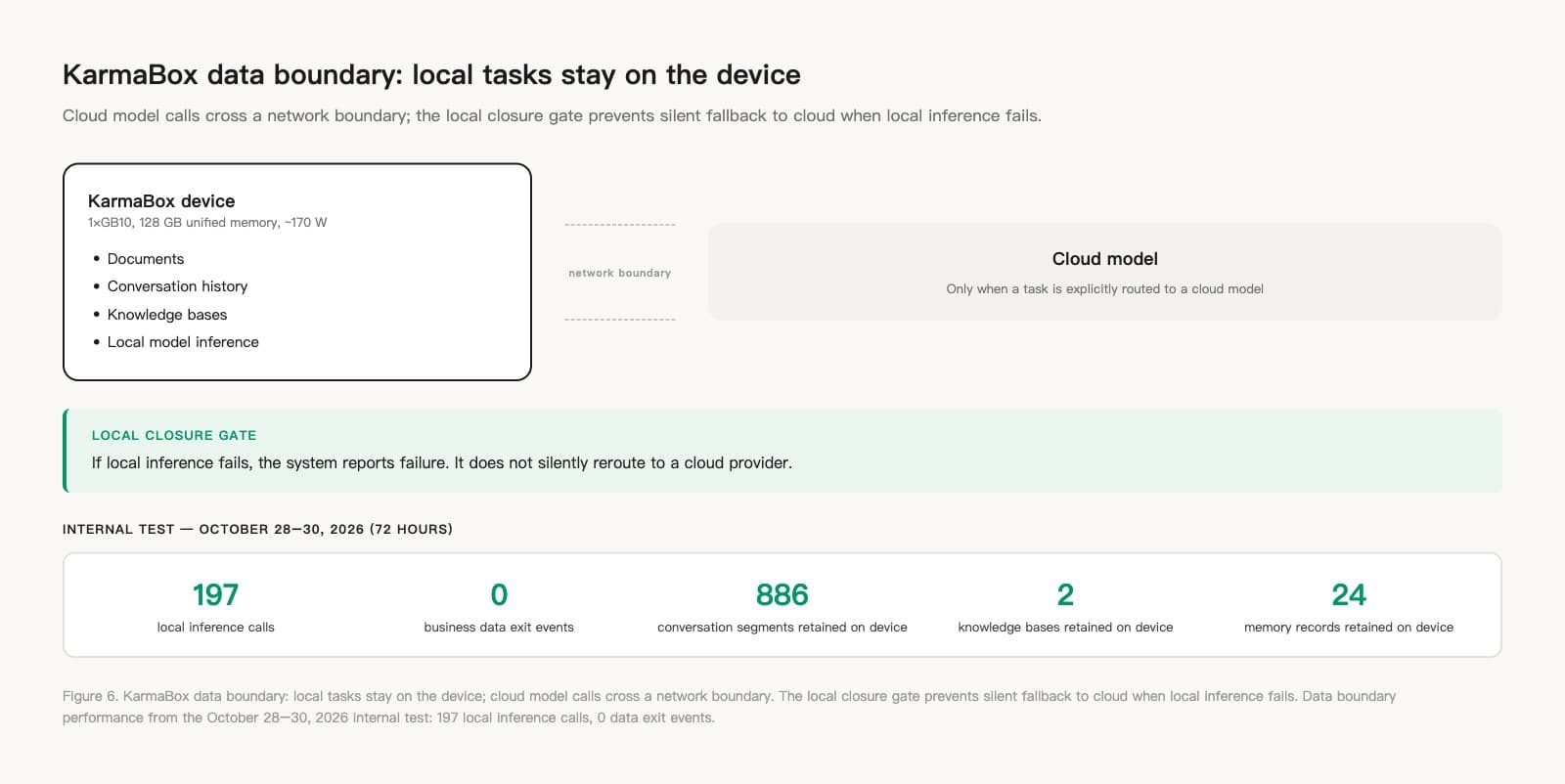
Figure 7. KarmaBox data boundary: local tasks stay on the device; cloud model calls cross a network boundary. The local closure gate prevents silent fallback to cloud when local inference fails. Data boundary performance from the October 28–30, 2026 internal test: 197 local inference calls, 0 data exit events.
What on-premise deployment does not solve
On-premise deployment answers the question of where inference and storage occur. It does not eliminate all data exposure vectors.
Personnel access remains the most direct path around a data boundary. A team member with device access can copy, export, or transmit data. Physical security of the device matters. Access controls (who can reach the device, the network it connects to, and the administrative interface) must be managed separately from the data residency configuration.
Application-layer vulnerabilities in the AI system itself can expose data regardless of where the hardware sits. A model that can be prompted to summarize and externally transmit a document creates an outbound channel that hardware location does not prevent. Prompt injection, where content the model reads contains instructions the model follows, is a documented and ongoing risk class. AI agent data leakage covers those outbound channels in detail; where data rests is distinct from how it leaves.
Third-party integrations reintroduce sovereignty exposure by definition. Any service an on-premise system connects to (a calendar API, a document storage service, a CRM) subjects that data to the terms and jurisdiction of the third party. Each integration should be assessed individually for the data it accesses and the jurisdiction it operates in.
Supply chain components (the model weights, the inference library, the operating system) may carry their own update and telemetry mechanisms. Organizations with strict data boundary requirements should verify what each component transmits and to where, particularly for foundation models with built-in cloud connectivity features. This is not a theoretical concern. Several widely used AI development tools have been found to transmit usage data, error reports, and in some cases partial query content to developer servers as part of default telemetry. The data processing agreement with the AI tool may cover the tool's intended data flows; it typically does not cover the telemetry behavior of its dependencies.
A supply chain review for an on-premise AI deployment should answer: What external connections does the inference library make on startup or during regular operation? What update mechanism does the model runtime use, and does the update process contact external servers? What logging or telemetry does the operating system or container runtime transmit by default? Each question has a verifiable answer, and organizations that have not asked them are relying on assumptions about components they did not build.
Employees accessing the system from outside the deployment jurisdiction (on a device in another country, or over a VPN that terminates elsewhere) may bring jurisdictional rules with them. This is not a residency problem but a data handling policy question that affects how the system is used.
None of these risks are arguments against on-premise deployment. They are the remaining items on a governance list after residency is handled. Each has a verifiable answer, and that is what a coherent compliance posture actually consists of.
A fuller comparison of the privacy properties of each deployment model appears in on-device AI vs cloud AI privacy. For the logging requirements that apply when AI agents act with meaningful access, AI agent audit trails covers what to record and retain.
Frequently asked questions
Is data residency the same as GDPR compliance?
No. GDPR compliance for cross-border data flows requires a lawful basis under Chapter V: an adequacy decision, standard contractual clauses, binding corporate rules, or a derogation. Data residency describes physical storage location. The two concepts overlap when storage location is relevant to the lawful basis analysis, but residency alone does not establish compliance, and compliance does not require any specific residency.
Does the CLOUD Act apply to non-US companies?
The CLOUD Act primarily applies to "electronic communication service providers" and "remote computing service providers" subject to US law: generally, companies organized under US law or operating in the US. A non-US company that is not subject to US jurisdiction in relevant ways is not directly covered by the statute. For AI deployments, the relevant question is usually whether the AI provider, cloud infrastructure provider, or model vendor is US-registered, not whether the customer is.
Before we commit to an AI platform, what should we confirm about data residency?
Ask the provider four things: (1) Where, specifically, will data be stored and processed, with the ability to audit this? (2) Are you incorporated in the United States or any other jurisdiction that has enacted CLOUD Act–equivalent compulsory disclosure laws? (3) What legal process have you received in the past 24 months involving customer data, and how was it handled? (4) What would you do if you received a government order requiring production of our data, and what notice would you give us? Answers to questions 3 and 4 are often not in the standard data processing agreement and require a direct conversation with the vendor's legal team.
Does putting data on-premise eliminate data sovereignty risk?
On-premise deployment eliminates the main vectors through which a third party's legal obligations can reach your data: the cloud provider's US incorporation, the terms of a managed service, and remote storage accessible to vendor personnel. It does not eliminate risk from integrations the on-premise system makes, personnel access to the device, or application-layer vulnerabilities. The broader set of conditions that constitute meaningful sovereign AI is described in the sovereign AI framework.
What does the EU AI Act require beyond data residency for high-risk AI systems?
For high-risk AI systems under Annex III, Articles 9–17 require a documented risk management system, data governance practices covering training data quality and bias examination, technical documentation sufficient to assess conformity, logging of system operation, transparency enabling oversight, and design that allows human intervention. These requirements address the lifecycle and governance of the system, not its geography. Whether a particular AI deployment qualifies as high-risk is a legal determination best made with qualified legal counsel.
Where do AI conversation logs go, and can they be compelled?
Conversation logs go wherever the AI platform stores them: on the device, in a cloud service, or both, depending on configuration. Whether they can be compelled depends on who holds them and under which jurisdiction's law. Where AI conversations live maps the typical storage paths, and whether AI chat logs are discoverable addresses the legal question directly.
About the author
Karma Box Team develops practical guidance on sovereign AI, data governance, and agent control for individuals and organizations. This guide distinguishes factual legal provisions from implementation analysis, cites primary sources, and flags where conclusions are interpretive rather than settled law. Fact-checked as of November 17, 2026. This content is informational and does not constitute legal advice; organizations should consult qualified legal counsel for jurisdiction-specific compliance decisions.