Ask "are local models good enough yet" and the argument never ends, because the question has no object. Good enough for what? A model that cannot plan a product launch can still draft two hundred shipping confirmations without a mistake. The question that produces a decision names the work: out of the tasks your team actually did last week, which ones could have run on a machine in your office? Most teams guess badly in both directions. They assume the hard-sounding work is out of reach when much of it is bounded and checkable, and they assume the easy-sounding work is safe to send out when it is exactly the work that carries their client data.
A local LLM for business is a language model that runs on hardware the company controls (an office machine, a workstation) and handles everyday work such as drafting, retrieval over the company's own documents, transcription and structured extraction, without sending that material to an outside service. Whether one belongs in your company is a property of your task list, settled task by task, and it can be settled with a test that takes an afternoon.
The capability excuse for not looking into this is also aging fast. Pete Warden, co-creator of Moonshine Voice and a deep learning engineer since the field's early days, said in an interview published November 19 that open models you can run locally now trail the flagship commercial models by only a few months on benchmarks, and that the real barriers left are usability and marketing, since a model running on your own machine earns no one a subscription. That is his judgment, from someone who builds local models for a living. The useful part is that you do not have to take his word or ours for any of it: your own tasks, run your own way, settle the question better than any benchmark table.
01Why "is it good enough" is the wrong question
Benchmarks rank models on the hardest open problems available: competition mathematics, novel research questions, long chains of unassisted reasoning. That is the right way to compare frontier models and the wrong way to plan a workload. A Tuesday in most businesses is not a benchmark. It is forty routine drafts, a stack of documents someone needs answers from, three spreadsheets to reconcile, and one genuinely hard question that deserves the best model money can rent.
The two wrong guesses look like this in practice. A law office assumes that answering questions from its own engagement letters is advanced AI and keeps paying a person to do keyword search, when retrieval plus a mid-sized model handles it on a machine under the desk. The same office happily pastes a client's draft settlement into a cloud chatbot to "fix the wording," sending its most confidential document of the week to an outside service for the most trivial task on the list. Difficulty and sensitivity got conflated, and the work flowed in exactly the wrong directions.
The ceiling keeps rising, which makes the one-number framing more tempting and less useful at the same time. KPMG ran a trial this month in which more than a hundred AI agents audited a FTSE 250 company and, in several areas, dug deeper and asked better questions than the human audit team (European Business Magazine, November 18, 2026; KPMG was careful to call it a non-statutory audit). Meanwhile a Harvard working paper from October 2026, covering 718 companies, found that teams using AI coding agents wrote about 30% more code without shipping more, because review time per change rose 49%. Put those two findings side by side and the lesson is awkward for the one-number view: the frontier handles more than ever, and the binding constraint in practice has moved from what a model can produce to what a team can check.
Checking is the hinge. For a bounded task with a verifiable answer, a mid-sized model that is usually right is a working tool, because the occasional miss is caught in seconds. For an open-ended task with no cheap check, even a frontier model is a draft generator whose output absorbs senior hours. The fitness of a task for a local model has surprisingly little to do with how impressive the model is, and a great deal to do with the shape of the task.
One boundary holds no matter how far the models move. However capable any model becomes, it cannot decide where your data should sit, which actions need a human sign-off, or how you reconstruct events afterwards; those are three decisions no model can make for you. The question that remains is narrower and more immediate: of the work on your list, what clears the bar on a machine you own, today?
02The four properties that decide whether a task fits
Four properties of a task predict local fit better than any benchmark score predicts it.
Boundary. The task has a defined input and a defined output. "Turn this inspection note into a client email" is bounded. "Figure out why margin slipped this quarter" is not. Material. Everything the task needs is in material you can hand over: your price list, your contract file, your inbox, your call recording. The model contributes language and procedure, and your documents contribute the facts. Work built on your own material favors a local model twice over, once because the knowledge was never inside any model's training data to begin with, and once because that material is usually the last thing you want leaving the building. Checkability. Someone can verify the output quickly, or the output is a number that can be recomputed, or a claim that can be looked up. Harvard's finding above is a warning about tasks that fail this test: generation got cheap and review did not. Recency. The task depends on knowledge from the last few weeks: current regulations, live prices, a competitor's launch. A local model's built-in knowledge froze on its training date, and for recency-bound work no amount of local horsepower substitutes for a live, current source.
Score a task high on the first three and low on the fourth, and it is a local candidate regardless of which 9-billion-parameter model you happen to run. The inverse holds too, and no release this quarter changes it.
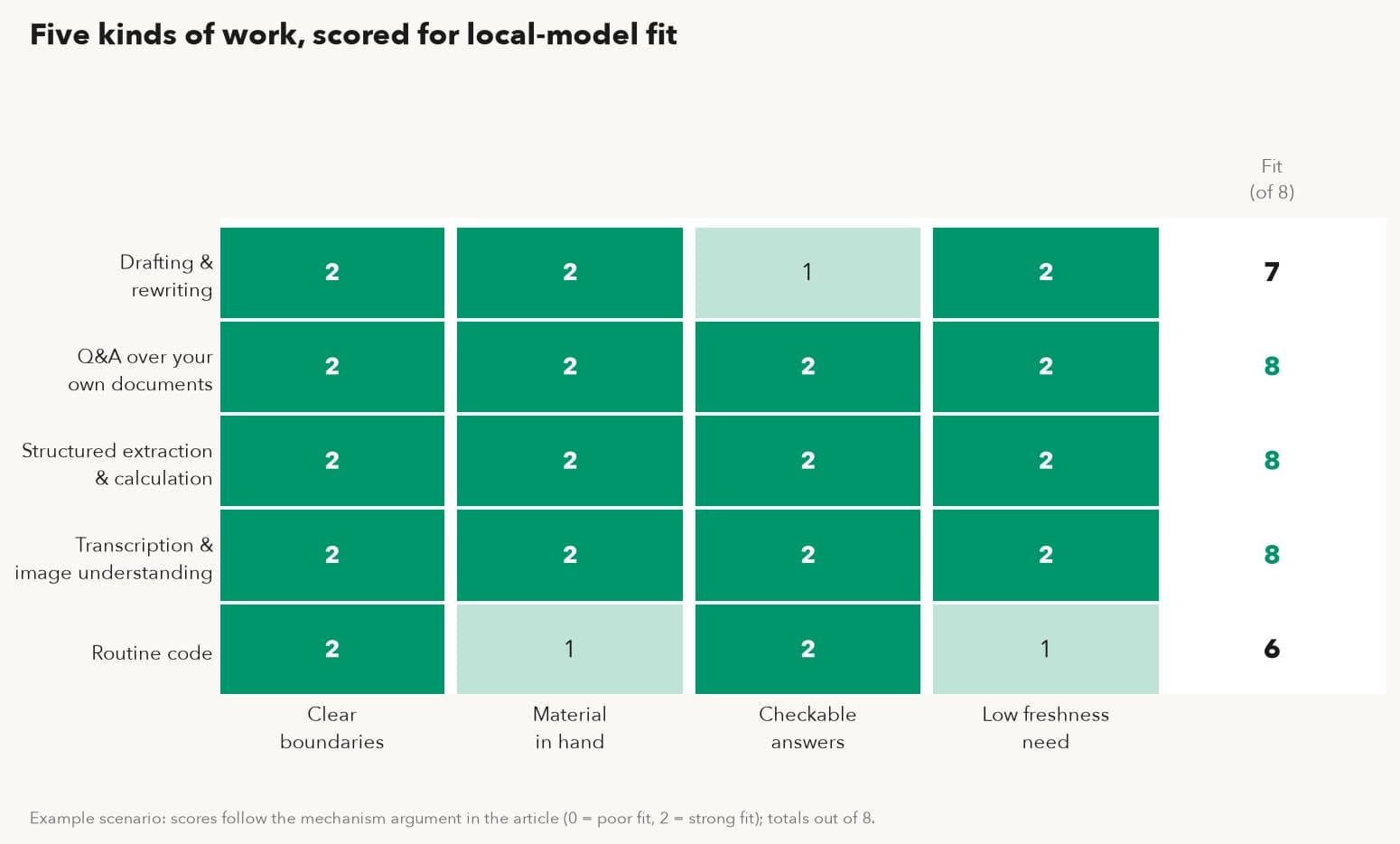
Example scenario: five everyday task families scored against the four fit properties. The scoring follows the mechanisms above; your own list will differ at the edges.
03Five kinds of work a local model handles today
Walk a normal week's task list against those four properties and the same five families keep passing.
| Task family | Everyday examples | Why it fits |
|---|---|---|
| Drafting and rewriting | Quotes, shipping notices, meeting summaries, routine translations | Input and output fully bounded; a read-through is the check |
| Q&A over your own documents | "What did we agree with the Hamburg client on returns?" | The facts come from your corpus, retrieved into the prompt; the model reads, it does not recall |
| Structured extraction and calculation | Pull fields from invoices; compute landed cost from a taught formula | One checkable answer; wrong is visible |
| Transcription and image understanding | Call recordings to notes; read a receipt or a shelf photo | Bounded input, local material, fast spot-check |
| Routine code and data munging | A CSV transform, a regex, a one-off script | Running it is the check |
Table 1. Five task families local models handle today
The second family deserves the mechanism spelled out, because it is where small models are most underrated. When an assistant answers from your documents, retrieval finds the relevant passages and places them in the model's context window (the working memory it reads before answering). The model's job shrinks to reading and synthesis. Your supplier terms, your rate cards, your project history were never in any vendor's training set, so on this work every model, frontier or local, depends on what retrieval hands it. A 9-billion-parameter model with the right passage in front of it routinely beats a frontier model guessing from its general training, and the passage never left your machine. For routine work over private material, context does more of the lifting than parameters do.
Traced through one real-shaped question, the mechanism is short. "What did we agree with the Hamburg client on returns?" causes retrieval to pull three passages: a clause from the signed frame agreement, an email where the terms were amended, and a note from the kickoff call. The model reads those three and writes four sentences naming the restocking fee and the carve-out, each tied to its passage. The heavy intelligence in that exchange was in keeping the documents findable; the language work at the end is well inside a mid-sized model's range, and the person checking can click straight to the clause.
Drafting fits for a humbler reason: the quality bar for most business prose is clarity against facts you supply, and mid-sized open models cleared that bar some time ago. A quote request comes in; the price list, the stock position and the delivery terms go into the prompt; the confirmation that comes back needs thirty seconds of reading before it goes out. The failure mode is not bad prose, it is a fabricated detail, which is why drafting belongs with materials attached and a human send button, a discipline worth keeping with any model anywhere. "Handles," throughout, means the output passes the same acceptance you would apply to a junior colleague's draft: you read it, you would send it, and being wrong would have been visible in that read.
Extraction and calculation fit because the answer is checkable by construction. A landed-cost number recomputed by hand either matches or does not. This family is also where teaching pays compound interest: taught once that duty is figured on the declared value, the assistant applies it to every subsequent sheet, and a wrong answer surfaces the day someone spot-checks. Transcription and image understanding went local earlier than most people noticed; speech models small enough to run on modest hardware have been production quality for a while (Warden's own specialty, as it happens). And routine code rounds out the list with the cheapest check of all, execution, with the Harvard caveat attached: keep the units small enough that reviewing one is minutes, because the review is the real spend.
None of this requires the newest release of anything. These five families were within reach of well-run local setups months ago; the task list, not the news cycle, is what most teams have not examined.
04The three marks of work that should stay on a cloud model
The same four properties, read in reverse, mark the work a local model should not hold.
Open-ended reasoning across domains. Strategy questions, novel analysis, anything where the path is unknown and the steps compound. The gap between a local 9B model and a frontier model is real here, and it shows up as subtly wrong reasoning that survives a casual read. Expensive to check means poor local fit even when the output looks fluent. Very long single-pass context. Feeding three hundred pages into one question is a different engineering problem from retrieving the right three pages. Local setups do the second well. The first belongs on models built and provisioned for it, at least for now. Recency-bound questions. Anything that turns on the state of the world since the model's training date. The failure is quiet: the model answers confidently from a world that has moved. A compliance question about a certification scheme that changed in October gets a fluent, well-structured, obsolete answer, and nothing in the answer's tone warns you. Recency failures are the reason "it sounds right" was never a check; for this family the check requires a current source, which is precisely what a frozen local model does not have.
A task wearing any of these marks goes out, ideally to the strongest model available, and that is a feature of the split rather than a defect. The point was never local purism; it is routing each task to the model that fits it, with the bounded, private, checkable majority staying home and the open-ended tail renting the frontier by the task.
05The hardware bar is lower than the reputation suggests
The reputation says local means a server room. The arithmetic says otherwise, and it helps to define the one term of art: quantization, which stores a model's weights at lower numeric precision to shrink them, trading a little quality for a lot of memory.
Warden's numbers from the interview are concrete. A capable 9-billion-parameter model stored at 8-bit precision is roughly nine gigabytes, which fits the memory of a decent midrange laptop GPU as shipped today; quantized to 4-bit it drops to around four gigabytes, which fits graphics cards that have been common for years. "The hardware barriers are a lot lower than people think," as he put it. At the other end of the range, machines with 128 or 256 gigabytes of unified memory (system memory the machine's AI accelerators can use directly) run open models in the hundreds of billions of parameters at usable speed; the five task families fit in the small end of that range with room left over.
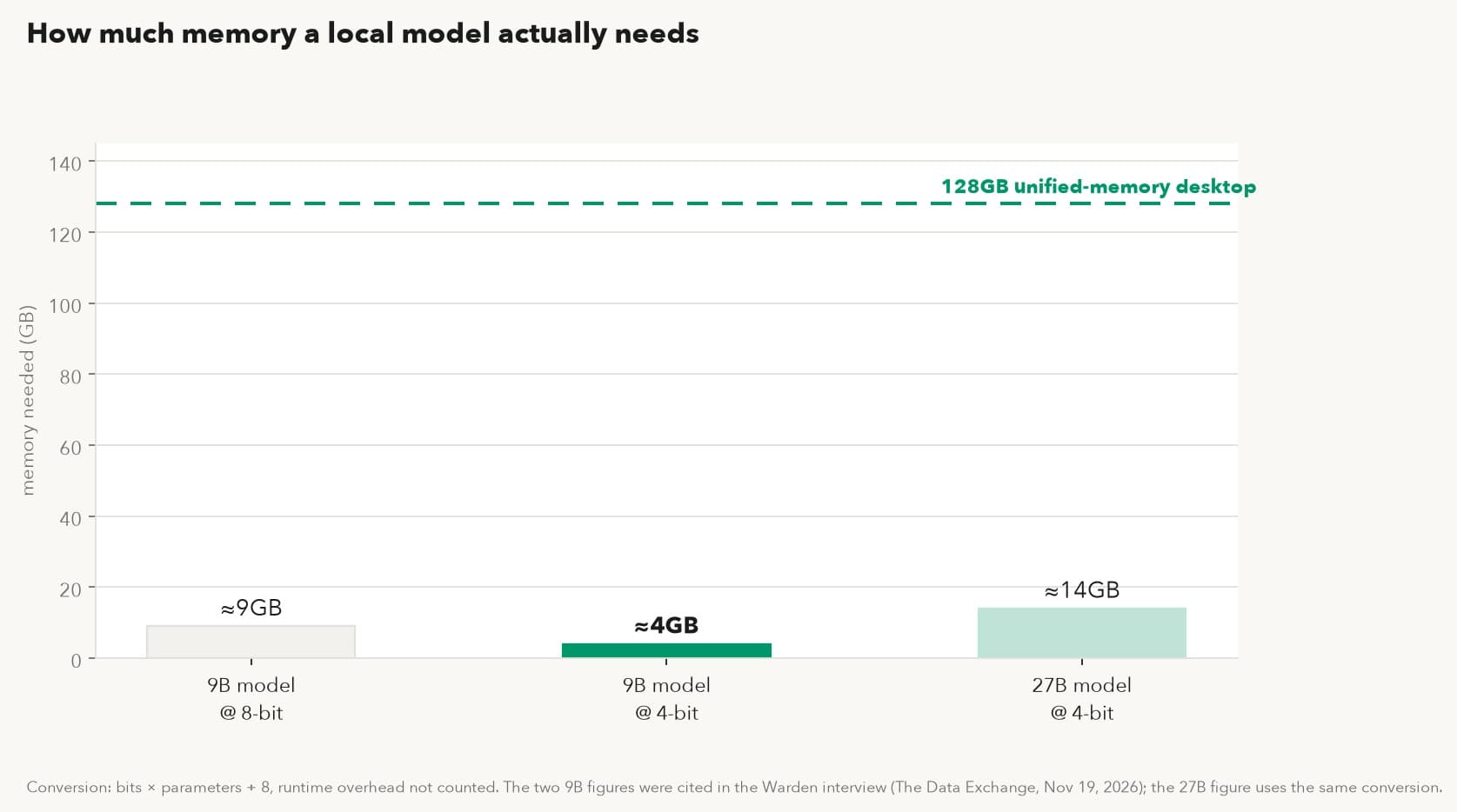
Model size against memory needed, using the quantization arithmetic from the interview (8 bits ≈ 1 byte per parameter, 4-bit ≈ half; overhead ignored). The 128 GB line is the class of machine discussed in the product section.
The part that moved against buyers this year is the entry price. Memory prices rose sharply through 2026 (Warden noted in the same interview that hardware makers are hobbled by DRAM price increases), so a box priced today costs meaningfully more than the identical box a year ago, and a buyer should price the market as it is, this month. Running costs are the smaller worry: the recurring line nobody budgets is the operations hour, the third line in the honest ledger of a self-hosted AI agent. None of which obliges anyone to buy first and find out second. The fit test in the next section runs on whatever hardware you can borrow for a day, a colleague's workstation included, and a purchase decision made after the test is working from your own pass rates instead of a vendor's demo.
Per-task economics frame the rent-or-own question without settling it. Across published price comparisons, one AI task (about 4,000 tokens in, 800 out, with 10% retries and a 70% cache hit rate assumed) costs between $0.00086 and $0.0603 depending on the model rented, a spread of roughly 70 times (IntuitionLabs, September 2026; InventiveHQ, prices updated October 2026). Against the cheap end, a box takes years of volume to pay back; against the expensive end, months. The break-even turns on what one AI task costs at your volume. The case that does not depend on volume at all: the material in those tasks stops leaving your building, the same property that decides on-device AI against cloud AI on privacy.
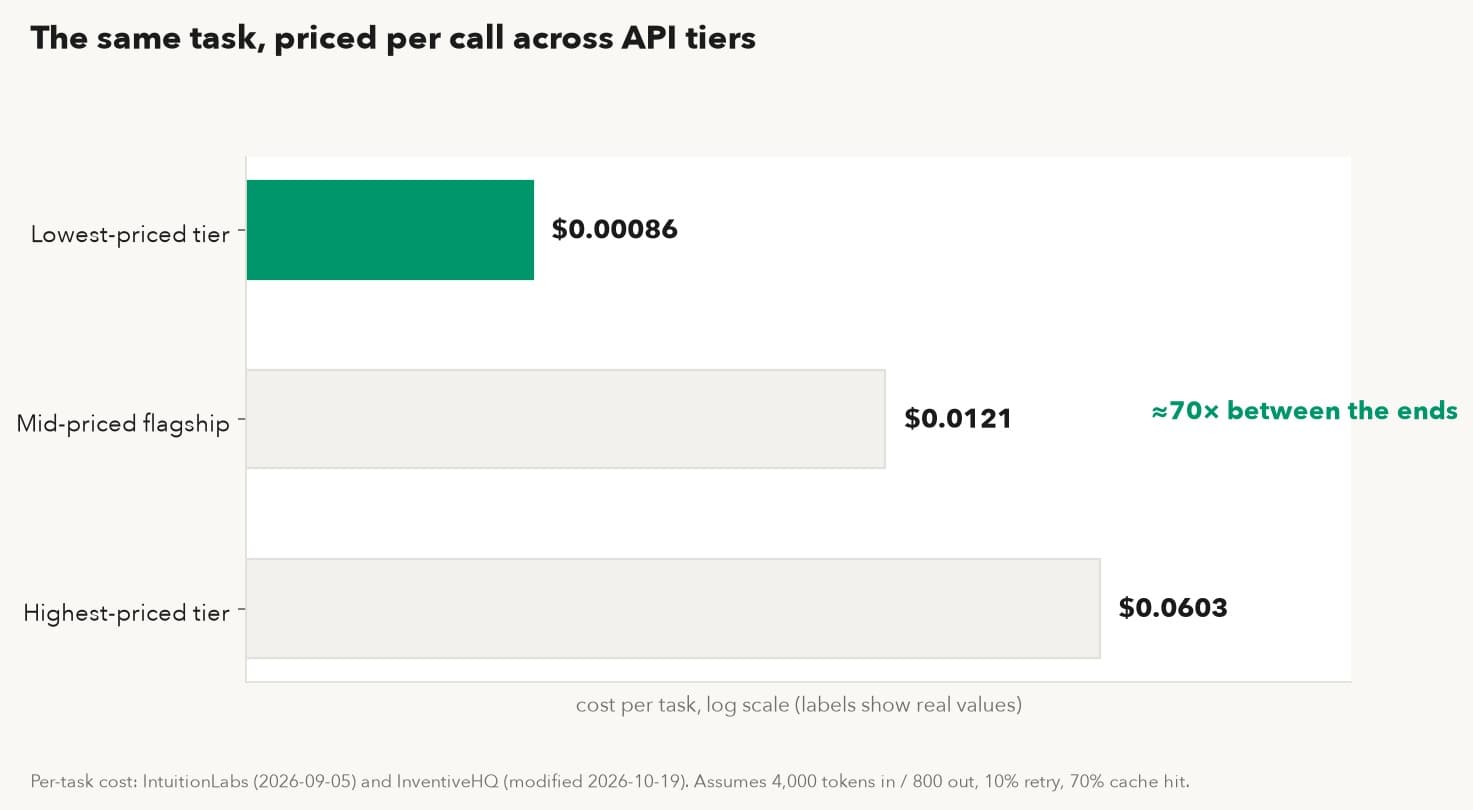
Cost per task across published API prices, log scale. Assumptions in the footnote: 4,000 tokens in, 800 out, 10% retry, 70% cache hit (IntuitionLabs 2026-09-05; InventiveHQ, modified 2026-10-19).
06Before you move work to a local model, what should you test?
Not benchmarks. Your own tasks, with answers you already know. The procedure has four steps and fits in an afternoon, plus a quiet month of spot-checks for the middle band.
Build a golden set. Pull ten real tasks from last month, spread across the families you actually need: three drafts you sent, three questions your documents answer, two extractions or calculations with one right number, a transcript you trust, a script that ran. For each, record the accepted answer, the one that actually went out the door. Ten is enough to catch gross unfitness; a bigger sample can come later if the stakes earn it. Run them locally, same materials, same phrasing. Grade by acceptance: would you have sent this output, used this number, trusted this summary? Acceptance is stricter than "pretty good" and it is the only grade that maps to money. Record one more number per task: how long the check took. A task whose output takes longer to verify than to produce by hand is a poor candidate at any pass rate, which is the Harvard finding restated as a rule of thumb.
Read the score in three bands. Nine or ten out of ten: move the family, and keep a monthly spot-check. Six to eight: move it with a standing spot-check on a sample (one output in five for the first month) and look at what the failures share; failures cluster by family far more often than they scatter. Five or below: that family stays on a cloud model, and the golden set just saved you the discovery by attrition. Re-test on a schedule, and on every change. Quarterly is enough when nothing moved. When you swap the local model, or a vendor update changes the cloud comparison, the same ten questions re-run in half an hour, and the same set doubles as the verification step of a model migration. The set is a reusable instrument; the afternoon you spend writing it down is the last time it costs an afternoon.
None of this needs an engineer. The person who assembles the set is whoever already knows which answers were accepted, usually an operations lead with access to sent mail and closed tickets. The scoring sheet is five columns in any spreadsheet: the task, the accepted answer, the local output, pass or fail, and minutes to check. The last column quietly becomes the most useful one over time, because it tells you which families are cheap to supervise and which ones eat the time the model was supposed to save.
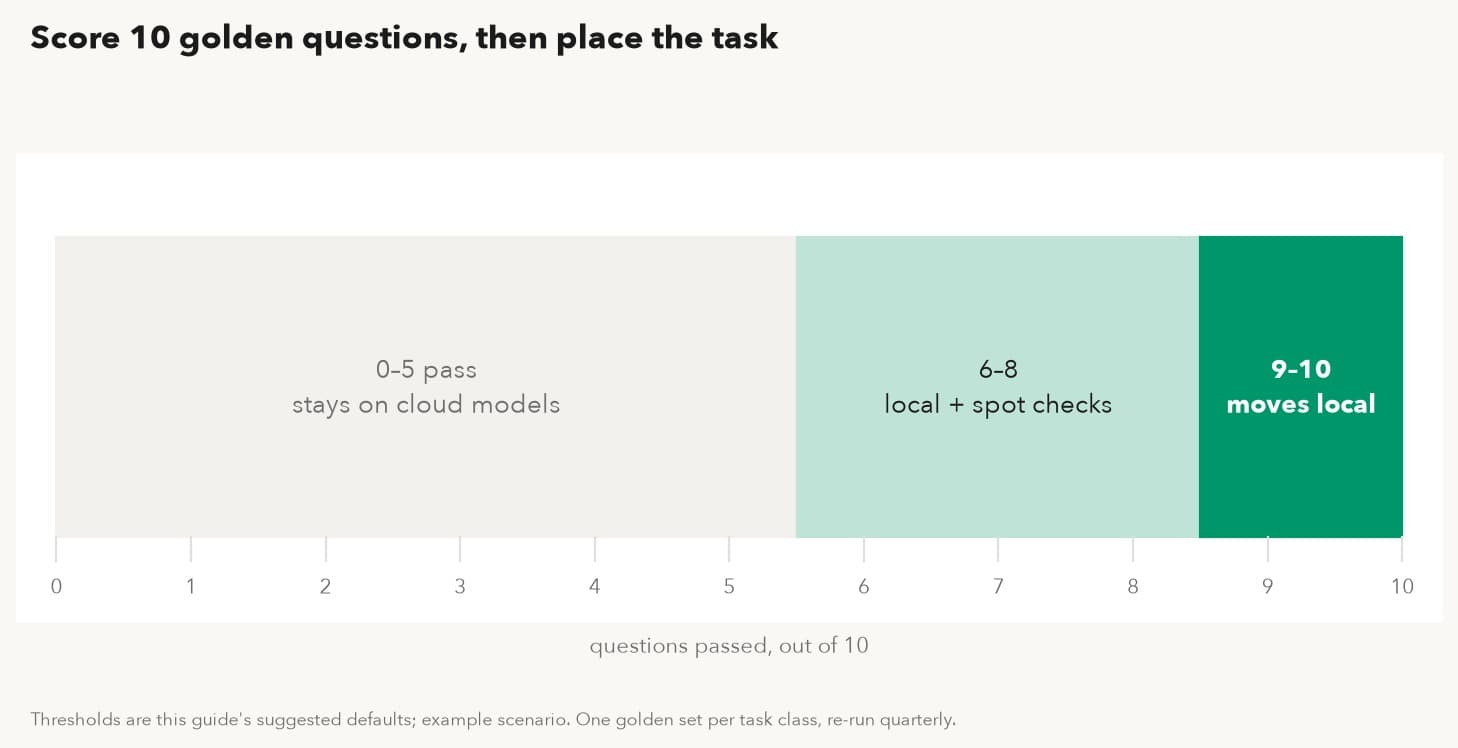
Example scenario: the three-band reading of a ten-task golden set. The bands are suggested defaults, tightened or loosened by how expensive a miss is in your work.
07A worked example: a twelve-person trading team splits its week
Suppose a twelve-person cross-border trading team counts its checkable AI tasks for one week and finds 240 (twelve people, four tasks a day, five days; the count is the example's assumption, and most teams have never counted). The list sorts into product listings and client emails, questions over supplier contracts and old quotes, landed-cost and margin calculations, call transcriptions, and a weekly tail of genuinely open questions: a new market to size, a regulation that changed last month.
The golden set takes one operations lead ninety minutes to assemble from sent mail and closed tickets. The local run scores 8 of 10. Both failures are the same shape: a 40-page contract summarized with two clauses missed, and a question about a current certification rule answered from stale knowledge. Neither failure is a surprise once the four properties are in view; both wear the marks from the section above.
The split that follows: about 150 tasks a week move local outright (drafts, document Q&A, extractions, transcripts), roughly 60 move with a one-in-five spot-check for a month (client-facing replies in a second language), and about 30 stay on cloud models (long-document analysis and anything recency-bound). The team's materials (price sheets, contracts, margin formulas) stop traveling with the 210 tasks that moved. The 30 that still travel are the ones that carry the least client data and need the most model.
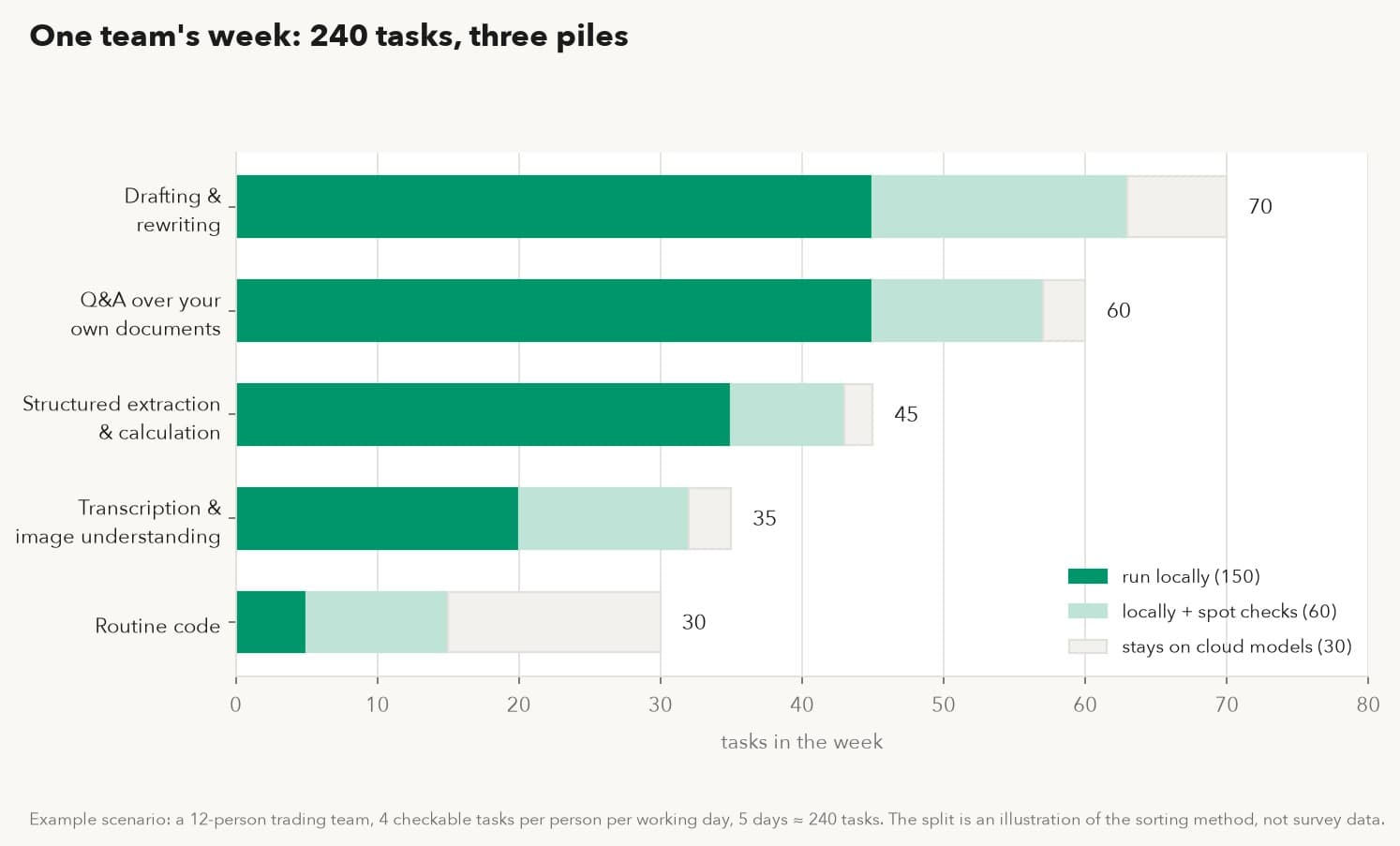
Example scenario: one week of 240 checkable tasks after the golden-set split. Assumptions in the footnote: 12 people × 4 checkable tasks × 5 days; proportions from the example, counted before your own test.
08What the mid-November releases change
The argument gained three data points inside 72 hours. Warden's interview ran November 19 with the trailing-by-months assessment and the four-gigabyte arithmetic. Radixark released DaisyRose-27B, an open-weight 27-billion-parameter model, on November 18, a size that quantizes to roughly 14 gigabytes. Tencent shipped Hy4 Flash on November 17. Nothing about those releases should trigger a migration; release notes are not a reason to move work. The reason to look again is that the open-model menu now refreshes monthly, so a task family that failed your golden set in the spring may pass it by winter. The test, kept in a drawer and re-run quarterly, is how a team notices without reading release feeds.
09How KarmaBox applies the split
Our own product, KarmaBox, is built for exactly this split: the routine work runs on a machine you own, and the hard cases go to built-in cloud models only when you approve the spend.
The machine is a KarmaBox device: one GB10 unit with 128 gigabytes of unified memory, drawing about 170 watts, sized for an office shelf rather than a rack, available now (a Pro model carries two GB10s and 256 gigabytes). Models come preinstalled, so the setup afternoon is not spent hunting checkpoints. What runs on it covers the five families directly: chat, drafting, retrieval over your own documents, image understanding and transcription all execute locally, and so do video models; heavier mass generation can be sent to a KarmaLith cabinet or to cloud, but by your choice rather than by silent necessity.
The workers on that machine are AI avatars: assistants with their own memory, skills and permissions, each assignable to a task family from the split. Official avatars ship with their scopes already narrowed, which operationalizes the checkability property: the finance avatar cites only numbers that are on the books, and the legal avatar cites only the statute library it is bound to. In a KarmaBox internal test (2026-11-15, test account), the listing avatar refused a product caption claiming "FDA approved" and two other non-compliant lines, and returned a compliant alternative built from materials, dimensions and thickness. A bounded worker is easier to check, which is the entire reason bounded tasks were the local candidates in the first place.
Two enforcement details carry the architecture. The first: local closed-loop is enforced, so a task set to run locally either runs locally or fails and says so (shipped 2026-10-22). There is no silent fallback to a cloud endpoint on a busy afternoon, which is the failure mode that quietly unwinds every data-locality promise. The second: the split's other half is built in. Cloud models are part of the platform, with no keys to apply for and nothing to configure, and when a task needs one and will cost money, the avatar asks first and waits for approval. The three-mark tasks from your list go out when you say so, priced per decision, and the approval log is your record of exactly which work still travels.
Whether the local half actually stays local is a checkable claim, and we published the check. In our own offline test (2026-10-28 to 10-30), one device ran three days with the network cable pulled: 197 local inferences on the busiest day, zero business-data egress events, and the device page reading "nothing has left" throughout, with 886 conversations, 2 knowledge bases and 24 memory entries on the device the whole time. Working with the cable pulled is one of the six marks of a sovereign AI avatar; for this subject it is the existence proof that the five families run without a connection at all.
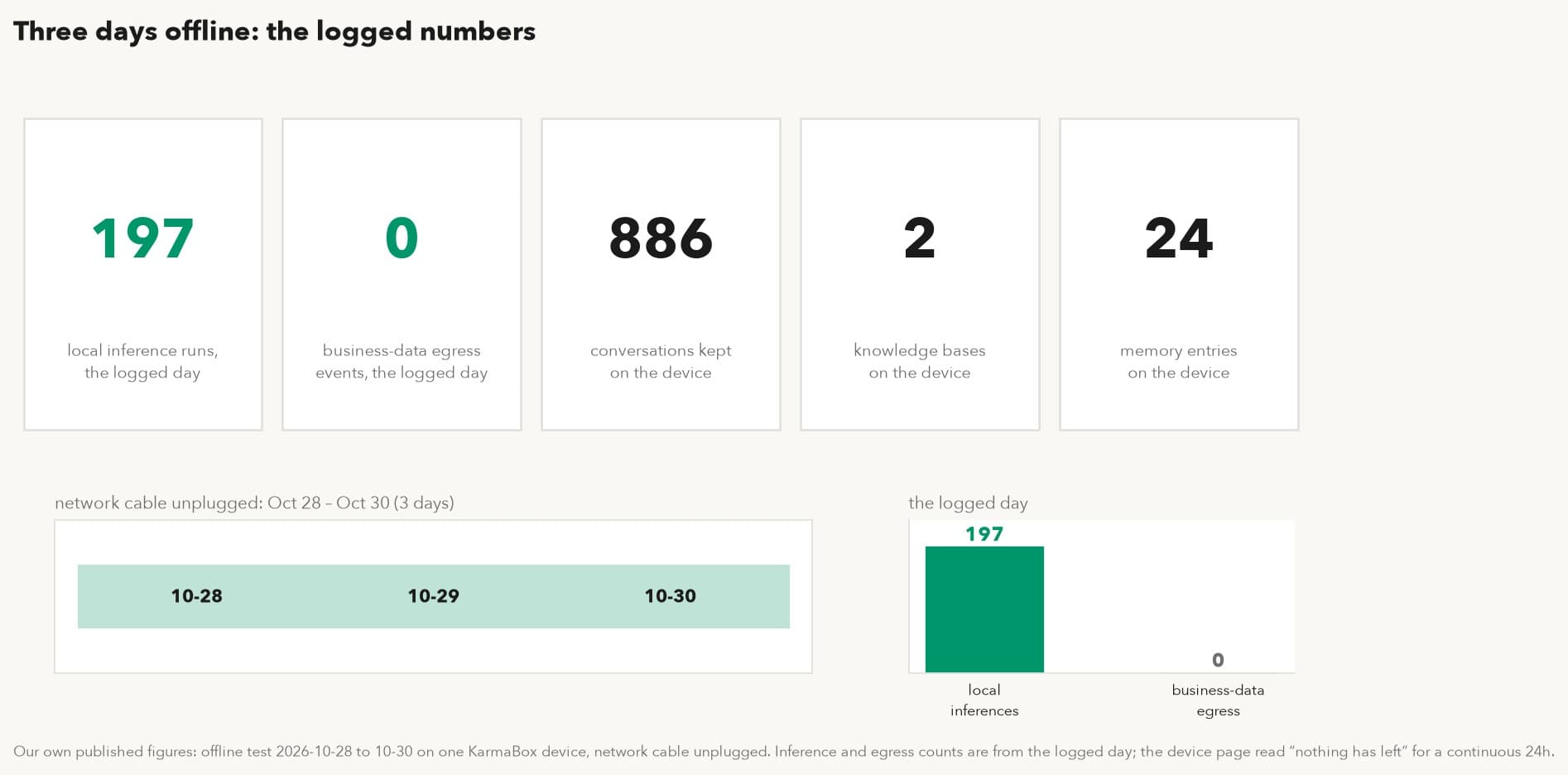
Our own published figures: a three-day offline test on one KarmaBox device, 2026-10-28 to 10-30.
The golden-set procedure has an in-house example with a number you can check. In the same test batch, a sourcing avatar was taught a cost model once: purchase price, first-leg freight, fulfillment fee, commission, duty, exchange rate. Given one instruction, it returned the landed economics of a yoga mat in 28 seconds: net profit of $12.55 per unit, break-even ACoS of 41.84%, matching a manual recalculation line for line. When any cost input is missing, it asks rather than estimating a range, which is what keeps the answer auditable. That is a golden question by construction, and a team can build its whole set this way, out of calculations the business already runs every week.
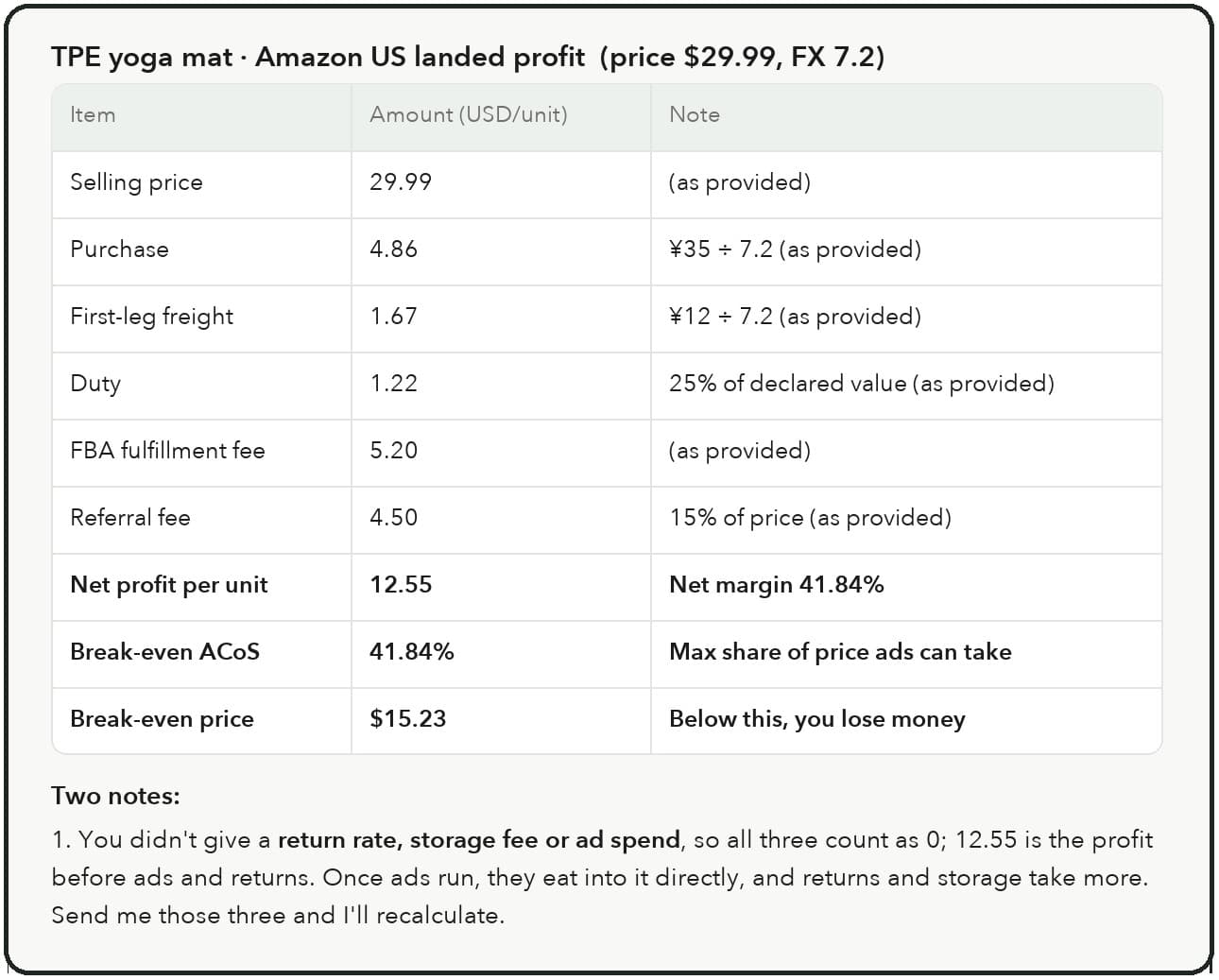
KarmaBox internal test (2026-11-15, test account), redrawn in English from the original Chinese interface. One taught cost model, one checkable answer.
Volume and the first week have answers too. The same machine runs multiple tasks in parallel, and instances scale on demand; in one small-business case we published, a shop ran 2 to 3 avatars in parallel most of the year and turned it up to 15 for the holiday peak, then back down. Starting needs a list, a pilot and some patience, and the four-step rollout for small teams is the one we recommend: list the chores that are each less than a full-time job, give each one its avatar, pilot in one store for two to four weeks to calibrate judgment, and keep outbound sends, spending and deletions behind a human confirmation. That last step is the default on a sovereign AI setup, and it is the checkability property written as policy.
| The problem above | What KarmaBox does | What you set up |
|---|---|---|
| Which tasks can run locally | 128 GB unified-memory device runs chat, drafting, retrieval, image understanding, transcription and video models on-site | Sort your week's tasks into the five families |
| A busy day quietly sends work to the cloud | Local closed-loop is enforced: local tasks run locally or fail loudly (2026-10-22) | Set sensitive task families to local closed-loop |
| The open-ended tail still needs frontier models | Cloud models are built in, no keys to configure; paid calls ask first | Approve or decline each spend |
| "It stays local" is just a claim | Offline test: 197 local inferences in a day, 0 egress, device page "nothing has left" | Check the device page; pull the cable if you want the proof |
| Pass rates are feelings until measured | Teach checkable facts once; a taught cost model returned $12.55/unit in 28 s, matching manual recalc | Keep a 10-task golden set with recorded answers |
| Getting started | Official avatars with bounded scopes; 2 to 3 instances scale to 15 and back | Run the four-step rollout on sub-full-time chores |
Table 2. Five questions mapped to how KarmaBox implements them
10What the split does not solve
Two risks live in this subject, and the golden set addresses exactly one of them.
Allocation risk is putting work in the wrong place: a private task drifting to a cloud endpoint, an open-ended task grinding away on a local model that cannot hold it. The golden set, the three bands and the spot-checks are allocation tools, and they work. Capability ceiling is the other risk, and no test moves it. The tasks your local model failed will keep failing until the open-model frontier moves, however disciplined your process is; a 10-task set can also miss a rare task type entirely, which is what the standing spot-check is for. Pass rates age in both directions, so the quarterly re-run is routine maintenance. The checking cost itself never reaches zero either: the Harvard result is a property of delegation, not of any vendor, and it applies to a box in your office exactly as it applies to an API. And the box is a purchase in a year when memory prices moved against buyers; the split earns its keep fastest for teams whose task volume was already high.
The method tells you where each task belongs today. Next quarter the answer may differ, and the scheduled re-run is how you find out.
11Frequently asked questions
Can a local LLM really handle business work in 2026?
For bounded tasks over your own material with checkable outputs, yes: drafting, document Q&A, extraction and calculation, transcription, image understanding and routine code are all within reach of mid-sized open models on office hardware. The test that settles it is a ten-task golden set built from your own sent work, not a benchmark table.
What hardware do I need to run a local LLM for work?
Less than the reputation suggests. A 9-billion-parameter model quantized to 4-bit fits in about 4 GB of GPU memory, per the arithmetic in Warden's November 2026 interview; 8-bit needs roughly 9 GB. Machines in the 128 GB unified-memory class run far larger open models and cover the five task families with room to spare. Price the purchase at today's memory prices, which rose through 2026.
Are local models as good as cloud flagships?
At the ceiling, no. On open-ended reasoning and very long context, frontier cloud models hold a real lead, and Warden's own estimate of a few months' gap is a judgment about benchmarks, not a guarantee about your work. The practical finding is narrower: for bounded, checkable business tasks, the gap rarely shows up in the accepted output.
Which tasks should stay on a cloud model?
Work wearing any of three marks: open-ended reasoning across domains, very long single-pass documents, and questions that depend on the state of the world since the model's training date. Send those to the strongest model available, with the least client data attached, and let the bounded majority stay home.
Is running a local LLM cheaper than paying per API call?
It depends on volume and on which API you compare against. One task costs between $0.00086 and $0.0603 across published prices (IntuitionLabs, 2026-09; InventiveHQ, updated 2026-10), a 70-fold spread, so a box pays back in months against the expensive end and may never pay back against the cheap end. The argument that survives any price list is that the material in the local tasks stops leaving your building.
Before we commit to buying local AI hardware, what should we check?
Three things, before any money moves: run your ten-task golden set on borrowed or trial hardware and read the bands; check the memory arithmetic against the specific models you would run (parameters times precision, plus headroom); and count your monthly task volume against per-task API prices at today's hardware quotes, since memory prices moved this year. A purchase that survives those three checks is a decision made on evidence.
12About the author
Karma Box Team publishes practical guides on AI sovereignty, workspace control and vendor evaluation. To keep this piece checkable: every dated claim carries its source in the sentence; the strongest case against local models (a real frontier gap on open-ended work, and hardware prices that rose this year) is stated rather than skipped; example scenarios are labeled as such in their chart footnotes; and KarmaBox material is kept to its own section. What this piece does not do: rank this week's model releases, or substitute for testing your own tasks. News and product facts checked on 2026-11-20.